Fear of Pulling the Trigger: Why don't you enter even when everything is given based on your rules
In this post

July 29, 2026.
In trading, there are moments when everything falls into place.
You find the setup you have been watching for a long time, the price reaches the right level, your conditions are met, and you clearly see the situation you have been waiting for.
Yet there is a moment when, instead of executing the decision, you rather wait.
You wait for one more confirmation. One more tiny sign that finally convinces you that you are making a good decision.
Then a few minutes later, the market moves in the direction you expected.
In such cases, many traders primarily examine whether they analyzed the market incorrectly, or if their strategy was appropriate. Yet, in many cases, the problem is not with the analysis, but with the moment when knowledge must be turned into a decision.
In this article, we examine what lies behind the Fear of Pulling the Trigger phenomenon, why it might develop, what impact it can have on your trading in the long run, and how you can develop a more conscious decision-making process.
Short summary
Why does it happen that you clearly see the opportunity, yet you do not make the decision?
What happens in the background at the moment when you start waiting instead of entering?
Why doesn't looking for even more confirmation solve the problem?
How does the fear of entry differ from FOMO?
What methods can you use to develop a more conscious decision-making process during your trades?
What is Fear of Pulling the Trigger in trading?
Fear of Pulling the Trigger refers to the situation when a trader recognizes the right opportunity for themselves, yet finds it difficult to make the final decision to enter. An important distinction is that this is not simple caution.
Caution means that someone recognizes that a situation does not fully meet their own conditions, so they consciously stay out.
In this case, however, something else happens.
Based on your own rules, you already have a decision, yet you procrastinate executing it.
The phenomenon often appears like this:
According to the trading plan, the entry would be given.
The necessary conditions are met,
yet a search for further confirmation begins
the decision is delayed or completely omitted.
The essence of this problem is not that you cannot recognize good situations. It is much more that an obstacle forms between recognition and execution.
Why does Fear of Pulling the Trigger develop?
There can be several reasons for this phenomenon, but mostly three fundamental factors lie behind it.
1. The possibility of loss receives greater significance
In trading, every decision comes with uncertainty. Even with a well-built system, losing positions can occur.
The problem begins when a single possible loss receives greater weight than the process upon which you made the decision.
In such cases, the brain naturally tries to avoid the negative outcome, so your attention increasingly shifts to "what if this doesn't work now?", while the fact that the decision must be evaluated not based on a single result, but on long-term repetition, fades into the background.
2. You try to find perfect certainty
Many feel that one last confirmation is necessary to comfortably make the decision.
The problem is that the market does not operate with complete certainty.
There always remains a factor that cannot be known in advance.
If someone tries to eliminate this missing certainty, they can easily get into a situation where they constantly look for another sign, while the original decision point has already passed.
3. A single trade receives too much significance
Long-term profitability does not depend on a single opportunity, but on the totality of many decisions.
However, when a trader places too much emphasis on a given entry, every single decision means much greater pressure for them.
This makes execution difficult, because attention is no longer on following the process, but on the outcome of that given moment.
Why is it dangerous if you don't solve this problem?
At first, it might seem that a missed trade is not a serious problem, since there will always be a next opportunity.
The problem does not begin with a single instance, but when this becomes a recurring pattern. Your trading system does not work because you recognize good situations once, but because you consistently execute them in the long run.
If situations that meet your rules are regularly missed, several negative effects can appear.
4. A part of your opportunities remains unexploited
Behind a good trading system, there is usually not a single perfect entry, but the repetition of many similar situations.
If you only take those that feel completely comfortable, it can easily happen that you miss out on exactly those opportunities that would provide the true edge of your system.
5. The connection between plan and execution breaks
A trading plan in itself is just an idea.
Its value appears when you actually apply it in appropriate situations.
If you regularly deviate from what you predetermined at the moment of decision, over time it will become harder to judge how your method would perform given true consistency.
6. Decisions can require more and more energy
When a situation repeatedly means a difficult decision, it can place an increasingly greater mental burden on you.
Instead of focusing on analyzing the market, the moment of entry can become the biggest obstacle.
At the same time, this process also has a positive side.
If you are capable of managing this pattern, it does not mean that every decision of yours will be profitable.
The real advantage appears in that:
You can react more clearly to situations you have already predetermined.
You depend less on the uncertainty of the given moment.
You use the edge provided by your own system with a higher probability.
The goal is to be able to make appropriate decisions even amidst uncertainty.
Fear of Pulling the Trigger vs FOMO. What is the difference?
Many confuse the two phenomena, even though they take trading decisions in completely different directions.
Both can divert your trading decisions, but they appear in different ways.
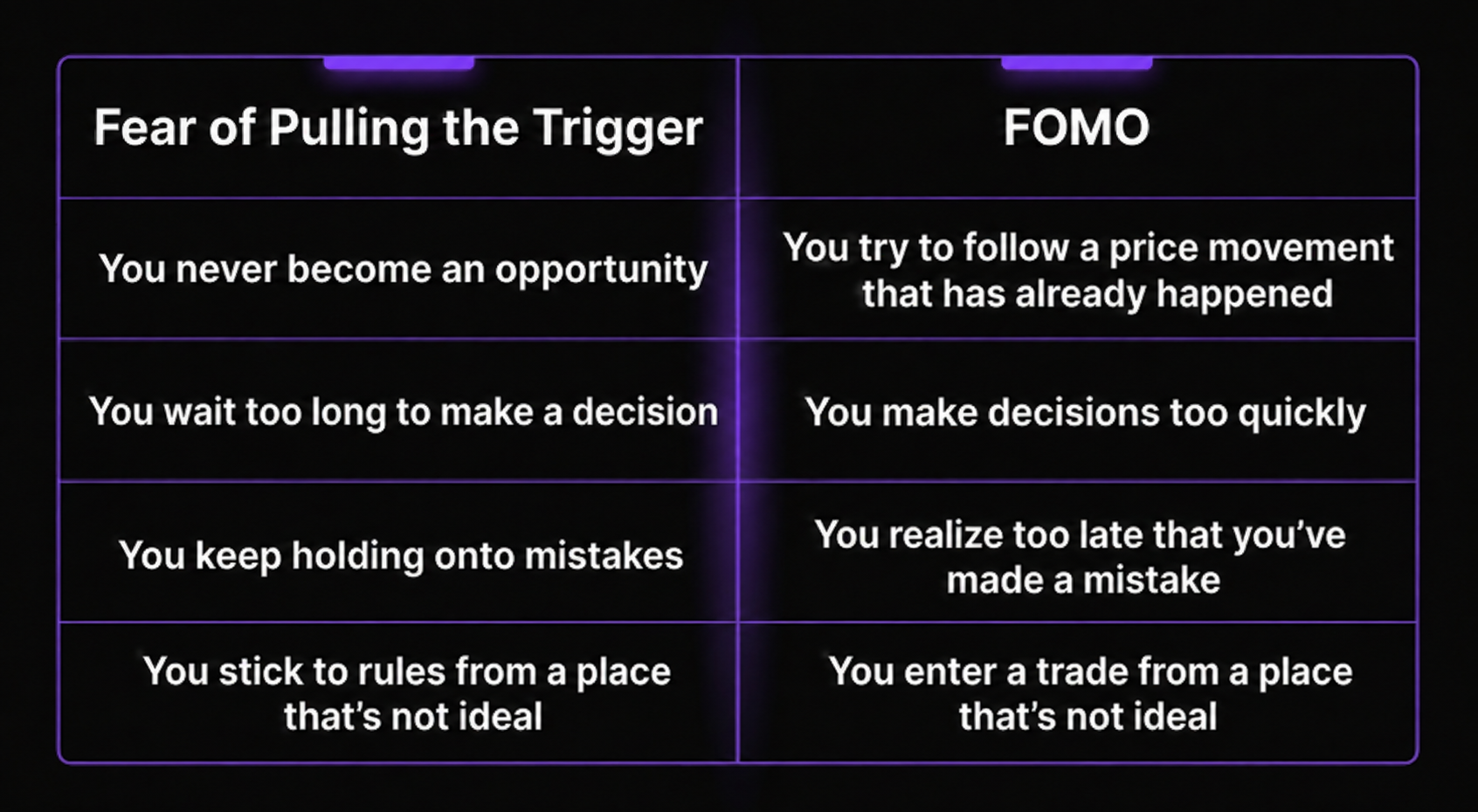
The difference is mostly visible in timing.
In the case of Fear of Pulling the Trigger, the problem is that the decision has not yet happened.
In the case of FOMO, however, the decision does happen, just not necessarily at the right moment anymore.
For example:
A trader sees a developing opportunity, but waits too long, and therefore misses out on the movement. After this, they fear being left out, and enter later anyway, when the original opportunity has completely changed.
Therefore, it is important to understand that the two problems are not opposites of each other, but two different ways in which emotions can divert the decision-making process.
What do many try to do, and what can help instead?
When someone regularly finds it difficult to make entry decisions, they often reach for the technical side first.
They think they need more information, more accurate analysis, or even more confirmation.
This, however, often does not solve the real problem.
In fact, the more conditions you build in front of the decision, the more opportunities you give yourself to postpone execution again.
The solution is not to try checking even more things, but to pre-establish a process that makes it clear when you have enough information for the decision.
A well-built checklist and regular review can help ensure that you do not have to make the same decision all over again in every single situation.
Take this with you to your next trade
The problem of Fear of Pulling the Trigger cannot be managed most effectively when the entry opportunity is already right there in front of you. At the moment of decision, you are already emotionally involved, so it is much harder to objectively evaluate the situation.
That is precisely why the goal is to develop habits and processes in advance that help you remain consistent at the moment of decision.
1. Determine in advance when a setup counts as valid
You should not make the entry decision when the opportunity is already in front of you.
You must clarify beforehand:
what conditions must be met;
what signs confirm the setup;
when you consider the analysis process closed.
This has significance because if your decision rules are not fixed in advance, then at the moment of entry you can easily start looking for new conditions. This way you do not decide based on your system, but the uncertainty of the given situation begins to direct the process.
2. Analyze missed opportunities as well
Most traders exclusively evaluate their opened positions, even though missed situations can also provide important information.
A missed entry can show that:
it truly did not meet your rules;
or all conditions were met, only the execution was omitted.
This is important because one of the biggest problems with Fear of Pulling the Trigger is that it often remains invisible. If you only examine your opened positions, you will not notice those situations where the decision-making process broke down.
3. Evaluate the quality of the decision, not the result
A good decision can result in a losing trade, and a bad decision can result in a profitable outcome.
If you exclusively look at whether a position won or lost, you can easily draw the wrong conclusion.
For long-term development, you must examine whether:
the entry met your predetermined rules;
you consistently executed the process you believe in.
This is important because if you evaluate every decision based on the result, then a single losing trade can shake your trust in your system, even if the decision itself was correct.
4. Recognize when further confirmation no longer helps
Not all further analysis means a problem.
There is, however, a point where new information no longer improves the decision, only delays it.
If the setup meets your predetermined conditions, but you continue to look for newer signs, then it is probably no longer the lack of analysis holding you back, but the difficulty of the decision itself.
Recognizing this is important because this way you can differentiate between real market analysis and procrastination developing due to uncertainty.
Frequently Asked Questions (FAQ)
What is Fear of Pulling the Trigger in trading?
Fear of Pulling the Trigger means when a trader recognizes an appropriate opportunity based on their own rules, yet finds it difficult to execute the entry.
Why don't I enter even when every condition is met?
Often because at the moment of decision, the possibility of loss receives more attention than the trading plan itself. Because of this, the trader looks for newer confirmations, while the opportunity may pass with time.
Is Fear of Pulling the Trigger the same as FOMO?
No. The two phenomena cause opposite behaviors. In the case of Fear of Pulling the Trigger, you wait too long with an entry, while in the case of FOMO, you are afraid of being left out, so you often make a decision in a less favorable situation.
How can the fear of entry be managed?
As a first step, it is worth developing a predetermined decision-making process. A checklist and keeping trading statistics can help ensure that you make decisions not based on the uncertainty of the given moment, but based on your own system.
Why is it important to learn to manage this problem?
Because for long-term profitability, it is not enough to recognize good opportunities, they must also be consistently executed. If valid situations are regularly missed, the true edge of your trading system cannot fully reveal itself.
Summary
Fear of Pulling the Trigger is not simply about someone being afraid to open a position. The real problem appears when a gap forms between your trading plan and your execution: you clearly recognize the opportunity, yet it is difficult to make the decision that you have already predetermined based on your own rules.
Due to the nature of the market, it will never provide complete certainty. There will always be factors that you cannot control in advance, so the goal is not to eliminate all uncertainty, but to develop a process that helps you decide consistently even when there is no perfect situation.
Long-term profitability is not built on every single decision of yours being correct, but on being able to repeatedly execute those decisions that represent value based on your own system.
Give yourself the opportunity to watch your decision-making processes more consciously during your next trades, and further build your experience in a real market environment.