Futures or forex prop firm: in what are the rules different?
In this post
November 17, 2026.
Would you choose a futures or forex prop account? There can be far more differences between the two types than the tradable instruments.
In one program you must close every position at the end of the day, while in another you can hold your trades even through multiple days. The calculation of the drawdown and the restriction of the position size can likewise differ.
Let's look at which conditions it is worth comparing before you decide!
Futures or forex? The main differences in one place
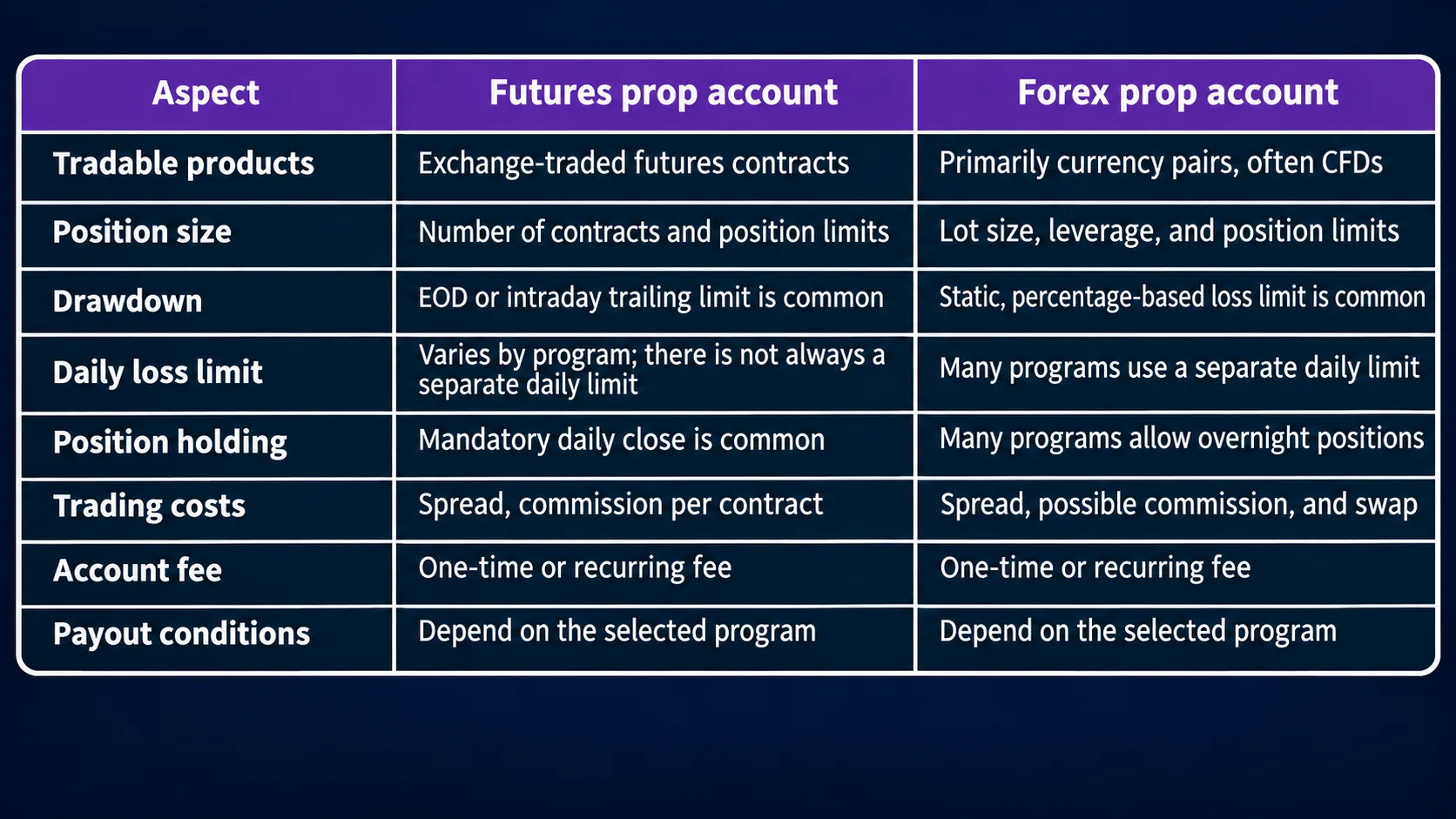
The table presents characteristic market practices. The specific rules depend on the chosen program.
1. Risk limits: drawdown and position size
In futures prop programs the trailing drawdown is frequent, which is calculated based on the highest intraday account value or the daily closing value. At forex accounts you can many times encounter a static maximum loss limit determined in the percentage of the starting account size.
This difference has special significance after profitable periods. In case of a trailing drawdown the loss limit can rise with the value of the account, while the static limit remains unchanged.
The daily loss limit can mean a further difference. Many forex programs apply a separate daily and total loss limit. Among futures accounts such constructions are also accessible in which there is no separate daily limit.
Position sizing likewise happens among different frameworks:
On a futures account the allowed contract number can set a limit to the size of the position.
On a forex account the lot size, the available leverage and the position limits of the program matter jointly.
A futures and forex account of identical nominal size can therefore provide a completely different risk room for maneuver.
You can already read in more detail about the different drawdown rules in our article about Daily, Max, Trailing and EOD drawdown.
2. Trading time, overnight and news trading
At futures prop accounts it is frequently mandatory to close every position at the end of the trading day, even if with the given futures contract one can trade again in the next trading period.
Among forex programs you can also find multiple such constructions which allow holding the position overnight. Weekend holding however can be tied to separate restrictions.
On the current futures accounts of Solo Clash for example every open position must be closed by 16:50 ET at the latest.
This has significance especially if your strategy is regularly built on multi-day positions. Because of a mandatory daily close you would have to modify your accustomed entry and exit rules too.
What is the situation with news trading?
Around important economic announcements restrictions can occur at both account types. A program for example can prohibit the opening of a position or even the holding of an already open position in a determined period.
At Solo Clash the Limitless and Liquid programs allow news trading, while the Legacy program applies restrictions around determined highlighted events.
The news trading and position holding rules are therefore worth examining together: one influences when you can enter the market, and the other until when your trade can remain open.
3. Regulatory background: in what does the underlying market differ?
The market structure of futures and forex/CFD products differs.
The futures contracts of the CME Group are standardized products traded on regulated exchanges, whose transactions are managed by a central clearing system.
A significant part of retail forex and CFD trading operates in an over-the-counter, that is OTC model. The conditions of quoting and execution connect to the given provider. To these products financial regulation can also apply, which differs per country and per provider.
In the case of prop firms at the same time a distinction must be made between the underlying market and the evaluation service.
A simulated evaluation program built on futures prices does not automatically become a regulated brokerage service. The legal classification of the service is determined by the actual operating model and the applicable laws.
4. Futures or forex: how can you make the decision?
When comparing the two account types it is worth starting from your own trading data and accustomed strategy.
Before you choose, think through:
With which instruments do you trade or would you like to trade?
To what extent does the drawdown and the daily loss limit fit to your risk management?
Is holding the position overnight or over the weekend necessary?
Are there such news trading restrictions which affect your strategy?
At the choice it is worth comparing the rules of the specific account with your already developed trading method. This way you can assess among what conditions you can follow your strategy without having to change its fundamental operation.
Do you have a question?
Join the Solo Clash Discord community, where you can ask for help from our customer service colleagues, and can be informed about the newest developments, changes and possibilities.
Join Discord →
The article serves informational and educational purposes, it does not qualify as financial, investment or legal advice. The presented differences are general market characteristics; the actual conditions are determined by the rulebook of the given program. Simulated trading results do not guarantee future payouts or real market results.