5 common drawdown mistakes that can make you lose your account faster than you think
In this post
Sept. 02, 2026.
Imagine you have a $50,000 funded trading account.
You have your strategy. You know what setup you are looking for. After the first losing trade, everything is still fine.
Then comes the second. Then you see a new opportunity, and you think:
"I can easily afford this."
You open it. And a few minutes later, you are no longer watching where the market is going, but calculating how much room you have left until the drawdown limit.
Many traders think at this point that they simply chose bad positions.
However, there is another possibility:
it wasn't necessarily their strategy that consumed their account, but how they managed their available room for loss.
Because you cannot completely rule out a losing trade.
But you can control much better how much impact a losing trade has on your next decision, and on your account as a whole.
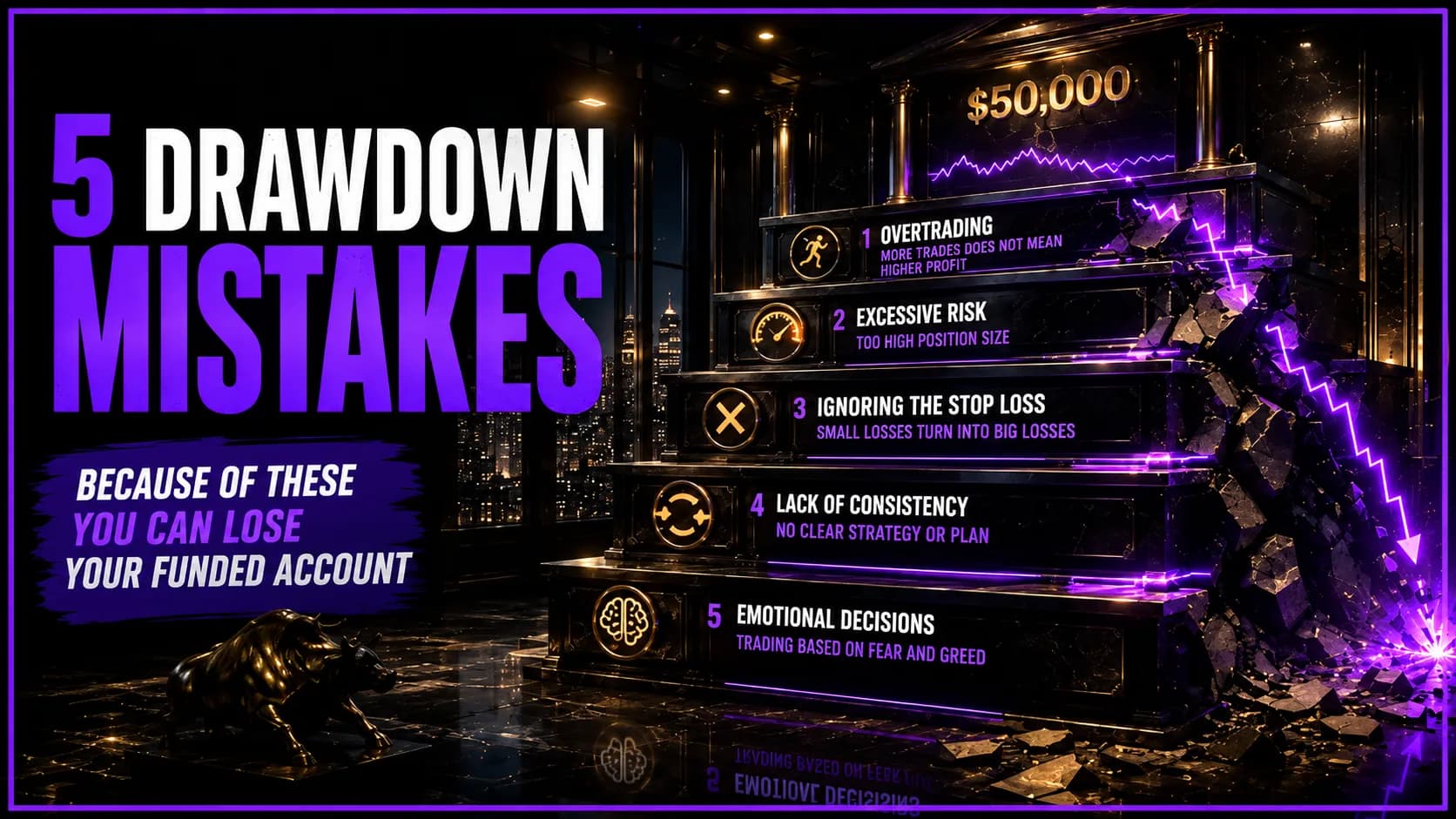
In this article, we will look at 5 common drawdown mistakes, as well as how you can avoid them.
Quick summary
Why your room to maneuver can be small even if, on paper, you still have plenty of space until the maximum drawdown.
Why it is dangerous to treat the loss limit allowed by the prop firm as your own risk limit.
How a single losing trade can gradually turn into a much bigger problem.
Why "not trading" can sometimes be a better decision than forcing a mediocre setup.
Before we move on, one thing is worth clarifying
If you trade, there will be losing results.
There will be a setup that seems perfect, yet doesn't work.
There will be a day when even two consecutive decisions of yours don't turn out as planned.
The problem is not the loss itself.
The problem starts when a normal loss triggers a series of decisions that already endangers your entire account.
Therefore, the goal of good drawdown management is not to avoid all losses.
But rather that even after a bad trade, you have enough room for the next good decision.
Here comes the first mistake.
1. You only watch the Max Drawdown
You might have more money left than you think, or much less.
Let's say the total maximum loss limit of your account is $2,000.
And you are currently down by $700.
A quick mental math: "I still have $1,300 of room."
Not necessarily!
If your account also has a separate Daily Drawdown, then you might have a much smaller loss limit left for that given day.
This is one of the simplest mistakes you can make:
the trader knows where the Max Drawdown is, but doesn't exactly know which limit they might hit first.
The two are not the same.
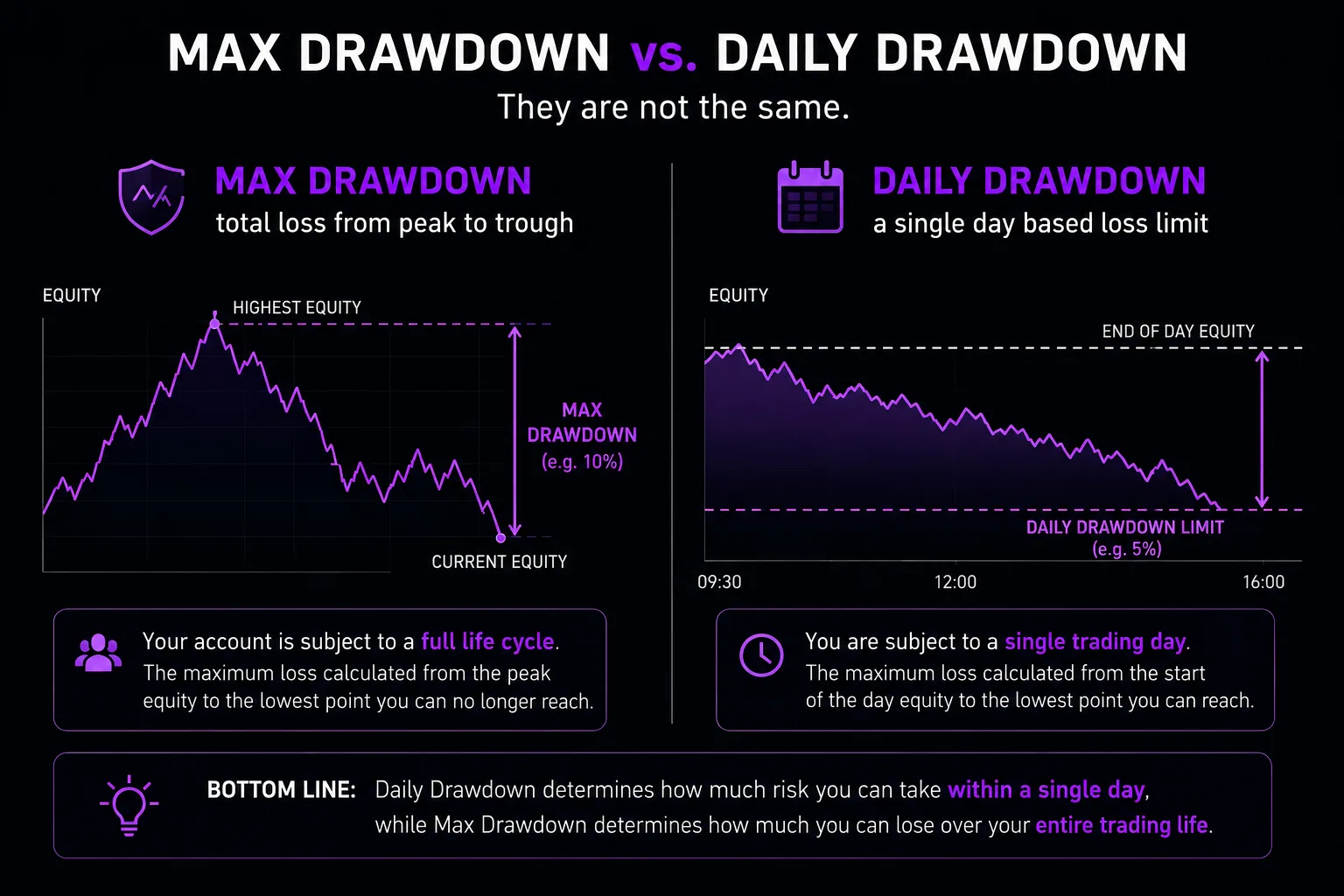
The Max Drawdown determines how much total room for loss you have at your disposal.
The Daily Drawdown, on the other hand, restricts how much of this you can use in a single trading day.
What should you do instead?
Before you start trading on an account, know at least these four things:
Is there a Daily Drawdown?
What is the Max Drawdown?
Is the loss limit Fixed or Trailing?
When does the limit reset?
Do not start reading rules when your position is already open.
Before trading, know exactly where those boundaries are that you cannot cross that day.
But there is also a less obvious problem here.
What if you know the limits exactly, yet you get too close to them?
2. You use the prop firm's limit as your own stop
Just because you can go this far doesn't mean you have to go this far.
You have a daily room of $1,000. Does this mean you should risk up to $1,000?
No.
This is one of the most important differences between knowing the rules and risk management.
The prop firm's drawdown limit is not a personal risk target.
It is an ultimate boundary.
If you trade every day going right up to the maximum allowed by the rule, you leave very little room for:
another losing trade,
the fluctuation of an open position,
or simply the fact that you were wrong.
What should you do instead?
Define your own loss limit within the prop firm's limit.
For example, decide in advance:
how much you risk on one trade
at what daily loss you stop
after how many consecutive losing trades you take a break.
The exact value must align with your own strategy and risk tolerance.
The key is the timing of the decision.
Define the limits when you are calm, not when you are trying to win back your previous loss.
Because this is exactly what breeds the next mistake.
3. You increase risk after a loss
One of the most dangerous moments is not the loss, but what happens immediately after it.
The first trade: -$200.
Unpleasant, but manageable.
At the next setup, however, a thought appears:
"If I risk a little more now, I can bring it back with one good trade."
But with this, the goal changes.
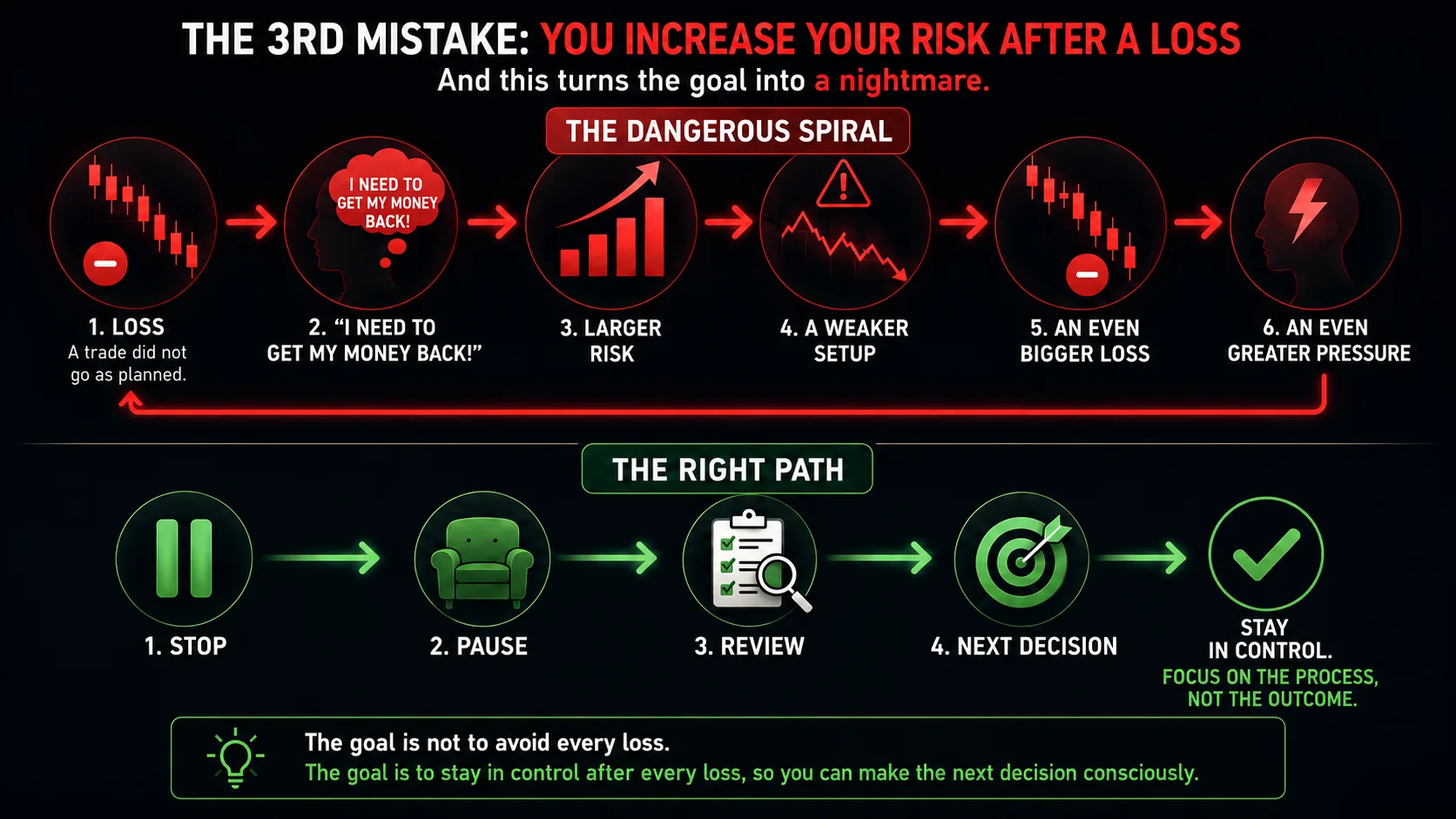
You are no longer simply looking for a good opportunity.
You want to get the money back.
This can easily lead to revenge trading: larger position size, accepting a weaker setup, faster entry, or more positions than originally planned.
We have already written an article about revenge trading, where you can read more about why it develops, why it is dangerous, and how you can avoid it. → Read it.
And the danger is mathematically simple too.
If you increase the risk after a loss, you make your account more vulnerable precisely in the state when your available room to maneuver is already smaller.
What should you do instead?
Have a predefined reaction to a loss.
For example: Loss → Pause → Review → Next decision
After a losing trade, the first question should rather be: "Did this trade fit my plan?"
If yes, the loss might simply be a natural part of the strategy.
If not, you've already found something to correct next time.
The next trade shouldn't have to fix the previous loss.
It must be an independent decision.
Here we arrive at a mistake that can crop up especially easily if you trade alongside a job or family.
4. You have little time, so you want to find an opportunity at all costs
What if you don't use your available time well?
18:00. You finally finished work or got home from school.
You have an hour and a half to trade. You open the chart, and there is no really good setup.
But you've been waiting for this time all day.
So the thought can easily appear:
"Since I've sat down, I have to make at least one trade."
You don't have to.
Just because you have time to trade doesn't mean the market is obliged to give you a good opportunity at that time.
If you start forcing entries because of the little time available, your drawdown can easily be consumed by positions you wouldn't have even opened with more patience.
This is especially important for those who trade alongside a job, business, or family.
The problem here isn't necessarily that you have little time.
But rather that you feel you have to utilize every available minute with a trade.
What should you do instead?
Before you open the platform, it should be clear to you what you need to see in order to start trading at all.
If the good opportunity isn't there, "not trading" can also be the right decision.
The point is to be able to sit down even for just 1–2 hours, know exactly what you are looking for, and not feel the need to extract something from the market at all costs.
However, the fifth mistake is even more complex than this.
5. After a good day, you suddenly allow yourself more
Sometimes it's not a bad day that starts the drawdown.
We talk less about this, but sometimes it begins after a very good day.
Let's say you close the day at +$800.
The next day it's easy to think:
"Now I have something to risk from."
A slightly larger position.
A mediocre setup that you might have skipped yesterday.
Just one more trade because the previous one went well.
The profit can psychologically easily feel like "house money."
Yet we are still talking about your account balance.
And in the case of a Trailing Drawdown, there is another important detail: as the account reaches new relevant peaks, the loss limit can also move upwards.
So it's not enough to look at:
"How much did I make?"
You also need to know: "Where is my drawdown limit now?"
What should you do instead?
Even after a big winning day, don't automatically change your system.
The same three questions should remain:
Is this my setup?
Does it fit into my predefined risk?
Would I open it even if I didn't have a winning day yesterday?
However, there is something common in these mistakes…
The common mistake behind all 5
They seem like five different mistakes. In reality, the same decision problem lies behind them.
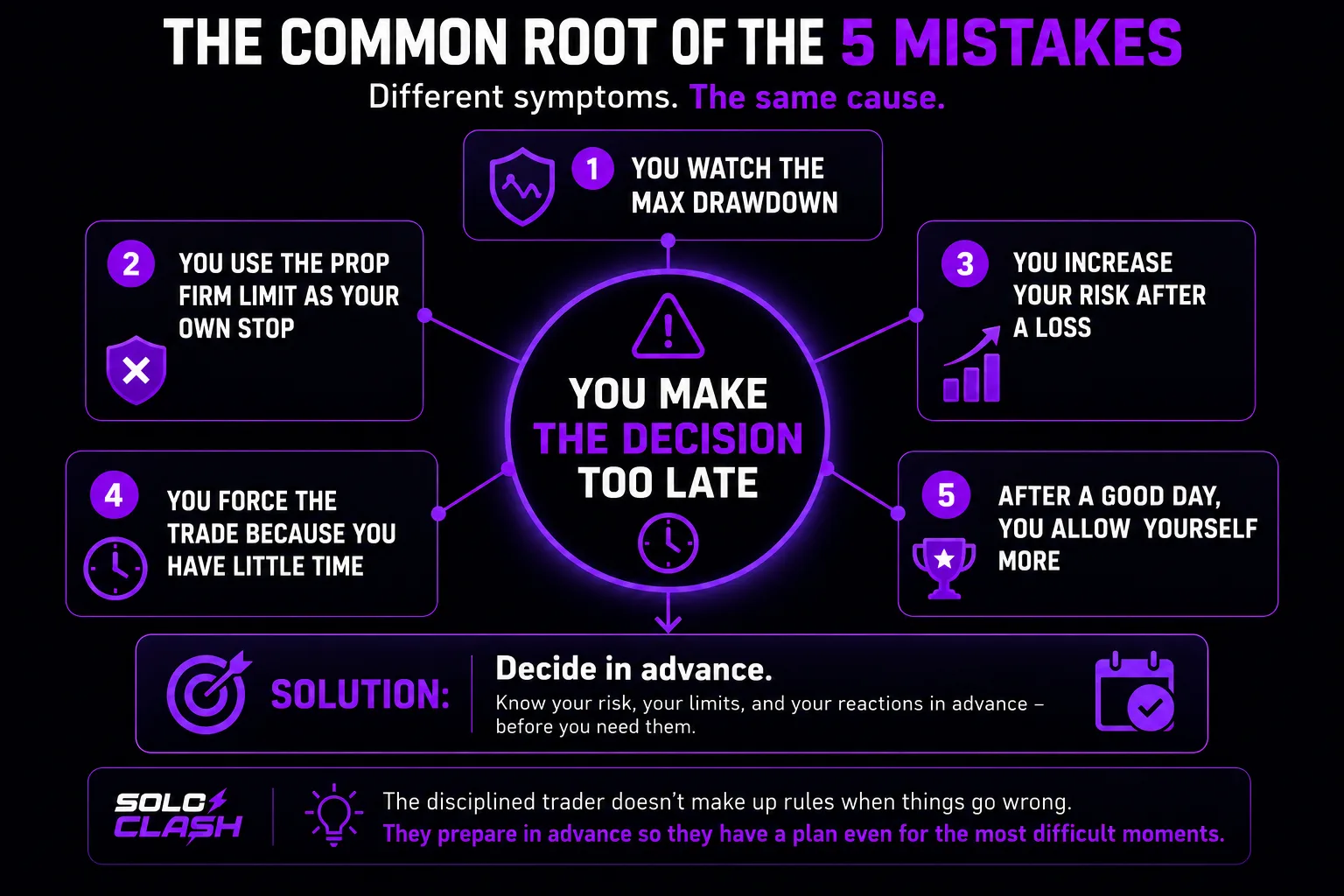
Let's look back now.
The five mistakes seem different at first:
You only watch the Max Drawdown.
You use the prop firm's limit as your own stop.
You increase risk after a loss.
You force trading due to lack of time.
You allow yourself too much after a profit.
In reality, however, they can be traced back to the same thing: you make the decision too late.
You decide on the risk when you are already trading.
You decide when to stop when you have already lost.
You start looking at the drawdown rule when you are already close to it.
You decide whether you should trade when you have already been sitting in front of the chart for an hour.
Therefore, the solution is not trying to concentrate even harder while trading.
Make more decisions before you actually need them.
A simple drawdown routine for your next day
Five questions worth asking before the first position.
Before you open your first position, answer these 5 questions:
Where is my account's loss limit currently?
Is there a separate Daily Drawdown I need to watch?
What is the maximum I risk on a single trade?
At what personal daily loss do I stop trading?
What is the setup outside of which I won't open a position today?
If you know this in advance, you won't have to invent new rules after every loss while trading.
This is exactly the goal.
To be able to rely on a well-defined plan, and not on momentary feelings.
What kind of account fits your trading style?
The question isn't which account allows the most.
By now it's clear that drawdown management is not just about "don't lose too much."
The rules of the account and your own trading system must work together.
If, for example, you are a beginner, or can only trade at specific times alongside a job, a simply transparent rule system can be especially important.
In the evaluation phase of Solo Clash Limitless, there is no separate Daily Drawdown, so you don't have to adjust your trading to an additional daily loss limit as well.
The maximum/trailing drawdown rule naturally still applies despite this.
Therefore, before you choose, think it over:
"Which account's rules fit best with how I actually trade?"
If you know the answer to this, you can choose much more consciously.
→ Check out LIMITLESS, and compare it with the other Solo Clash accounts.
Frequently Asked Questions (FAQ)
1. What is the difference between Daily Drawdown and Max Drawdown?
The Daily Drawdown determines how much you can lose on a given day, while the Max Drawdown is the maximum loss limit for the entire account. Always also watch which limit you might reach first.
2. Can the loss of an open position also count towards the drawdown?
This depends on the rules of the given account, so always check how the drawdown is calculated. In some cases, floating loss can also count towards the limit.
3. Why is a Trailing Drawdown more dangerous?
In the case of a Trailing Drawdown, the loss limit can change along with the performance of your account. Therefore, it is worth continuously monitoring not only your profit, but also the location of your current drawdown limit.
Summary
Drawdown management is not about avoiding all losses, but about ensuring that losses do not lead to bad decisions. If you define your own risk limits in advance and know the rules of your account, you can trade much more consistently.
Therefore, when choosing an account, it is also worth looking for a solution that fits your trading style.