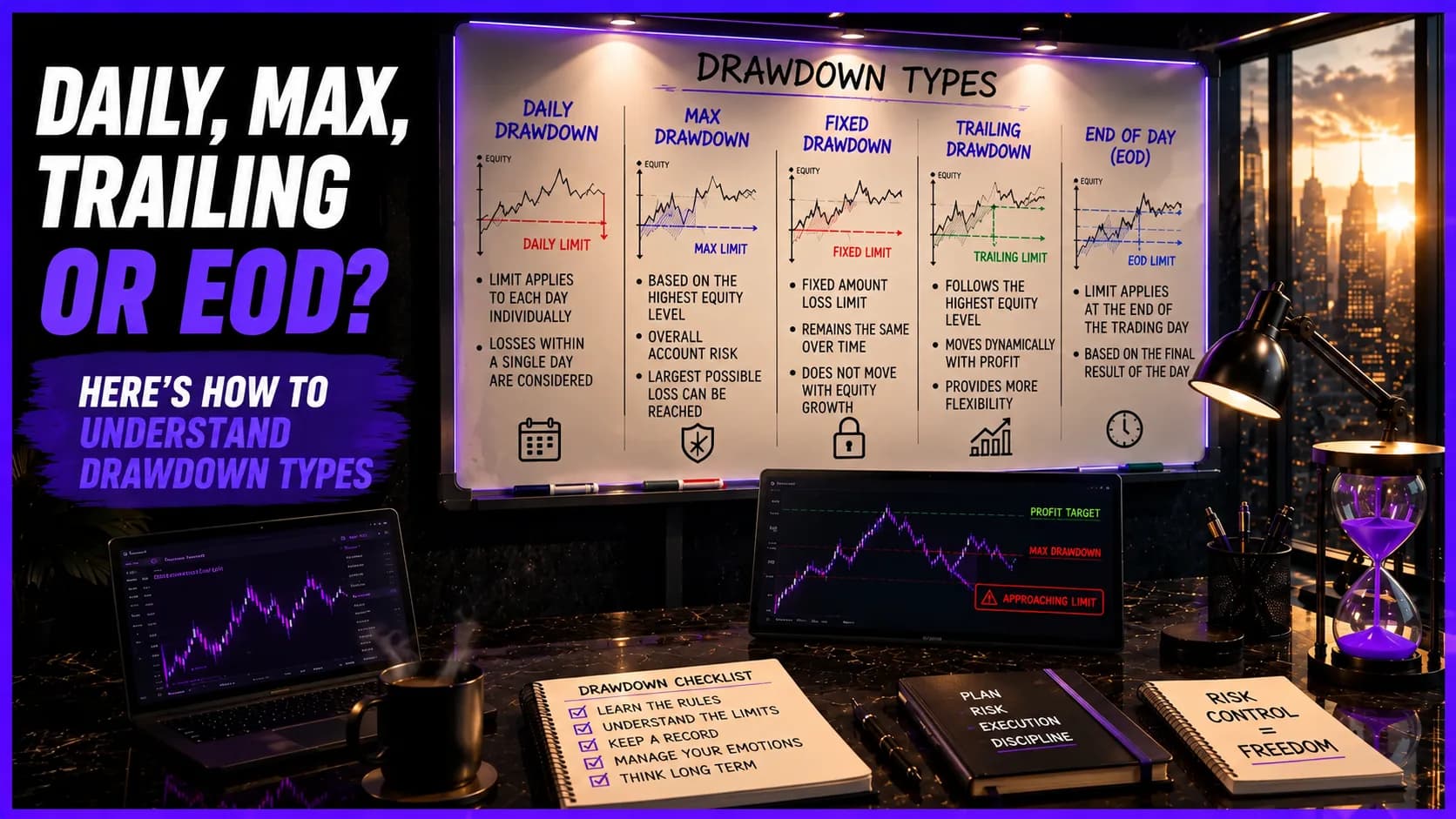
DAILY, MAX, TRAILING or EOD? - How to understand drawdown types.
In this post
August 31, 2026.
You want to choose between two trading accounts of the same size.
Both are $50,000. At first glance, they seem similar.
However, one has a separate daily loss limit. The other does not. One's loss limit trails the account's growth. The other rule works differently.
These might seem like minor differences until you actually start trading. Let's assume you open a position. The market initially moves against you, then later turns in the direction you expected.
Did the temporary loss fit within your account's rules? Or did you hit a loss limit before the position even had a chance to reverse?
An account's size alone does not tell you how much room to maneuver you have. For that, you also need to know how the drawdown rules work.
In this article, we will clear this up exactly.
Short summary: what will you learn?
By the end of the article, you will understand:
what Daily Drawdown means;
how Max Drawdown differs from it;
what makes a loss limit Trailing;
what End-of-Day (EOD) operation means;
and how to compare two accounts based on your own trading style.
Before we look at them one by one, there is an important distinction.
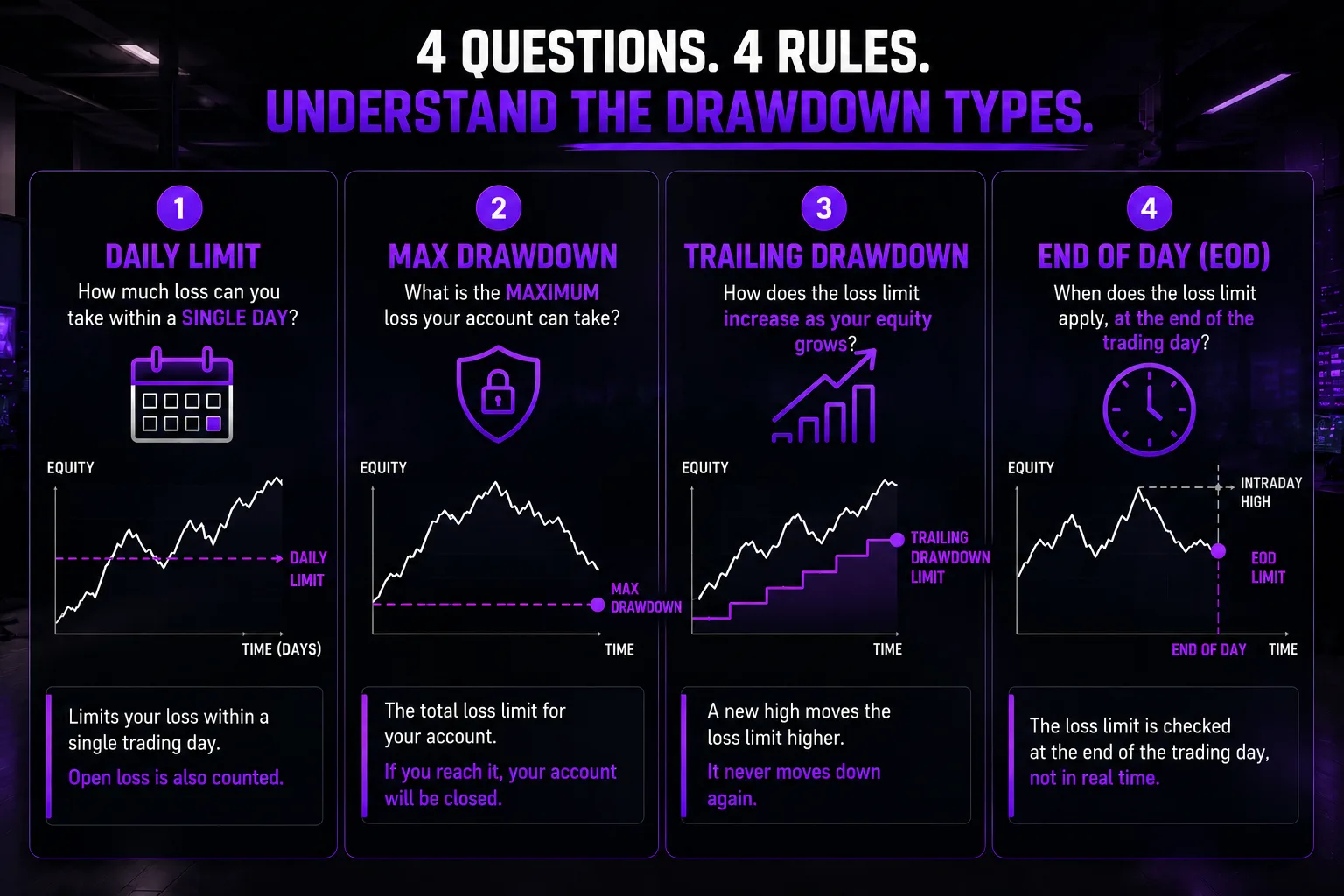
Daily, Max, Trailing, and EOD do not answer the same question
It is easy to think of these as simply four different types of drawdown.
In reality, they describe different parts of how the loss limit works on your account.
Daily Drawdown → How much loss fits into a single trading day?
Max Drawdown → What is your account's total loss allowance?
Trailing Drawdown → Does the loss limit follow your account's growth upward?
End-of-Day Drawdown → When is this trailing updated?
If you can separate these four questions, it will be much easier to understand a prop firm's rule system.
Let's start with the limit that can determine your room to maneuver within a single trading day.
Daily Loss Limit – Daily Drawdown
You might still be far from your total loss limit, yet your account can hit its daily limit.
Daily Drawdown is a defined loss limit for a given trading day. Just because you have room left in your account's total loss allowance does not necessarily mean you can use it all in a single day.
On Solo Clash LIQUID accounts, the daily loss limit is measured based on intra-day equity. This means that floating losses on open positions also count.
In other words, you do not need to close the position to hit the daily loss limit.
Let's look at a simple example
For a $50,000 LIQUID account under current rules:
Maximum loss limit: $2,000
Daily loss limit: $1,000
Daily limit at a $50,000 starting equity: $49,000
Let's assume you open a position.
The trade later shows a -$900 floating loss. You haven't closed it yet because, based on your setup, you still expect the market to turn.
However, the price continues to move against you.
If the account's intra-day equity reaches the level determined by the daily loss limit, you hit the daily limit.
Therefore, with a Daily Drawdown, not only your closed losses matter. The temporary loss of an open position can also be decisive.
What does this mean for your strategy?
Let's assume you trade with a strategy where a position occasionally endures a larger temporary pullback before heading in the planned direction.
It is not enough to know whether the strategy works in the long run.
You also need to examine:
do the account rules leave enough room for the strategy's natural fluctuations?
Therefore, the fact that an account is "$50,000" in itself gives very little information about how you can actually trade on it.
Maximum Loss Limit – Max Drawdown
Daily Drawdown tells you how much loss the account allows on a given day.
Max Drawdown, on the other hand, limits the account's total loss allowance.
Staying with the $50,000 LIQUID example:
Daily Drawdown: $1,000
Max Drawdown: $2,000
These are two separate limits. It could happen that you still had room left in your total $2,000 loss allowance, but you already hit the $1,000 Daily Drawdown on that given day.
This leads to an important lesson:
The nominal size of the account does not equal the loss allowance available to you. The rule systems of two $50,000 accounts can differ significantly from each other.
Therefore, when comparing accounts, do not just look at the account size, look at what actual loss allowance you get and under what rules you can use it?
However, there is another important variable.
What happens if the loss limit does not stay at the same level the entire time?
Trailing Loss Limit – Trailing Drawdown
Imagine you start growing your account.
You are in profit. You could rightly think that you are simply getting further away from your loss limit.
In the case of a Trailing Drawdown, however, the loss limit itself can also change.
The trailing loss limit moves higher along with the new peaks of the account.
The movement is one-way: when the account grows, the limit can follow it upward. If the account's value drops later, the loss limit does not move back down with it.
Example with a $50,000 Limitless account
Let's assume the account starts with a 4% trailing end-of-day loss limit.
Initially:
Account: $50,000
Loss limit: $48,000
If the relevant end-of-day balance rises to a new peak, the loss limit can also move higher. This means that as the account grows, the minimum level below which it can no longer fall may also change.
Profit, therefore, does not necessarily mean that your available risk allowance has grown by the same amount.
That is why with a Trailing Drawdown it is important to know where the current loss limit is located, not just how much profit your account is in.
On Solo Clash accounts, the trailing movement stops at a specific point according to the relevant rules: when the account reaches the required profit level, or the first payout occurs. Whichever comes first.
From then on, the loss limit is fixed and no longer trails the account upward.
But one question remains:
When does the trailing itself happen? This is where EOD comes into the picture.
End-of-Day Loss Limit – EOD Drawdown
Let's assume your day goes like this:
Starting balance: $50,000
Intra-day peak: $50,800
End-of-day balance: $50,200
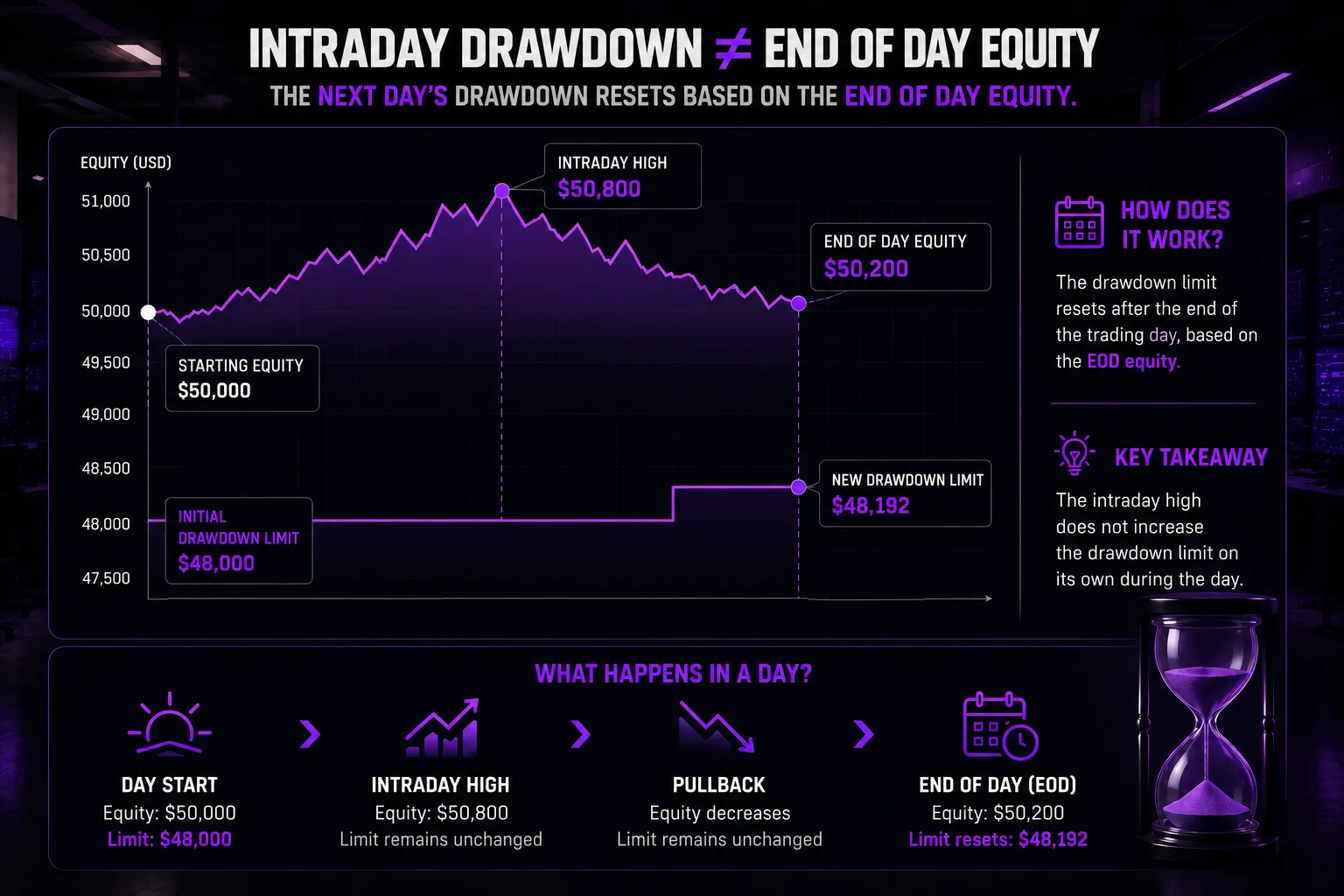
Based on which value does the trailing loss limit change?
Based on the $50,800 intra-day peak?
Or based on the $50,200 end-of-day value?
This is exactly what the End-of-Day operation determines.
The Solo Clash end-of-day trailing loss limit updates based on the relevant balance at the close of the trading day. Therefore, the $50,800 peak reached intra-day does not in itself mean that the loss limit automatically moves higher at that moment.
The value reached at the end of the day determines the next update. This can be a significant difference compared to an account where the trailing happens intra-day.
When interpreting drawdown, therefore, not only the percentage matters. It also matters when it is recalculated.
What to look at when comparing the drawdown rules of two accounts?
Now you no longer have to decide which term "sounds better".
You have to understand how the given rule will behave when you actually start trading.
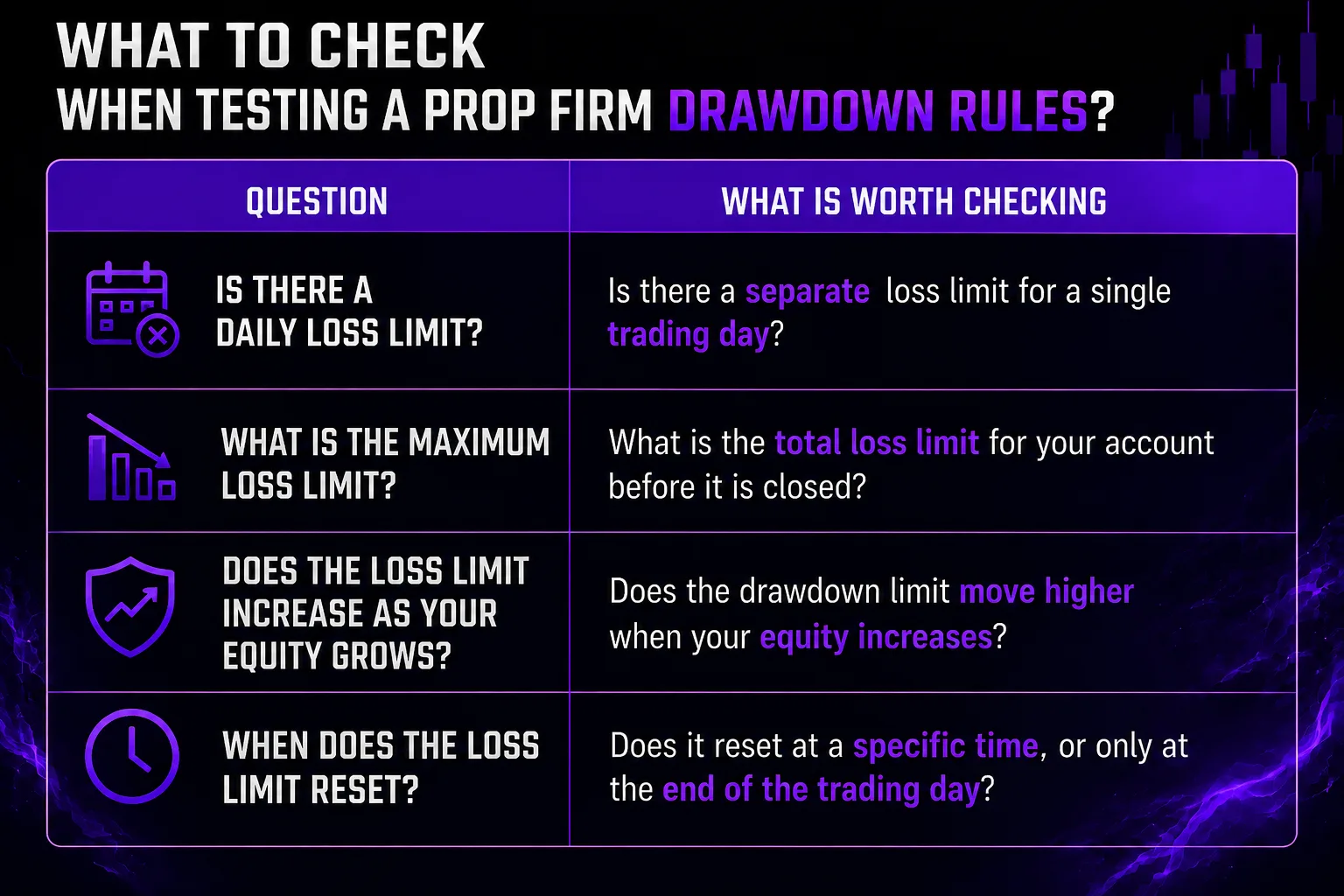
These four questions can tell you much more about an account than the nominal account size alone.
If your strategy regularly involves larger intra-day fluctuations, the Daily Drawdown and its calculation method can be especially important.
If you trade with a trailing loss limit, you need to understand exactly how and when the limit moves.
There is no universally "best" drawdown system for every trader. The question is which one fits how you actually trade.
What does all this look like for the Limitless account?
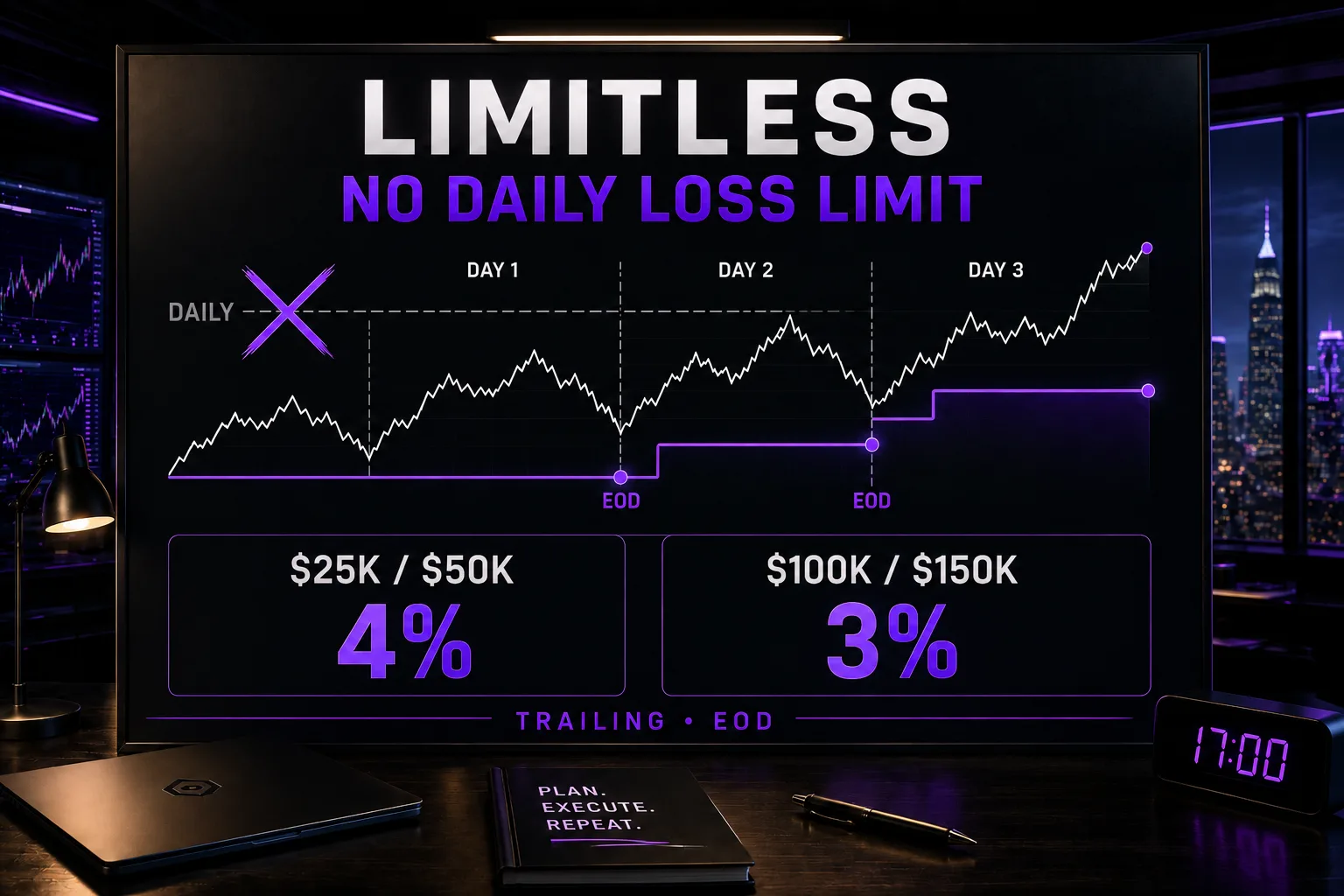
Now let's apply this same thinking to a specific account.
In the evaluation phase of Solo Clash LIMITLESS, there is no separate Daily Drawdown.
In the current structure:
For $25,000 and $50,000 account sizes, a 4% trailing end-of-day loss limit applies;
For $100,000 and $150,000 account sizes, a 3% trailing end-of-day loss limit operates.
What does the lack of a Daily Drawdown mean for you here?
During the evaluation, you do not have to adjust your trading to a separate daily loss limit as well.
This does not mean your loss allowance is unlimited. You still have to consider the maximum trailing loss limit.
The difference is that you have one less daily restriction to adapt to.
This can be particularly useful if your own strategy requires a larger intra-day room to maneuver, and you do not want a separate Daily Drawdown to dictate how you can distribute your total loss allowance.
The bottom line, however, remains the same here too:
do not choose an account just because a feature sounds good. Choose it because how it operates fits your strategy.
Frequently Asked Questions (FAQ)
What is the difference between Daily Drawdown and Max Drawdown?
Daily Drawdown limits the loss of a single trading day. Max Drawdown, on the other hand, determines the account's total loss allowance. Both rules can be present on an account at the same time.
Is there a Daily Drawdown in the LIMITLESS evaluation phase?
There is no separate Daily Drawdown. The loss allowance is regulated by the relevant maximum trailing end-of-day loss limit.
Does the trailing loss limit move downward too?
No. It can move upward driven by new relevant peaks, but it does not track the balance downward during a subsequent decline in the account.
What does EOD Drawdown mean?
EOD, or End-of-Day operation, means that the updating of the trailing loss limit is tied to the close of the trading day, not to every intra-day new peak.
When does the trailing loss limit stop?
According to the relevant Solo Clash account rules, trailing becomes fixed when the account reaches the specified profit threshold, or the first payout occurs – whichever happens first.
Summary
To understand drawdown rules, do not stop at the percentage.
Look for the answers to four separate questions:
Daily → how much can you lose in a single day?
Max → what is your total loss allowance?
Trailing → does the loss limit follow your account's growth?
EOD → when is this updated?
If you understand these, it is already much easier to tell the real difference between two seemingly similar accounts.
Choosing a good account is not about which account has the biggest number on it.
It is about how well the rule system behind it fits how you actually trade.
From now on, do not just look at the account size.
Look at the loss limits, how they move, when they update, and how much actual room to maneuver they leave for your strategy.