This is how you reach the profit target so that you can immediately request a payout.
In this post

September 11, 2026.
It can happen that you are in profit, yet you do not fulfill one of the conditions necessary for the payout.
The reason for this at certain prop accounts can be the consistency rule.
At first it seems simple: there is a percentage limit that you must adhere to. Uncertainty usually begins when you try to calculate what exactly this percentage is compared to, what an outstandingly profitable day means, and what happens if you exceed the determined value.
This is particularly important because consistency rules can differ per account and even between individual trading phases.
Misinterpreting a rule can thus directly influence when you complete the Eval, or when you can become eligible for a payout.
In this article, step by step we look at how the consistency rule works, how you can simply calculate it, and what is worth paying attention to when you choose a prop account for your own trading style.
Short summary
In the next few minutes you will get an answer to:
what the consistency rule actually shows;
how you can check your own numbers with a simple calculation;
what can happen after an outstandingly profitable day;
why it is worth separately checking which trading phase a rule applies to;
and how you can take all this into consideration when choosing your next account.
1. What exactly does the consistency rule mean?
If you earn a significant part of your profit in a single day, how can that influence your account?
The consistency rule gives an answer to this.
The rule examines what part the profit of a given trading day represents out of a determined profit value. The exact basis of comparison can differ per account, therefore you must always check the rules of the given account.
Let's take a simple, illustrative example.
Let's assume that a 30% consistency rule applies to an account, and your total profit serving as the basis of the calculation is 3,000 dollars.
In this case:
3,000 × 30% = 900 dollars
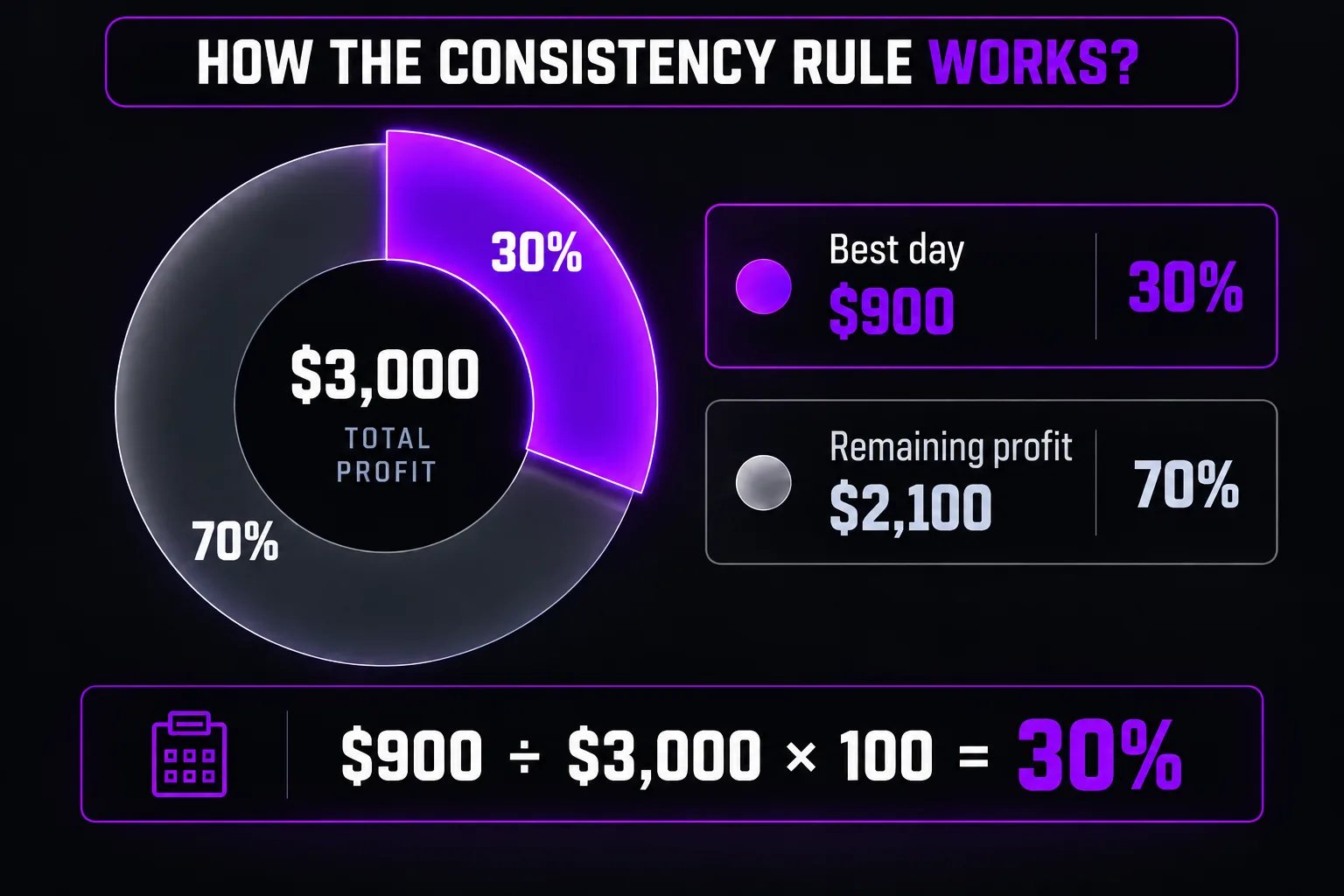
If according to the rule no single day can represent more than 30% of this amount, then your largest profitable day can be a maximum of 900 dollars.
So far it is simple.
Most questions arise when one of your trading days is much more successful than this.
2. What happens if one of your profitable days became too big?
Let's assume you had an outstandingly good day. Did you lose your account with this?
There is no answer valid for every account to this. The consequence depends on what the consistency rule of the given account is like.
The calculation, however, is easy to understand.
Let's stay with the 30% illustrative example:
Total profit: 3,000 dollars
Best trading day: 1,200 dollars
Your own value:
1,200 ÷ 3,000 × 100 = 40%
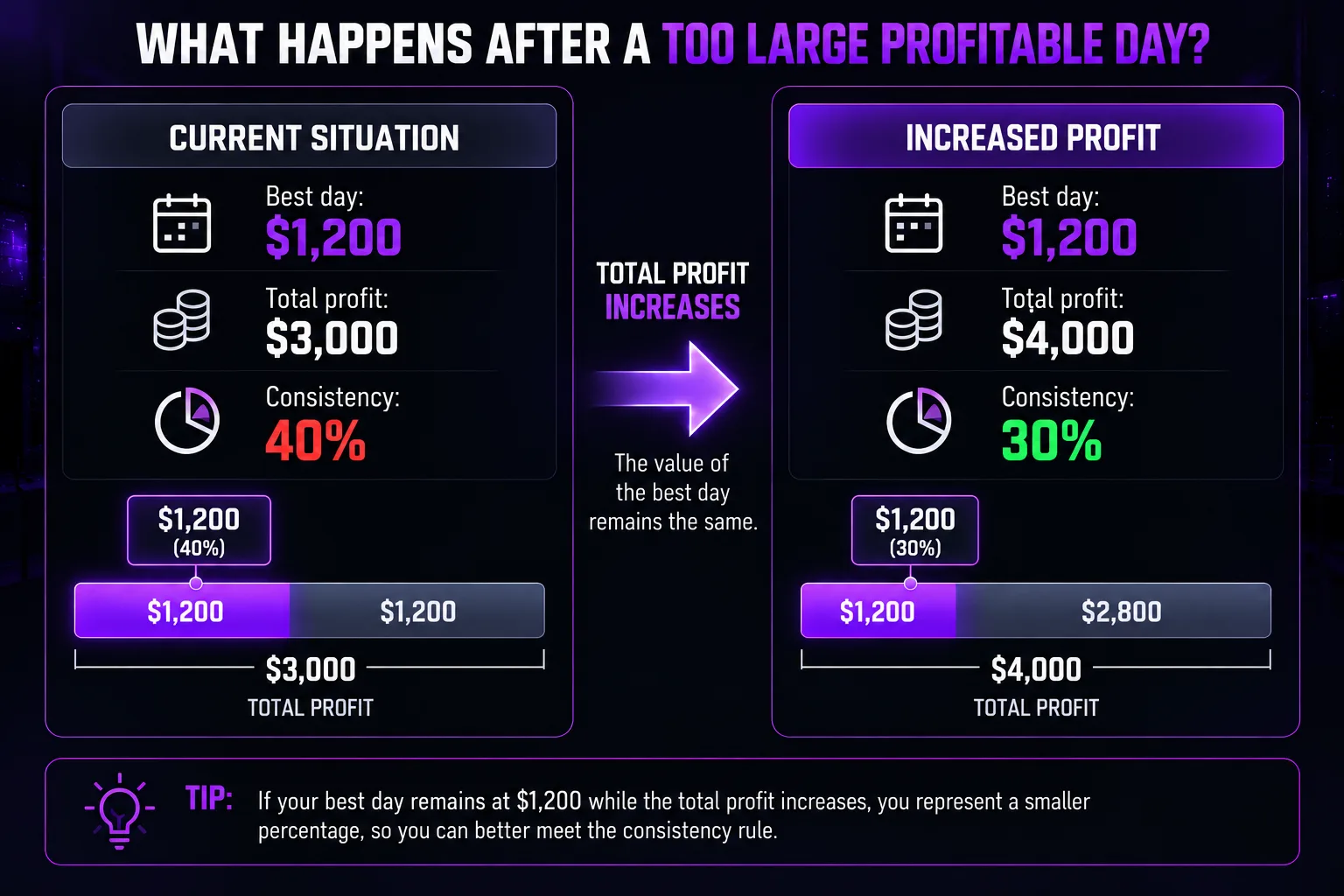
So your best day gives 40% of the total profit. If the given condition is maximum 30%, currently you do not fit into the determined value.
From here comes the part which is worth understanding for many traders: the percentage can change even if the profit of your best day no longer changes.
If the 1,200 dollar day must represent a maximum of 30%, you can calculate alongside how much total profit this is fulfilled:
1,200 ÷ 0.30 = 4,000 dollars
Thus at a 4,000 dollar total profit the 1,200 dollar day already represents exactly 30%.
This calculation, however, only correctly describes your situation if the specific account also calculates the rule from the total profit. That is precisely why it is dangerous to automatically conclude about your own account from the example of another prop firm.
The next step is therefore that you know how to check the percentage yourself too.
3. How do you calculate your own consistency value?
You do not have to use complicated formulas to see where you stand.
If the account compares the result of your best day to your total profit, the basic formula is:
Largest profitable day ÷ total profit × 100 = consistency value
For example:
750 ÷ 3,000 × 100 = 25%
In this example the best day gives 25% of the total profit.
With this you can already quickly check your own situation. There is, however, an important step before the calculation: look at what profit value exactly the rule of the given account compares your best day to.
4. The same percentage rule can operate differently too
Two consistency rules can seem similar, while a completely different calculation stands behind them.
Let's look in the case of the LIQUID account.
During the LIQUID Evaluation a 40% consistency rule applies. Here the profit of no single trading day can exceed 40% of the profit target of the given account.
At a 50,000 dollar LIQUID account, for example, the profit target is 3,000 dollars. 40% of this is:
3,000 × 0.40 = 1,200 dollars
A single day can contribute a maximum of 1,200 dollars to the original profit target. If you generate a larger profit than this in one day, according to the current rules of Solo Clash the necessary profit target will be higher.
In the LIQUID Express phase the consistency rule already operates differently. Here a 35% limit applies at the payout request: no single trading day can give more than 35% of the total profit belonging to the payout request.
If for example the payout request covers 3,000 dollars of profit:
3,000 × 0.35 = 1,050 dollars
In this case no single day can contribute with more than 1,050 dollars.
This well shows why it is worth reading the basis of the calculation and the affected phase alongside the percentage too.
Well, here the LIMITLESS account type becomes especially interesting.
5. How does the consistency rule operate at the LIMITLESS account?
What happens if the requirement regarding consistency changes in different phases of the same program?
The LIMITLESS account is a good example of this.
During the LIMITLESS Evaluation there is currently no consistency rule. Even a single strong trading day can fulfill the profit target, provided that you adhere to the other rules of the account as well.
After you fulfill the Eval and enter the LIMITLESS Express phase, a 30% consistency rule comes into effect at payouts. No single trading day can give more than 30% of the total profit existing at the time of the payout request.
Let's assume that in the Express phase you have 5,000 dollars of total profit.
5,000 × 0.30 = 1,500 dollars
For you to comply with the payout condition from this perspective, your largest profitable day can amount to a maximum of 1,500 dollars.
For the first payout, you must also complete at least five trading days on which a profit of at least 200 dollars was generated individually. At a payout request a maximum of 50% of the available profit can be taken out, alongside an upper limit determined at 8% of the starting account balance.
And if you reach the LIMITLESS Live phase, the requirement regarding consistency ceases. According to current rules, in the Live phase it is not restricted what part of your profit you can earn on a single trading day.
This account path from this perspective can therefore simply be summarized like this:
Evaluation: no consistency rule → Express: 30% → Live: no consistency rule
This is already enough information for a more important question to arise: how does all this fit to how you actually trade?
6. How can the consistency rule affect your trading style?
Look back at your last few profitable weeks. Was your profit evenly distributed, or did a few outstanding days give a significant part of the result?
This can reveal a lot about how much significance a consistency rule has for you.
Let's assume that two traders achieve the exact same 4,000 dollar profit.
One's best day was 800 dollars. This is 20% of the total profit.
The other's best day was 2,000 dollars. This is 50%.
The same total result, yet a completely different situation alongside a 30% consistency rule.
This can be especially important for those traders who exploit fewer opportunities, and their result occasionally concentrates around a few larger profitable days.
That is precisely why before choosing an account it is worth looking back at your own previous results. Examine what part of your profit falling on a weekly or longer period your best day usually gives.
This way you already have an own data which you can compare with the conditions of the chosen program.
Knowing the consistency rule also helps in that you do not only encounter it first when you already want to request a payout.
7. What to check before choosing an account?
A 30% or 40% number in itself is still little for you to understand the real effect of the rule.
It is always worth checking three things:
How large is the percentage value of the consistency rule?
To what profit value do they compare your best trading day?
In which phase and at what condition is it applied?
After this compare these with your own trading results.
If your profit often concentrates on a few outstanding days, different conditions can fit you than a trader whose result is distributed among several smaller profitable days.
With this approach the consistency rule already becomes such a specific aspect which you can take into consideration when choosing an account.
Frequent questions (FAQ)
What happens if I exceed the 30% in LIMITLESS Express?
You must comply with the 30% condition at the time of the payout request. If your best trading day gives more than 30% of the total profit, for the payout first you must reach such a total profit value alongside which this day already fits into the 30% limit.
Is there a consistency rule on a LIMITLESS Live account?
There is none. In the LIMITLESS Live phase there is currently no daily consistency requirement, thus the rule does not restrict what part of your profit you can reach on a single day.
How much is the LIQUID consistency rule?
During the LIQUID Evaluation it is 40%, and they compare it to the profit target of the given account. In the Express phase it is 35%, which they examine based on the profit belonging to the payout request.
Why is there the consistency rule?
This can protect you as a trader too, because it less encourages you to take on too large a risk in the interest of a profit target or payout.
The goal is not only reaching the profit, but also that you get there in a controlled and repeatable manner.
Summary
To understand the consistency rule you must clearly see three data: how large the percentage limit is, what they compare it to, and when they apply it.
If you check these already before starting the trading, you can more easily assess how the conditions of the given account fit to your own trading style.
Among the accounts of Solo Clash there are significant differences in this field too. If you already understand how the consistency rule operates, it is worth putting the other important conditions next to each other too, and based on these choosing the account appropriate for you.