Do you really have to review everything before trading?
In this post

October 5, 2026.
You looked at the market. You checked the important economic events of the day. You looked through those conditions based on which you would like to trade.
After this you could still look at a huge amount of information.
Another timeframe. A related market. A new economic data. A fresh analysis. Another indicator.
The market never signals that your analysis is finished.
Therefore at every new information the same question becomes important: does it add something to your next decision, or does it only prolong the analysis?
In this article we show such a system with which you can predetermine what information you need for the preparation, for the trading decision and for the subsequent analysis. And at the end you also get a specific method for how to examine in your own trading which of your information sources give real decision value.
Short summary
Why can it be hard to find a natural finishing point in market analysis?
How can you separate the information necessary for the decision from what you only check out of habit?
With what simple test can you measure the real value of a new information?
How can you build your own information map based on your trades?
What is it worth determining in advance so that you know when your preparation can be considered finished?
Market analysis has no natural end
While examining a trading opportunity you can almost always find something else that you could check.
You can look at another timeframe. You can check another economic data. You can look at another indicator or fresh news.
Each one can give new information.
Because of this, not every one is necessary for the given decision.
Let's assume that based on your trading method you need three informations for the evaluation of an opportunity:
reaching the predetermined price level;
the fulfillment of your entry conditions;
checking whether there is no such important economic event which according to your trading plan you must take into consideration.
You checked all three conditions.
After this you open a new information source.
Here it becomes important what exact role the new information has in your decision.
If you cannot determine what condition you are checking with it, your analysis has no clear finishing point. There always remains another data that can be looked at.
Every information should have a task
One of the simplest methods for shortening the analysis is if to every regularly used information source you assign a specific task.
For example:
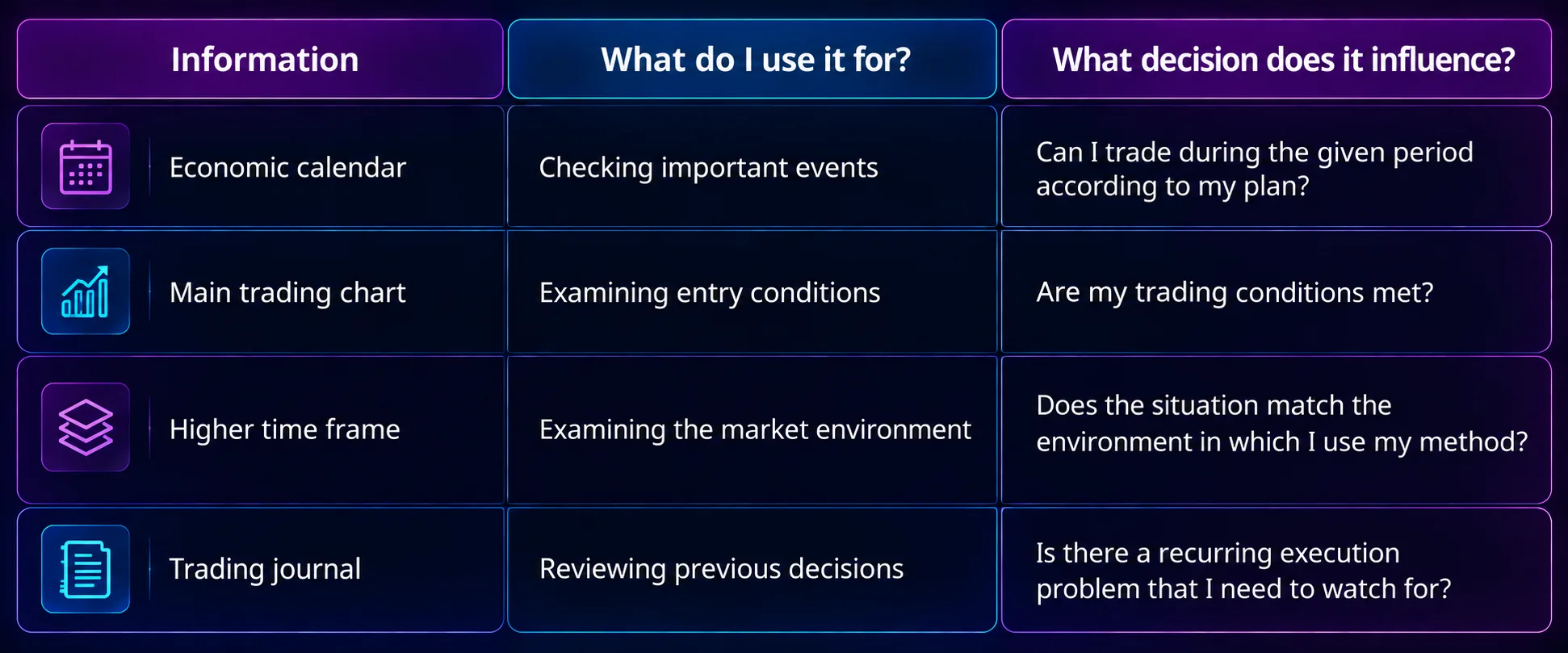
Your own spreadsheet can naturally differ from this.
The important part is the third column.
If to an information source you cannot assign such a decision which it can actually influence, examine why you use it while trading.
With this you can already determine much more exactly which informations belong to your decision process.
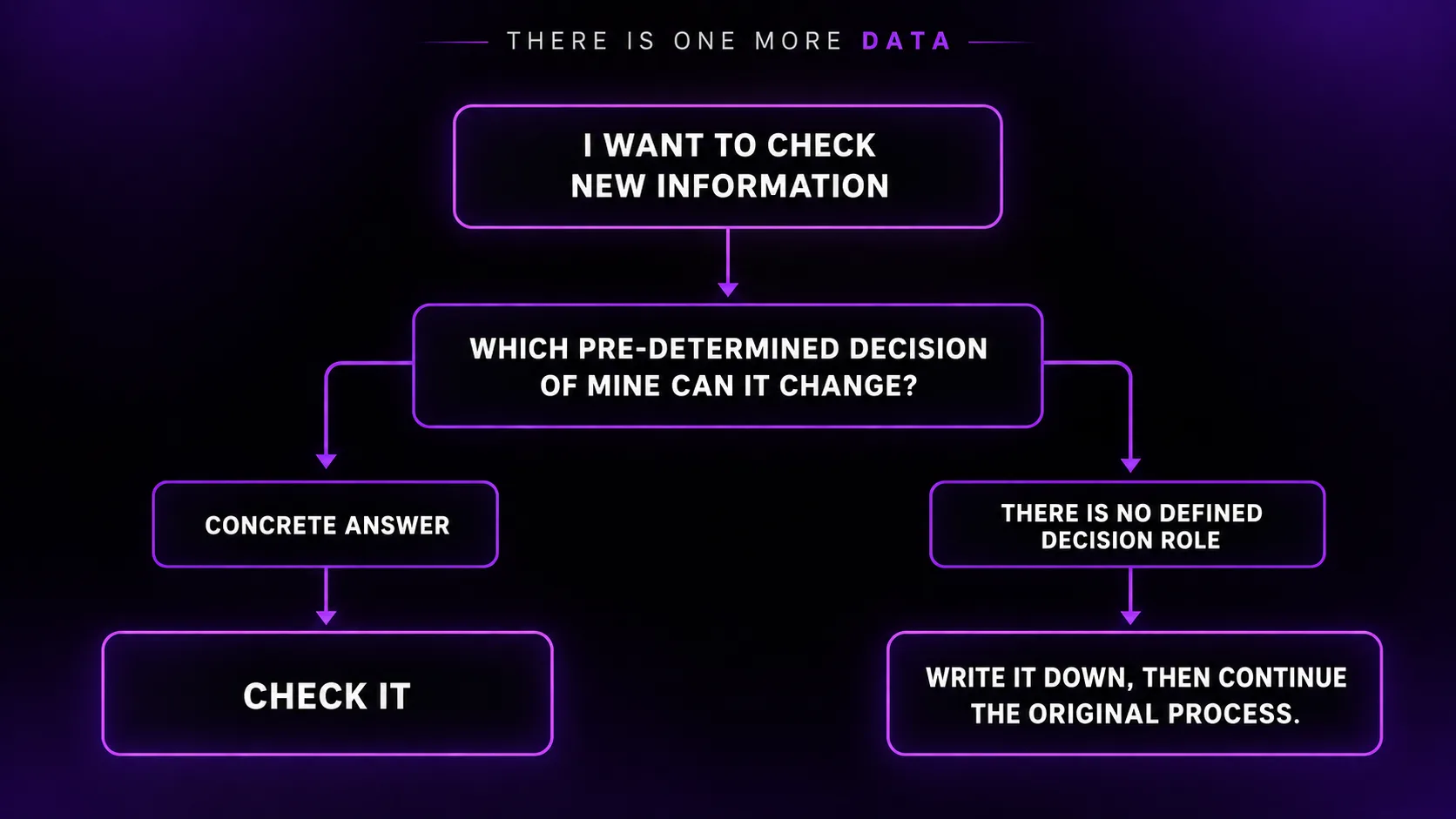
Use the "one new data" test
When during analysis you look at a new information source, first connect it to a specific trading condition or decision.
Examine whether the new information:
checks an already determined condition;
can influence the next trading decision;
possesses a clear role in the current analysis.
For example if within 15 minutes an important economic data arrives, and according to your own plan in such a period you do not open a new position, the checking of the economic calendar directly connects to the decision.
In the case of another indicator it is already worth looking at what signal or value would change your evaluation. If you do not have a predetermined condition for this, the role of the information is not yet clearly determined.
At such times note down the information source, then continue your original checking process.
After a few days it already becomes measurable how many times you opened such a new information source which eventually did not influence any predetermined decision condition.
Create three information boundaries
In the next step separate your trading process into three parts.
This is useful because you need different information before the trading period, at the moment of a specific decision and during the subsequent analysis.
1. Preparation boundary
Write down in advance what informations you must check so that you can consider your daily preparation finished.
For example:
important economic events planned for that day;
their times;
the current environment of the market traded by you;
important price levels based on your own plan;
your own trading conditions referring to the given day.
After this determine the finishing condition too.
This way the preparation will have a measurable end.
2. Decision boundary
At a specific opportunity an even stricter system is usable.
Write down which informations can actually change your entry decision.
For example you use five conditions.
The decision process ends when the checking of all five has happened.
If after this you would look for new information, first use the "one new data" test.
Which of the five conditions' result can it change?
If none, you already know that the new data is not in your predetermined decision system.
3. Analysis boundary
After trading you again need different information.
Here for example you can record:
what opportunity you evaluated;
which conditions were fulfilled;
what decision you made;
based on what informations you made it;
what result was born;
subsequently did such information appear which at the moment of decision you could not yet know.
The last point is especially important.
The information at your disposal after the trade is easy to confuse with what you could actually know at the moment of the decision.
Therefore during the analysis always separate the two.
Measure which of your information sources actually change your decisions
Here you can go one step further than the simple checklist.
On the next five trading days keep a short information journal.
You do not have to record every opened page. Only note down those new informations which you looked for while evaluating a specific trading opportunity.
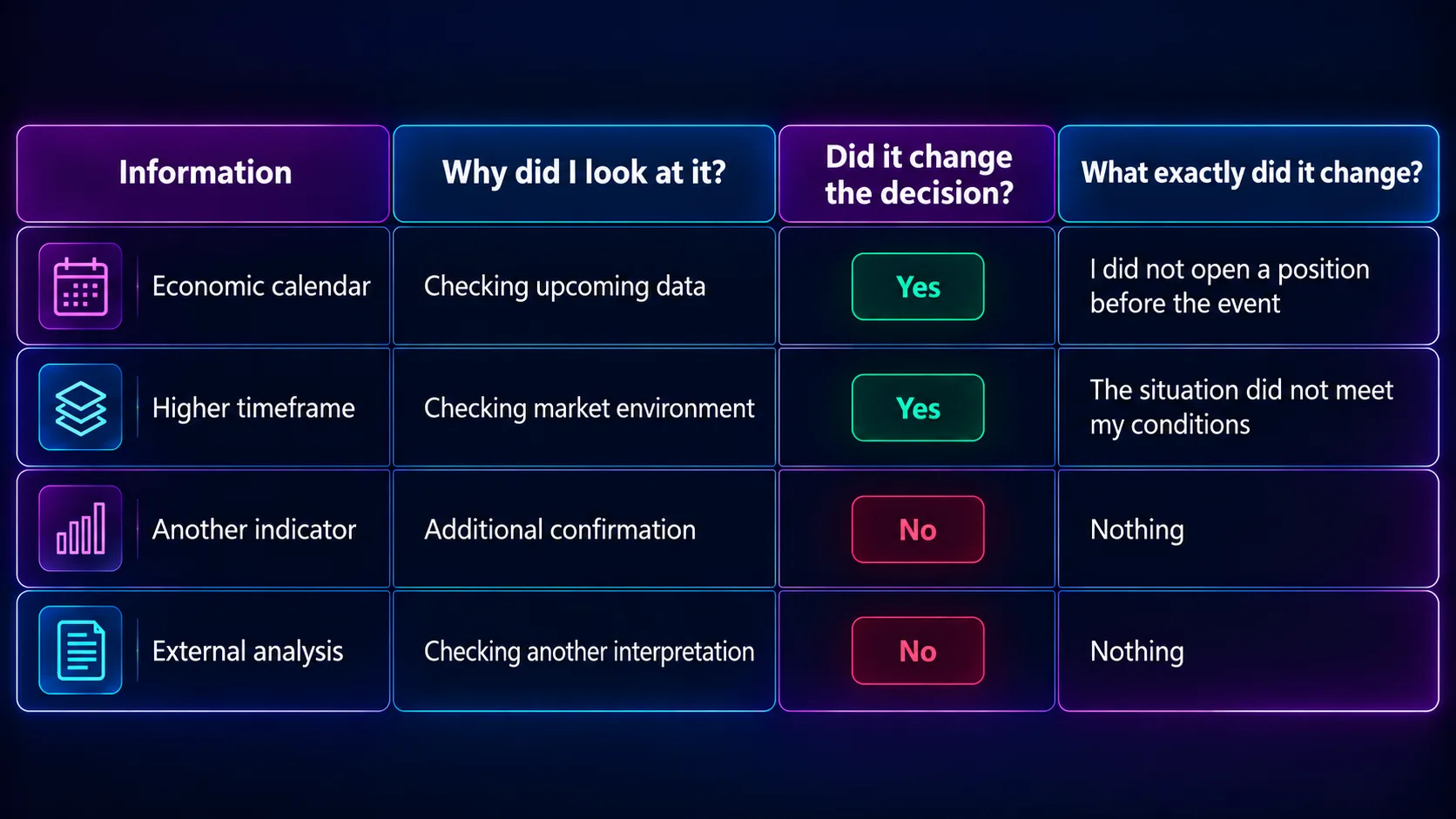
After five days count up which information sources actually changed any of your predetermined decisions.
After this separately look at those which you regularly checked, but not once did they lead to a different decision.
By the end of the five days this way you not only see how many information sources you use. You also see which one has a clear task in your trading process, and which one's role it is worth examining further.
From this you can already prepare your own information map.
Prepare your own information map
At the end of the five-day observation sort every regularly used information source of yours into one of three groups.
Necessary for decision
Here gets every such information which checks a predetermined trading condition, or can directly change your decision.
Necessary for preparation or analysis
These can be important informations, but you do not have to reopen them while evaluating a specific entry.
For example the detailed analysis of an earlier trade can be valuable in the evening. When a new opportunity appears you already have a different task.
To be examined
Here should get those sources which you regularly use, while you cannot yet exactly formulate what decision task they supply.
This third group can be the most interesting.
Here you can find those informations which require time and attention without having a clear role in your trading process.
Where does Solo Clash HQ connect to this?
If you already determined what informations you need for the preparation and the subsequent analysis, it is worth looking at too under how much time you access these.
One of the goals of Solo Clash HQ is that you can access multiple important informations and tools connected to your own trading in one place.
In the HQ among others you can follow your trades, you can use the trading journal, you can analyze your performance, you can prepare notes, and you can overview the upcoming important economic events.
This can be well fitted to the previously developed system.
The economic events can help in the preparation.
The trading data and notes can help in the recording.
The journal and the performance analysis can help in the subsequent examination.
The goal is a shorter path from the information through the preparation and trading to the analysis.
Frequent questions (FAQ)
How do I know that I use too much information?
Quantity in itself is little for this. Examine whether to all your regularly used information you can assign a specific task and decision consequence.
Why is it worth separating the preparation and the decision?
Because an information can be useful for the understanding of the daily market environment without you having to recheck it at every single trading opportunity. With the separation you can give a more exact role to the informations.
What should be the first step?
On your next trading day every time when while analyzing a specific opportunity you would look for new information, first write down which of your decisions it can change. This in itself can show multiple such information sources whose role you have not exactly determined so far.
Summary
You can always find one more data, a new viewpoint or an additional analysis about the market.
Therefore it is worth predetermining the finishing conditions of your own analysis.
Determine what information is necessary for the preparation, which data can change one of your specific trading decisions, and what you would like to record for the subsequent analysis.
After this for five days measure which of your information sources actually change your decisions.
The goal is the development of such a process in which every regularly used information has a clear role.
If you would like to follow this process more simply in one place, look at how Solo Clash HQ connects the trading journal, the analysis of your performance and the important economic events.