Why do even experienced traders lose a part of their profit after a winning streak? 3 rules that can help.
In this post

September 28, 2026.
In the morning, out of three trades three are profitable. You are already at +900 dollars.
The day so far has shaped up almost exactly as you would have liked. Your entries worked, your decisions brought results, and there is still plenty of time from the trading period.
The next opportunity is somewhat weaker, yet you open the position. After it comes another one, where the position size will already be larger too.
A few trades later, out of the +900 dollars +300 remains.
The process leading to the loss of the previously acquired profit can start already before the first losing trade. The change appears in what decisions you allow yourself after a winning streak.
Short summary
What can change unnoticeably after a few consecutive wins?
Why can such an opportunity get in later which at the beginning of the day would still have been little?
How can a good result gradually lead to greater risk?
Where can the erosion of the daily profit actually begin?
Which three decisions is it worth making already before the day starts well?
What can change after a winning streak?
Let's assume now that three trades met your predetermined rules, and you made your decisions following your trading system.
At the fourth trade, however, something already appeared which was still missing at the beginning of the day: the experience of three consecutive successful decisions and the profit acquired up to then.
This can have an effect on how you evaluate the next opportunity.
Several consecutive wins can reinforce your confidence placed in your own decisions. Because of this, a situation previously judged as uncertain can seem less risky, and you can more easily accept such deviations too which at the beginning of the day you still considered an excluding reason.
At the beginning of the day you would have skipped an uncertain entry situation. After a few wins the same uncertainty can already seem smaller.
At the beginning of the day 200 dollars was the acceptable risk. At +900 dollars risking 250 or 300 dollars can seem less significant.
At the beginning of the day you waited for three strong opportunities. After all three worked, a fourth and fifth trade also becomes more easily acceptable.
The change usually does not appear in a single big decision.
A slightly more permissive entry.
A slightly larger position.
One more trade.
Separately these can seem like tiny deviations. Together, however, they can already create a completely different risk situation than in which the first profits were born.
1. The winning streak can loosen your entry standard
Let's assume that you select your trades based on five own conditions.
The first opportunity meets all five. You enter, you close with profit.
The second and the third meet them too. Both are profitable.
After this a situation arrives in which only four conditions are met.
Here it is worth asking a simple question:
Would you open this trade even if this was the first opportunity of the day?
If in the morning you would have skipped this same situation, then it is worth examining what changed.
The previous three wins did not add a fifth condition to the next opportunity. The situation still fulfills four out of the five.
Your acceptance threshold, however, could have shifted.
This is the point where the process leading to the erosion of the daily profit can already begin, while you haven't yet lost a single dollar from the previously acquired amount.
We have already explained the reasons for deviation from the trading plan in more detail in another article of ours. Read it here.
At this situation it is specifically worth paying attention to how the deviation can start after a successful trading streak.
2. The acquired profit can also change the perception of position size
Imagine two trading opportunities of the exact same quality.
One is the first trade of the day. The other appears when you are already at +900 dollars.
At the first you take on 200 dollars risk. At the second already 250 or 300 dollars can also seem more acceptable, since even after a losing trade the day would remain in profit.
With this, however, the result up to then starts to influence the size of the next position.
The +900 dollar profit did not make the next entry situation stronger. The outcome of the next trade continues to be uncertain.
The larger position size meanwhile changes how much effect a losing trade will have on the result up to then.
If for example at the first trades you risked 200 dollars, then you raise this to 300 dollars, three full losses already mean 900 dollars.
The profit built up with smaller risk, then alongside larger risk it can erode much faster.
3. The looser standard can also increase the number of trades
If more opportunities seem acceptable, the number of trades can also easily rise.
At the beginning of the day perhaps you only selected the strongest situations. After a few wins a mediocre opportunity gets in. Then another one, since the day continues to be in significant profit.
This way three changes can reinforce each other:
lower entry standard → more trades → possibly larger position size
If the number of trades increases unjustifiably compared to your own system, overtrading can also appear.We have already explained the operation and handling of this in more detail in our article about overtrading. Read it here.
At this problem the trigger point is especially important: the change started after a winning streak.
This is how the process comes together:
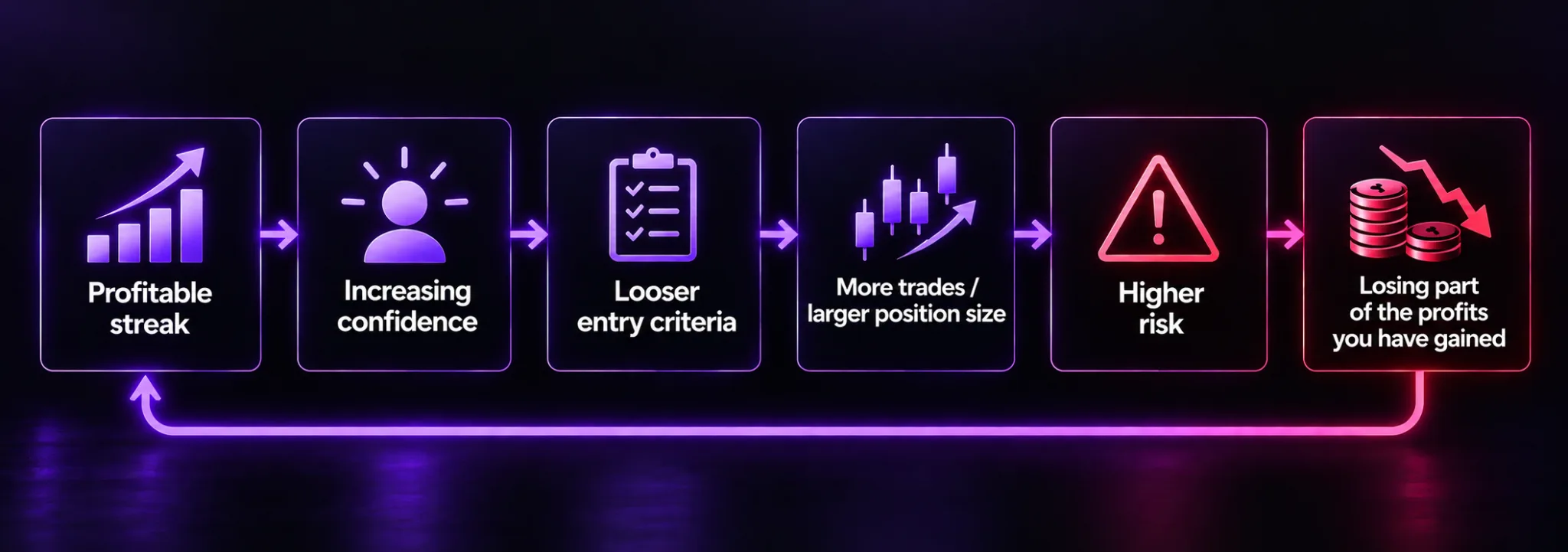
At three points of the process you can also set up a check in advance.
3 rules that can help preserve your profit after a strong streak
It is worth determining the rules even before the trading period. This way the daily result can less have a say in what you consider an acceptable next decision.
1. Keep the exact same entry standard during the entire trading period
Determine in advance which conditions must be met for you to accept a trading opportunity.
If you set up five conditions, at +900 dollars the exact same five remain.
Here a simple checking question is usable:
Would I open this trade even if this was the first opportunity of the day?
If yes, the opportunity can continue to meet your original standard.
If no, you already noticed before the entry that the daily result could have started to influence your decision.
This is valuable because you do not have to wait for the next loss for you to recognize the change.
2. The daily profit should not change your position size
If your risk determined at the beginning of the trading period is 200 dollars per trade, keep this after a larger result too.
The raising of the position size should have a predetermined process. You can tie it for example to the analysis of the results of several weeks or a determined number of trades.
This way a +900 dollar morning in itself does not give reason for you to risk 300 dollars in the next trade.
The numerical consequence of this is quickly visible.
Three consecutive 200 dollar full losses mean 600 dollars. Three 300 dollar losses already 900 dollars.
If the entry standard loosened meanwhile too, the larger risk is capable of eroding the result up to then even faster.
3. Have a predetermined checking point after a strong profitable phase
Decide already before the trading period what happens if you have multiple profitable trades in a row, or you reach an outstandingly strong daily result for yourself.
This can be for example a short mandatory break, after which you check again:
whether your entry conditions are met;
whether your position size changed;
whether you accept the exact same opportunities as at the beginning of the day.
It is worth adjusting the exact checking point to your own trading system. For the trader looking for one or two opportunities daily a different framework can be appropriate than for the one whose method regularly results in multiple trades.
The pre-fixed check interrupts that process in which one successful decision almost automatically leads to the next.
This is how the three rules can work together
Let's assume that you risk 200 dollars per trade, for every entry the fulfillment of five conditions is necessary, and after three consecutive profitable trades you take a 15-minute break.
After three wins you are at +900 dollars.
After the break a new opportunity appears, which meets only four conditions. Based on the first rule it is left out.
Later a situation arrives which meets all five conditions. Based on the second rule you continue to risk 200 dollars.
And the third rule already created a point earlier where you checked whether you continue the day with the exact same standard.
The three rules this way protect the exact same process at three separate points: at the entry, at the risk and at the continuation.
Frequent questions
Is it always worth finishing trading after a winning streak?
It is not necessary to stop after every winning streak. Your own trading system determines how many opportunities are natural in a given period. A predetermined checking point can help in that you notice the possible change of your standard before the continuation.
How can I know that my entry conditions loosened?
Compare the next opportunity with what you would have accepted as the first trade of the day. If earlier you would have skipped it, look exactly at which condition you yielded from.
Do more trades automatically mean overtrading?
No. It is worth comparing the number of trades to your own system. The problem can appear when the quantity increases because you accept increasingly weaker opportunities too.
Why is the increasing of the position size risky during a strong day?
Because of the larger position size a later losing trade is capable of taking away a larger part of the profit up to then. The earlier result of the day meanwhile did not improve the quality of the next trading opportunity.
Summary
After a strong winning streak the erosion of the daily result often begins with tiny changes.
A weaker opportunity gets in. The position size increases. More trades are born than planned. These together can gradually change that risk framework in which you acquired the first profits.
The three rules therefore fix three decisions in advance: what kind of opportunity you accept, how much risk you take on, and when you recheck your own decision standard.
This way even after a strong result the exact same frameworks can guide your next decision with which you built up the winning streak.
In a prop trading environment to this belongs the knowledge of the rules of the account too. If you already know exactly what kind of risk and trading framework you would like to follow, the next step is looking at which current Solo Clash account type's rules fit to it.