How many decisions after can the quality of your trading decisions change?
In this post

October 10, 2026
During a trading period you make far more decisions than the number of trades you eventually execute.
You examine an entry opportunity. You check your conditions. You wait for another price movement. Finally, you reject the opportunity, and you watch when the next one appears.
All this requires attention, even if you haven't opened a single position.
But do you check your conditions just as thoroughly at the fifteenth opportunity as at the first?
During a longer trading period the number of consecutive decisions can continuously grow. Along with this the attention devoted to checking can also change.
The question is, how can you recognize this change in your own trading, before it leads to more significant mistakes.
Short summary
Why can there be a significant difference in the number of decisions between two days closing with the identical number of trades?
What tiny changes can indicate if you already evaluate later opportunities differently?
Why can it be misleading if you exclusively watch the time spent with trading?
How can you examine under a few days whether your own decision-making is changing?
What is it worth doing with the result if you find a recurring deviation?
What counts as an evaluated opportunity?
Let's assume that on two different trading days you opened three positions too.
On the first day you evaluated a total of five entry opportunities, out of which you found three suitable.
On the second day however you had to examine twenty opportunities, before you found three such situations which met your conditions.
The number of executed trades was the same on both days.
On the second day however you had to evaluate four times as many opportunities.
At every single evaluation you had to check your own conditions, then make a decision about whether the given situation is suitable for trading.
This required attention then too when the decision eventually was the rejection of an opportunity.
Here however it is important to define exactly what we count as an evaluated opportunity.
Another glance at the chart does not yet necessarily mean a new decision.
Count an evaluation then when you actually examine a possible entry situation based on your own trading conditions.
If later because of a new price movement or information you have to evaluate the exact same situation all over again, you can also record that separately.
With this you can already consistently count those situations which required a real decision.
What can change after many consecutive decisions?
Decision fatigue means that after many consecutive decisions it can become harder to evaluate the next situation with the same thoroughness.
While trading this is important because your entry conditions remain unchanged, while the attention devoted to their checking can decrease.
This can appear in multiple ways too.
For example in the later part of the trading period:
you evaluate a new opportunity under a shorter time;
you leave out a previously regularly checked condition;
even without new information you return multiple times to a previously rejected situation;
you only notice a detail in hindsight which you could have checked before the decision too.
Faster evaluation in itself does not yet mean a worse decision.
About a clearly excludable opportunity for example it is natural that you can decide faster.
It is worth examining the change more thoroughly when together with the faster decisions checking points also fall out, or mistakes noticed in hindsight become more frequent.
From these it cannot yet be securely established that decision fatigue stands in the background. However there are already specific signs which you can observe.
Alongside elapsed time the number of decisions is also worth watching
Two hours of trading can require completely different attention depending on what happens meanwhile in the market.
One day during this you had to evaluate three clear opportunities.
Another day under the exact same time fifteen such situations appeared at which you had to check your entry conditions again and again.
The elapsed time is the same, the number of decisions significantly differs.
Therefore from the time point in itself it does not turn out in which part of the trading period your evaluation begins to change.
It might be that the shaping of your attention rather correlates with the elapsed time. It can also be that the many consecutive evaluations have a role in it.
For you to be able to examine this, it is worth recording both.
This is how you examine your own decision-making under five trading days
On the next five trading days keep a short observation journal.
At every actually evaluated situation record five data.
1. Which evaluated opportunity of the day was it?
Give every evaluation a serial number. For example 3rd, 7th or 12th opportunity.
With this later you will see where the given decision was located within the trading period.
2. When did it happen, and how long did the evaluation last?
Note down the time point and approximately the time devoted to checking.
This way you can also separately examine whether alongside the elapsed time or the number of consecutive decisions changes appear.
3. Did you check every predetermined condition?
A simple yes or no.
If any point was left out, briefly record which one it was.
4. Did you notice such information in hindsight which you could have checked before the decision too?
If yes, note down what you ignored.
Here exclusively examine the information already accessible then. Treat the data appearing later separately.
5. Was there some unusual market circumstance?
For example important economic data appeared, price movement suddenly accelerated, or you had to evaluate a more complex situation than usual.
This later can help understand in what kind of market environment the change presented itself.
It is not necessary for you to prepare long descriptions. A few short entries at every evaluated opportunity can be sufficient for the first observation.
By the end of the five days this way you will already have comparable data about how the order of your decisions, the time devoted to evaluation and the consistency of your checking process shaped up.
What to look for in the collected data?
Firstly compare the opportunities evaluated at the beginning and in the later part of the individual trading days.
Look at in which group how often a predetermined checking point was left out.
It is important that you compare the proportion of the deviations, especially if a different number of opportunities features in the two groups.
Let's look at a specific example
Let's assume that you keep the journal through five trading days, and you evaluate ten opportunities every day.
From the first five evaluations of the day there will be a total of 25, from the last five of the day likewise 25.
Your data shapes up like this:
5 days × first 5 opportunities of the day = 25 evaluations
5 days × last 5 opportunities of the day = 25 evaluations
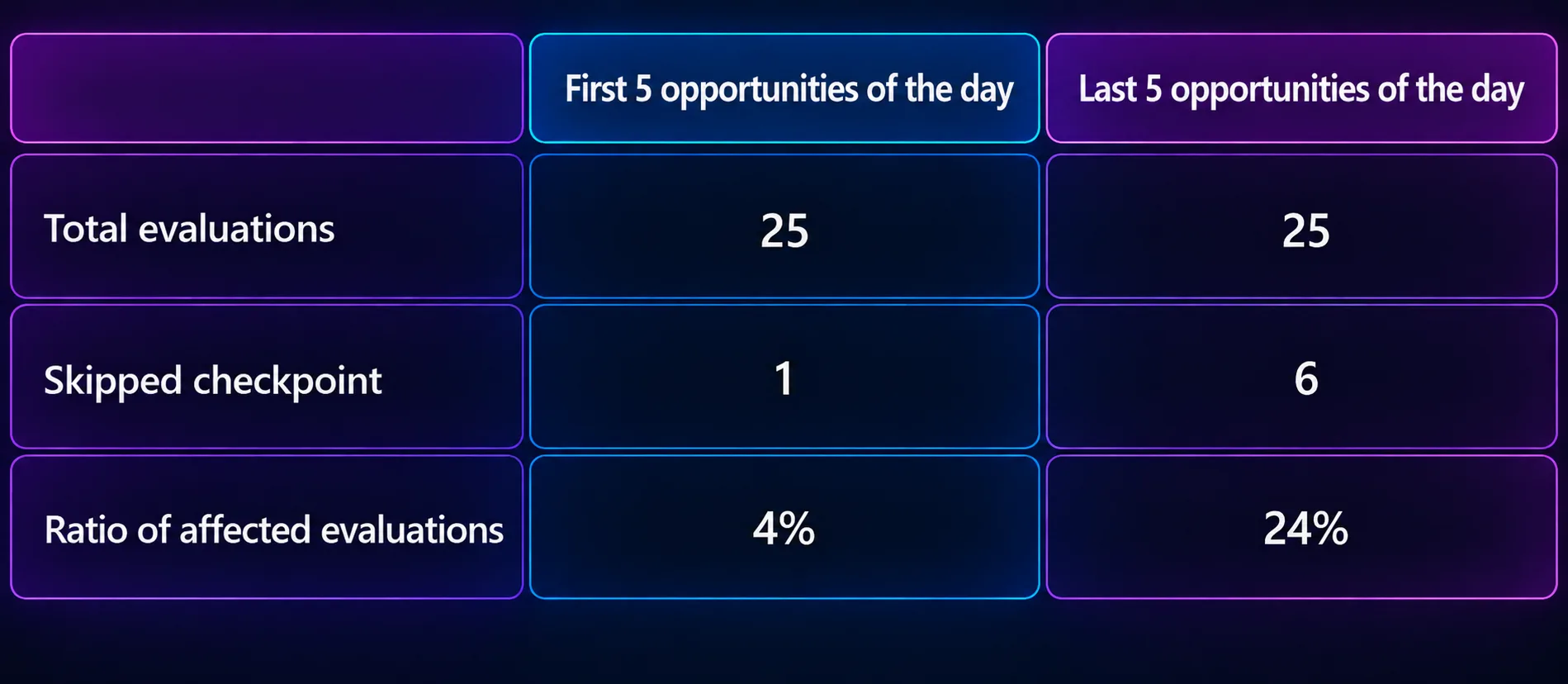
The data are illustrative examples.
In this case among the later evaluations it occurred much more frequently that some checking point was left out.
This is already a specific difference which it is worth examining further.
But did it happen because of the number of decisions?
The data in themselves do not yet prove this.
It can occur for example that in the second half of the trading period an important economic event appeared, the market became faster, or you had to evaluate more complex opportunities.
Therefore look at whether the dropouts presented themselves on multiple different days, and whether they returned among similar market circumstances too.
The more comparable situations you gather, the more exactly you can observe alongside what circumstances your checking process changes.
What should you do if you find a recurring change?
If at later decisions through multiple days the same problem appears, the next step is examining exactly what kind of nature the deviation is.
It is worth distinguishing two different situations.
Always the exact same checking point drops out
If you regularly ignore the same condition, examine how clear its role is in your own trading method.
It might be that it is worth making this condition more visible in your evaluation process.
At such times on the following days you can separately watch whether after the refinement it gets left out more rarely.
Multiple different checking points drop out at the later decisions
If the deviations appear mainly after many consecutive evaluations, it is worth examining this part of the trading period.
You can try out for example a short interruption before you start evaluating new opportunities.
After the interruption use the exact same checking points, and continue the observation journal.
This way later you can compare whether the consistency of the checks changed.
It is important that a short interruption in itself does not guarantee the restoration of attention.
The goal is examining alongside which modifications you can apply your own trading conditions more consistently.
With this from the deviations found in the journal specific, verifiable observations can be born.
Frequent questions (FAQ)
What if I only evaluate a few opportunities daily?
In this case under five days probably little comparable data gathers. Continue the observation through a longer period, and only search for a recurring pattern when you already recorded enough data.
Are five days enough to determine my own decision boundary?
The five days can be useful for a first observation, but in itself is little for the establishment of an exact, reliable boundary. It is worth checking your conclusions with the data of multiple different trading periods.
Why do we examine the checking process instead of the profit?
Because at a losing trade too it can occur that you appropriately checked every predetermined condition. The consistency of the decision process is therefore a more direct observation aspect at this examination than the financial result of the individual trades.
What happens if I don't find a significant difference?
Then you have no reason to develop a boundary tied to an artificial decision number. It is also a useful result if in the observed period no recurring change appears at the later evaluations either.
Summary
During a trading period the number of concluded positions only shows one part of the decisions.
The rejected and re-evaluated opportunities likewise require attention, therefore it is worth taking these into consideration too when you examine your own decision-making.
With the five-day observation you can already start off on this path. The order of decisions, the elapsed time, the checking points and the market circumstances together can help recognize the recurring deviations.
If you find a change, first examine among what circumstances it presents itself, and how consistently it returns. After this you can already check more targetedly what modifications can help your own decision process.
The most important lesson is that the quality of your next trading decision can also be influenced by how much attention the opportunities evaluated before it required.
And if you are looking for a Solo Clash prop firm account, it is worth choosing such an account type whose rules and conditions fit to your own trading method.
[I look at the Solo Clash account types →]
The article serves an educational purpose, and does not qualify as financial or investment advice.