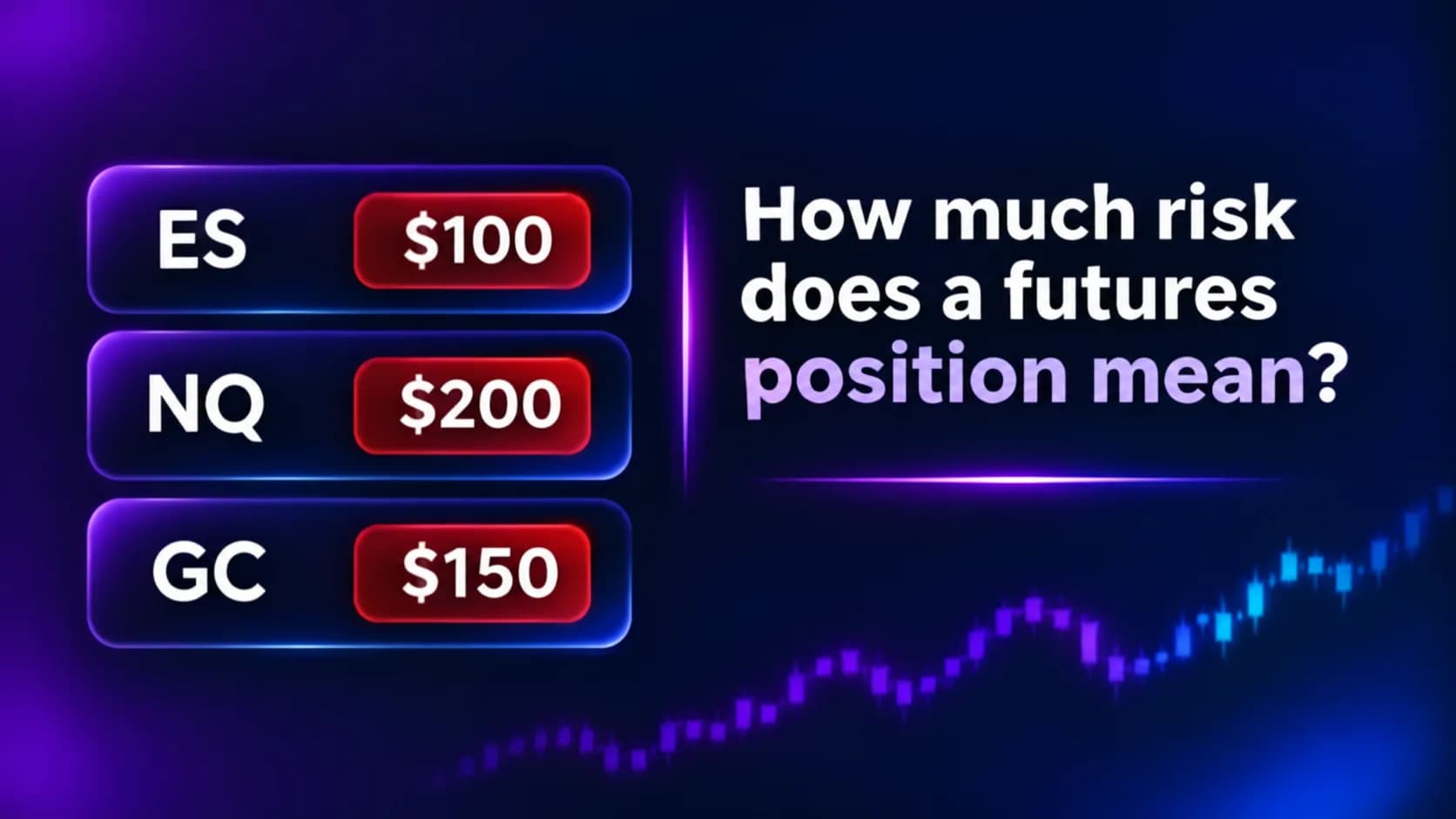
How much risk does a futures position mean? ES, NQ and GC examples on Solo Clash accounts
In this post
November 24, 2026.
The same ES, NQ or GC position can result in the same dollar loss on a 25K and a 150K prop account. Compared to the loss limit of the two accounts, however, the same trade can carry a completely different weight.
When sizing a position, therefore, alongside the stop and the number of contracts, it must also be taken into consideration how much loss room for maneuver is available on the given account.
Let's look with concrete calculations at how these factors connect in the case of ES, NQ and GC futures contracts, through the Solo Clash LIMITLESS EVAL accounts.
What does the planned risk of a futures position depend on?
Three pieces of data are needed for the calculation: the distance of the stop, the tick value of the given contract and the number of contracts.
The formula for planned loss:
Planned loss = Stop distance in ticks × Tick value × Number of contracts
Let's assume that on an ES contract the stop is located 8 ticks from the entry price. Since one ES tick is worth $12.50:
8 × $12.50 × 1 = $100
The planned loss of the position is therefore 100 dollars, provided the stop is executed at the specified price. The calculation does not include possible commissions and more unfavorable execution. In practice, it is worth determining the placement of the stop based on the given trading situation, then comparing the resulting dollar risk with the chosen position size.
And if we start from a predetermined risk budget, the formula can be reversed:
Number of contracts = Risk budget ÷ (Stop distance in ticks × Tick value)
The result must be rounded down to a whole contract. This shows how large a position can fit into the chosen risk budget under the specified conditions, but alongside this it is also worth checking the rules of the prop firm.
We have already presented the more detailed process of the calculation in our article about NQ and MNQ position sizing.
ES, NQ and GC: the same number of ticks, different value
In the futures market, the tick value differs by contract. Therefore, the risk of two positions cannot be compared merely based on the stop distance measured in ticks or the number of contracts.
According to the official contract specifications of the CME Group:
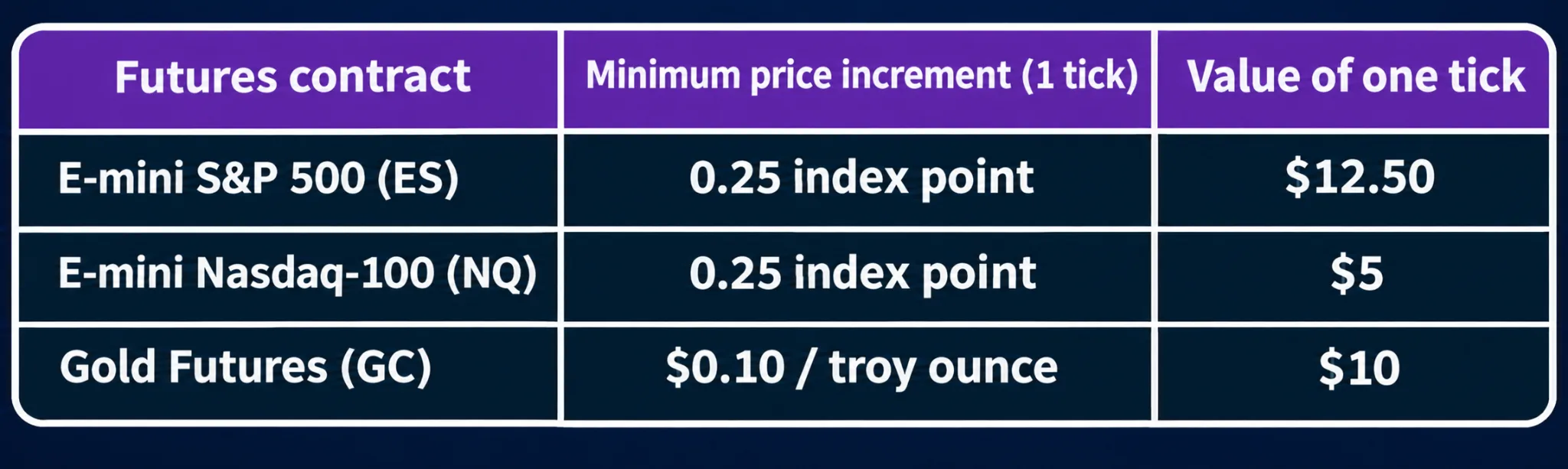
The ES and the NQ are equity index futures, therefore their prices are quoted in index points. The GC is the COMEX gold futures contract: the price of gold is given in dollars per troy ounce. One standard GC contract corresponds to 100 troy ounces of gold, thus a $0.10 price change per ounce means 10 dollars on one contract.
For all three instruments, the same calculation principle applies: we measure the stop distance in ticks and multiply it by the tick value of the given contract.
Let's look at three illustrative positions:
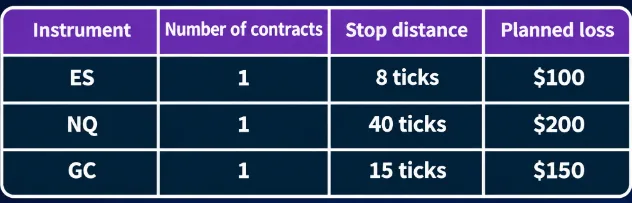
The stop distances were chosen exclusively to demonstrate the calculation. They are not recommended stop settings: the justified stop placement in individual trades is determined by the given market situation.
Now we already see the planned dollar loss of the three positions. The next step is examining what portion these amounts represent of the initial loss limit of the different Solo Clash accounts.
How does the same position relate to the different Solo Clash accounts?
The initial EOD trailing drawdown of the LIMITLESS EVAL program is 1,000 dollars on the 25K account, 2,000 dollars on the 50K, 3,000 dollars on the 100K, and 4,500 dollars on the 150K.
The table below shows what percentage of the account's initial drawdown amount the illustrative loss of the three previous positions corresponds to.
Important: these ratios do not compare to the total account value, and do not show the currently remaining loss room for maneuver.
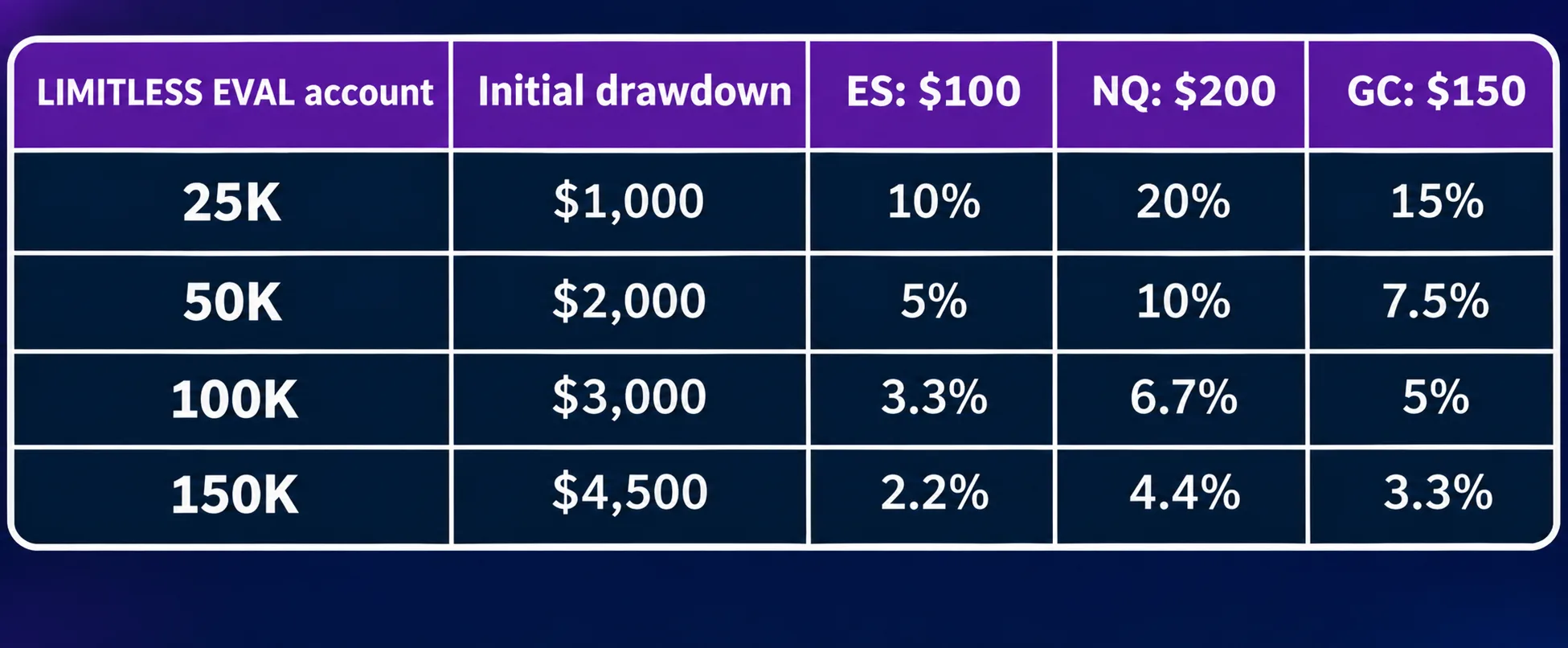
The values are exclusively illustrative comparisons, not recommended per-trade risk percentages.
What does this show in practice?
Let's take the 200-dollar NQ example.
This loss corresponds to 20% of the initial drawdown of the 25K LIMITLESS EVAL account. On a 100K account, this same amount represents approximately 6.7% of the initial 3,000-dollar drawdown.
The planned dollar risk of the trade is identical in both cases, but its ratio compared to the account's loss limit differs.
The table, at the same time, only shows the initial values. Due to the trailing drawdown, the loss threshold can change with the trading results, therefore the actually available room for maneuver can later differ from the initial drawdown amount.
This also means that based on the table it cannot be automatically determined how many consecutive losses fit into an account.
The calculated number of contracts must also fit into the program limit
The result obtained from the risk formula must in every case be compared with the contract limit of the given Solo Clash program.
The official rulebook of LIMITLESS EVAL defines the following maximum E-mini contract limits:
25K: 3
50K: 5
100K: 10
150K: 15
These are the upper limits applying to the LIMITLESS Evaluation phase, not recommended position sizes.
The program limit must be checked taking all open positions into consideration. Nor is it sufficient that every trade fits into its own risk budget individually: if multiple positions are open at the same time, it is also worth calculating their combined planned loss.
For example, the combined planned loss of the earlier 100-dollar ES and 200-dollar NQ position would be 300 dollars, if both stops were executed at the specified price. The actual loss can differ from this depending on execution.
Special attention must be paid to GC.
Gold futures are not E-mini equity index contracts, therefore the E-mini quantities above cannot be automatically interpreted as GC contract limits. The platform and program rules valid for GC must be checked separately.
The trading phase also matters: the fixed contract limits of LIMITLESS EVAL are not necessarily identical to the limits applied in the Express or Live phase.
Short checklist before opening a position
After performing the calculation, it is worth looking through five aspects:
Stop and tick value: what is the planned dollar loss per contract?
Position size: what is the planned risk of the entire trade with the selected number of contracts?
Aggregated risk: in the case of multiple open positions, what is the combined planned loss?
Account limits: how does the risk relate to the current drawdown room for maneuver, and does the full position comply with the contract limit?
Costs and execution: did we account for commissions and the fact that the stop can also be executed at a more unfavorable price?
Position sizing therefore begins with calculating the planned dollar risk, but for the decision the specificities of the given futures instrument and the current rules of the account must also be taken into consideration.
The comparison of the LIMITLESS EVAL accounts between 25K–150K clearly shows that the same futures position can burden the loss limits of the accounts in different proportions.
This can also be a useful aspect when choosing an account, especially if it has already taken shape which instruments and characteristic position sizes you trade with.
Choose the Solo Clash account that is right for you!
The article serves educational and informational purposes, it does not qualify as financial or investment advice. The presented stop distances, positions and risk ratios are illustrative examples, not trading recommendations. The Solo Clash Evaluation and Express programs operate in a simulated futures trading environment. Achieving a trading result and a payout is not guaranteed.