What is a futures contract? The operation of futures trading simply explained
In this post
November 11, 2026.
When a trader opens a position on the price of gold, the S&P 500, or the Nasdaq, do they truly buy gold or stocks?
In futures trading, upon opening a position, you do not directly purchase the underlying product.
You conclude a transaction with a futures contract, the value of which is connected to the given product or financial indicator.
With these contracts, a position can be opened alongside rising and falling prices too. To understand their operation, however, first it is worth clarifying exactly what a futures contract covers, who participates in the transaction, and how the result of the trading is generated.
What is a futures contract?
A futures contract is a standardized, exchange-traded futures contract, which refers to the future purchase or sale of a determined product or financial instrument.
The important characteristics of the contract are fixed in advance. Such is, for example, the underlying product, the size of the contract, its expiration, and the method of settlement.
Let's take gold as an example.
A standard Gold futures contract (GC) refers to 100 troy ounces of gold. By purchasing the contract, the trader does not yet receive gold bars in hand: they open an exchange-traded futures position.
Futures contracts are available in multiple kinds of markets:
Stock indexes: for example, futures contracts connected to the S&P 500 and the Nasdaq-100 index.
Precious metals: for example, gold and silver.
Energy carriers: for example, crude oil and natural gas.
Currencies and other financial products: for example, certain currency and interest rate futures contracts.
How fulfillment happens at the expiration of the contract is determined by the conditions of the given contract. We will return to this later.
Who is the buyer and who is the seller?
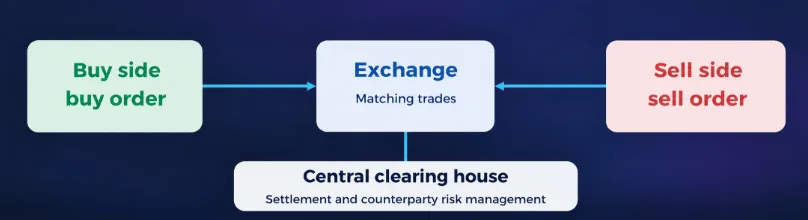
Every created futures transaction has a buying and a selling side.
Who opens a position with a purchase takes up a long position.
Who opens with a sale, a short position.
The buying and selling orders are paired by the exchange system. In the settlement of the created transactions, the central clearing house participates, which operates as a central counterparty between the clearing participants. With this, it contributes to the reduction of counterparty risk.
How can one trade in a rising and falling market too?
One of the important characteristics of futures is that the trader can take up a position for both directions of the expected price movement.
The two basic possibilities are the long and the short.
Long position: when you count on a rise
In the following examples, we calculate with a single ES contract, at illustrative prices.
You open a long position if you step into the market with a buy order.
If you later close the position at a higher price, a profit is generated for you.
If the price decreases, you can have a loss.
Let's assume that you purchase an E-mini S&P 500 (ES) futures contract at 7,000 index points.
If you close the position at 7,005 points, the price rose 5 points.
Since at an ES contract one index point is worth 50 dollars, the result of the trading is:
5 × 50 dollars = 250 dollars profit, before trading costs.
If this same contract falls to 6,995 points, and you close the position there, the result is a 250 dollar loss.
Short position: when you count on a fall
You open a short position with a sale, then to close it you buy back the same contract.
For example, if you open a short position at 7,000 points, then close it at 6,995 points, the 5-point decrease at an ES contract means 250 dollars profit before fees.
If, on the other hand, the price rises to 7,005 points, a 250 dollar loss is generated for you on the short position.
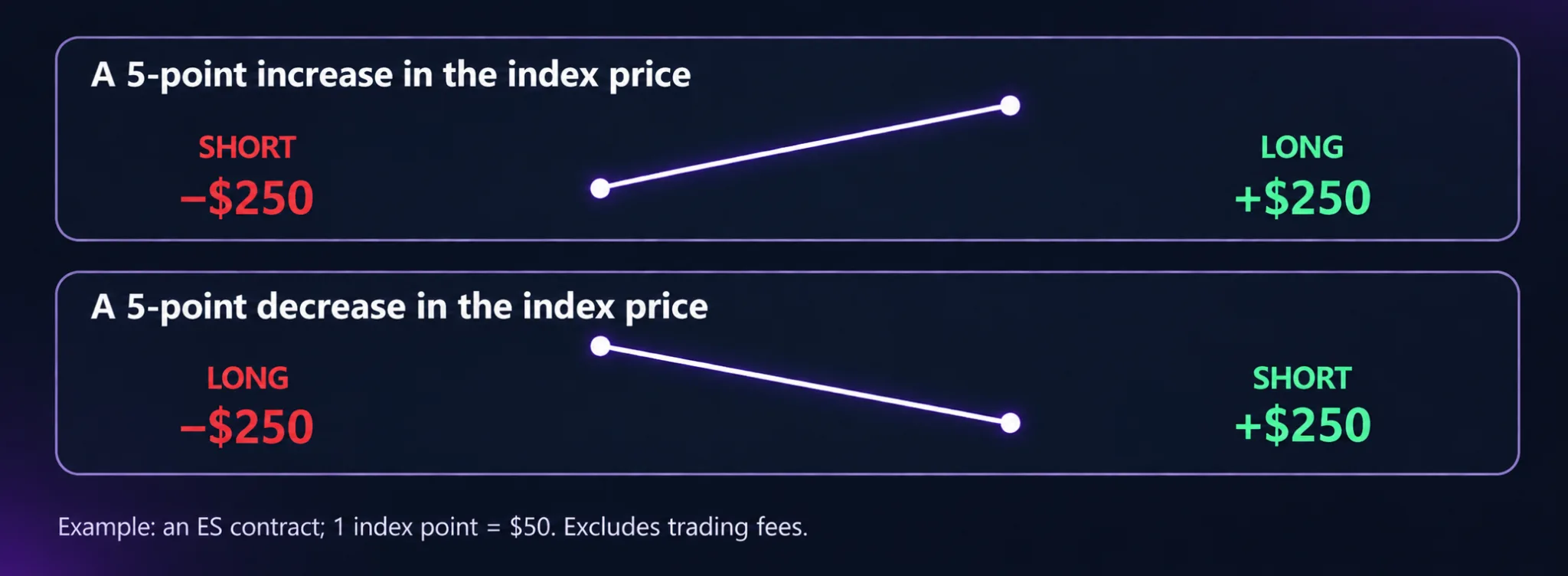
From the examples, it is visible that the direction of the position fundamentally determines which price movement results in a profit or loss. The magnitude of the result, at the same time, also depends on the size of the contract.
Why does it matter what futures contract you trade with?
Not every futures contract means the same financial exposure.
The multiplier belonging to the contract determines what dollar value a determined price movement corresponds to.
Let's look at three frequently traded products:
Futures contract | Symbol | Value of unit price movement |
|---|---|---|
E-mini S&P 500 | ES | 1 index point = $50 |
E-mini Nasdaq-100 | NQ | 1 index point = $20 |
Gold futures | GC | 1 dollar/ounce = $100 |
The ES and the NQ connect to stock indexes, while the GC is a contract referring to 100 troy ounces of gold.
Therefore, the same numerical price movement can cause a different financial result at the three products.
What does a tick mean?
In futures trading, you can frequently encounter the term tick. This is the smallest allowed price increment of the given contract.
For example:
Contract | Smallest price increment (1 tick) | Monetary value of one tick |
|---|---|---|
ES | 0.25 index point | $12.50 |
NQ | 0.25 index point | $5 |
GC (gold) | 0.10 dollar per troy ounce | $10 |
The price of gold futures is quoted in dollars, per troy ounce. Since a standard GC contract refers to 100 troy ounces, a 0.10 dollar price change means a 10 dollar result change at one contract.
At an ES contract, therefore, four ticks mean a full index point, which corresponds to a total of 50 dollars movement.
The knowledge of the contract size and the tick value is important because from these the possible financial effect of a given price movement can be calculated.
In the futures market, alongside this, margin, that is the collateral necessary for maintaining the position, can also be needed. The amount of the margin is not identical to the maximum sufferable loss: because of leverage, the market exposure can be significantly larger than the provided collateral.
You can read more about margin and the capital requirement of futures trading in "Own account or prop account? How much money is actually needed for futures trading?".
What is the role of the CME in the futures market?
A significant part of futures contracts is traded on organized, regulated exchanges.
One of the most well-known participants is the CME Group, which brings together multiple exchanges, among them the Chicago Mercantile Exchange (CME), the Chicago Board of Trade (CBOT), the New York Mercantile Exchange (NYMEX), and COMEX.
The individual exchanges offer different futures products. On the CME, among others, important stock index contracts, and on COMEX, for example, gold futures contracts are available.
The participants of the system have different tasks:
The exchange determines the trading conditions of the contracts, and provides the infrastructure of organized trading.
The broker can provide access to the appropriate market, manages the client account, and brokers the orders.
On the trading platform you can follow the prices, analyze the market, and enter orders.
The clearing house participates in the settlement of the concluded transactions and in the management of counterparty risk.
This structure helps the transparent and regulated operation of futures markets.
The contractual conditions determined by the exchanges also include the expiration.
But what happens when a futures contract approaches this date?
What happens at the expiration of the contract?
In contrast to stocks, futures contracts have a determined expiration.
This marks the end of the contractual life of the contract, but the trader does not have to keep their position until then.
Exactly because of this, it is important to pay attention to which expiration contract we work with, and what possibilities stand at our disposal with the approach of the expiration.
With the approach of the expiration, multiple possibilities can arise.
1. Closing the position
Before the expiration, the trader concludes a transaction in the opposite direction to their original position for the same contract. This way they can terminate their open position.
2. Rollover to a later expiration (rollover)
If they would like to continue to maintain their market exposure, they can close the position of the earlier expiration, and can open a new position in a contract of a later expiration.
3. Settlement at expiration
If a position remains open until expiration alongside the appropriate conditions, settlement according to the prescriptions of the contract follows.
Cash settlement or physical delivery?
The mode of fulfillment at expiration can differ per contract.
The ES futures connected to the S&P 500 index is cash-settled. At such times, settlement happens based on the financial value of the contract.
The standard Gold futures (GC), in contrast, is a physical delivery contract, whose rules also make the delivery of gold possible alongside determined conditions.
Short-term traders typically already close their positions before expiration. The exact deadlines and fulfillment rules, however, must always be checked based on the prescriptions of the given contract.
How does all this connect to Solo Clash trading?
The evaluation programs of Solo Clash provide an opportunity for traders to assess their performance in a simulated futures environment.
During the evaluation, the trader must keep the rules belonging to the chosen account.
The basic concepts of the futures market are important here too: one must know what contract you open, how much a tick is worth, and how the result of your position changes with the movement of the price.
Separate program rules also apply to the accounts of Solo Clash, which you can get to know in detail in the Help Center of Solo Clash.
Why must positions be closed daily?
In futures markets, with certain contracts, one can also trade outside the usual daytime trading hours.
In the programs of Solo Clash, however, open positions must be closed every trading day by 16:50 (US Eastern Time, ET) at the latest.
This precedes the daily market close determined in the documentation by ten minutes. The violation of the rule can result in the closing of the account.
The mandatory daily close is a program rule of Solo Clash, therefore it is important to distinguish it from the general trading possibilities of the exchange.
Before you would start trading with any futures contract, it is worth getting to know its specification, its tick value, the trading periods, and the restrictions referring to the chosen account.
Frequent questions (FAQ)
Do I truly have to buy the gold if I trade with a Gold futures contract?
Upon the purchase of a contract, you open a futures position. This in itself does not mean immediate physical receipt of gold.
Can a short position be opened even if I didn't buy a contract earlier?
Yes. In futures trading, you can also open a position with a sell order. This is the short position, which you can later close with a purchase referring to the identical contract.
What is the difference between a tick and a point?
The tick is the smallest allowed price increment of the contract. The point can be a larger price unit. In the case of ES, for example, four ticks of 0.25 points each make up a full index point.
Why are there multiple expirations from the same futures product?
Because futures contracts are for determined periods. Traders can therefore also encounter contracts of the same product with different expirations.
How much capital is necessary for futures trading?
This depends on the chosen product, the broker, the margin requirements, and the taken risk. The minimal margin in itself does not show how large a loss can hit the account.
Are you stuck in anything, or do you have a technical question?
Join the Solo Clash Discord community, where you can ask for help from our customer service colleagues if you are stuck in anything, furthermore, you can be the first to be informed about the newest developments, changes, and possibilities here.
Join Discord →
The article serves informational and educational purposes, it does not qualify as financial or investment advice. Futures trading can involve significant financial risk. The Solo Clash evaluation takes place in a simulated environment, and the successful completion of the program is not guaranteed. Account prices and program rules can change.