5 hidden mistakes that can ruin your trades
In this post

September 17, 2026.
You close a trading day. You had a few profitable positions, a few losses, and in the evening you look back at the charts.
At one losing entry it immediately stands out what you could have done differently.
At a winning trade, however, everything seems to be in order, therefore you quickly move past it.
A few days later you analyze new trades.
The biggest losses again receive more attention, and the profitable positions come under observation less. Meanwhile, based on the last few trades, it might already arise that it is worth changing something in the trading process.
Yet a part of the most important mistakes can remain unnoticed exactly in such ordinary situations. Behind a profitable trade there can also be a weak decision, and behind a losing position exact execution.
It also matters which trades you analyze, what you remember from them, and which results receive the most attention.
That is exactly why, in this article we show 5 such trading mistakes which it is sometimes easy to not even notice.
Short summary
Why can a profitable trade teach a bad lesson?
How can your memory about why you entered a position change in hindsight?
What mistake can it cause if you always only analyze your most conspicuous trades?
What can be missing from a seemingly detailed trading journal?
Why can your last few trades receive too much significance?
The first mistake immediately shows why it is worth looking deeper than the result.
1. You deduce the quality of the decision from the result
It can happen that at an entry not every condition that you previously determined is met, the position yet closes with a nice profit.
At such times not only the profit remains as an experience. The deviation from the rule can also become more easily acceptable, and in a next similar situation that condition which you previously considered important can already receive lesser significance.
This way a profitable trade is also capable of reinforcing a weak decision.
Except that the final result in itself says little about based on what information the original decision was born.
In decision research this phenomenon is called outcome bias. In the classic studies of Baron and Hershey, participants evaluated the exact same decision process to be of better quality alongside a favorable outcome than alongside an unfavorable result.
The result was therefore capable of changing the subsequent judgment of the decision.
In trading this can have particularly great significance, because uncertainty is part of every trade.
A regularly executed position can close with a loss too. And a weak decision can bring profit.
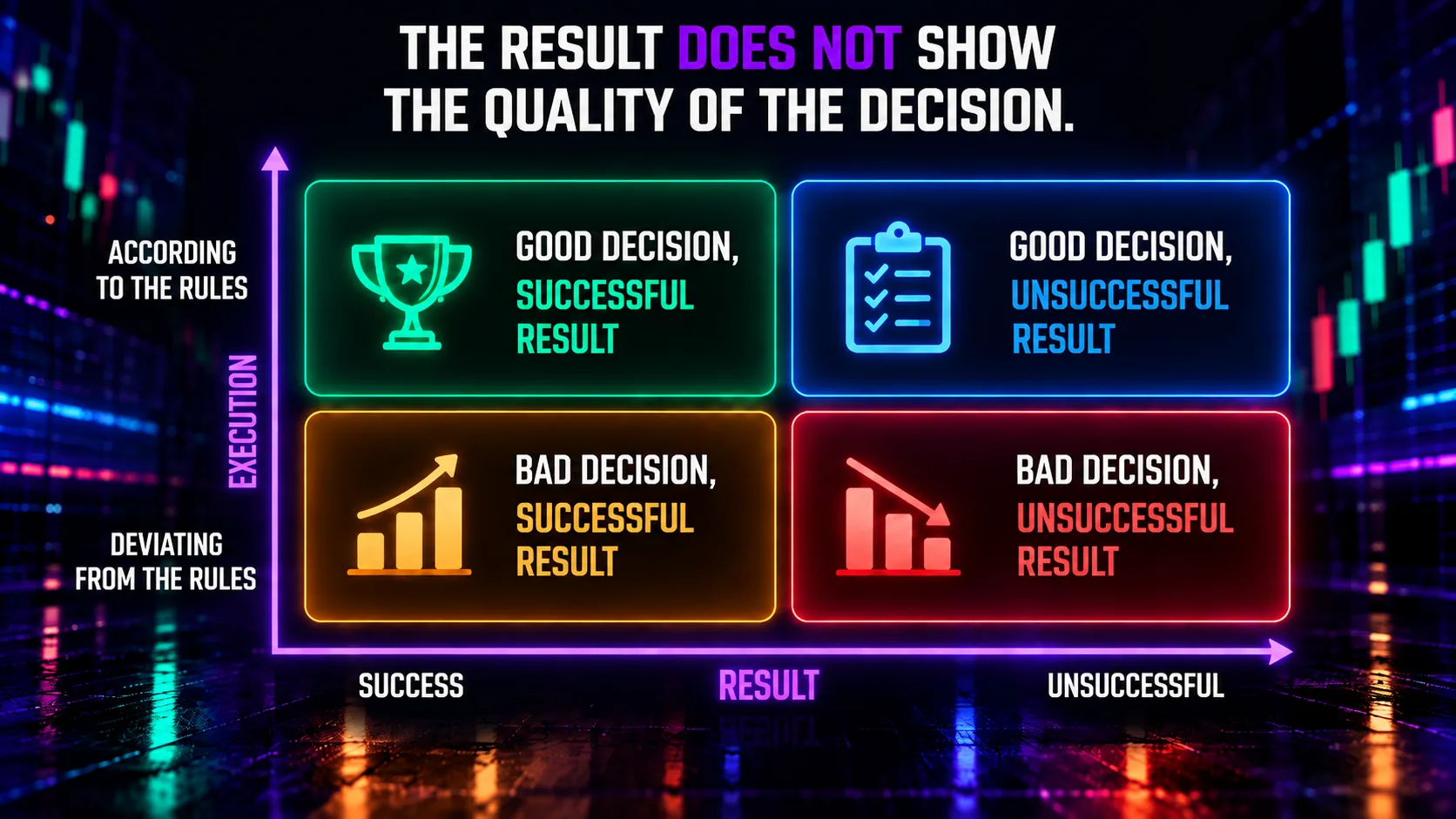
If the profitable, irregular trade receives positive reinforcement, the exact same behavior can easily get into your next decisions. And in the case of the losing, regularly executed position, you can unjustifiably start doubting a decision which was correct based on your own system.
Therefore when evaluating a trade, two separate data have significance:
What was the result?
How much did the decision meet the predetermined rules?
If you record the two information separately, over time you can see more clearly what decisions you reinforce in yourself.
If you do not have an exactly written down rule system yet, it can already help a lot if you predetermine what conditions must be met for a valid entry, where you place the stop, and in what situation you skip the trade. Without this it is harder later to objectively decide whether you truly traded according to your own plan.
The result, however, is capable of influencing the evaluation in another way too: it can change how you remember the original situation.
2. In hindsight the situation seems clearer than it actually was
After the closing of the trade something fundamental changes: you already know what happened.
When looking back at a losing position, the resistance from which the price later turned down, the breakout which eventually did not continue, or that point from where the movement completely changed can already become visible.
These, however, are not visible in the same informational situation as when the entry decision was born.
You reopen the chart, you see the entire movement, you know the peak and the trough, and you know exactly which direction proved to be correct.
From this perspective many decisions can seem simpler.
In psychology this is called hindsight bias. The early research of Baruch Fischhoff showed that knowing the outcome of an event is capable of influencing its subsequent judgment. In a related study, the participants' recollection of previously estimated probabilities also shifted according to what eventually happened.
In trading this can be important for example when you look back at the chart after a position.
At the moment of closing, a resistance, a weak breakout or a turning point can already seem easily visible. At the moment of entry, however, the subsequently formed price movement was not yet available to you.
Therefore it is dangerous to reconstruct exclusively from memory why you made a decision.
A simple example
Before your entry you watched three conditions. Two were met, the third was uncertain.
The position was eventually successful.
Looking back in the evening, the already formed price movement can easily make that third sign clearer too, which at the moment of decision was still uncertain.
If the same thing closes with a loss, the same uncertain sign can seem like a much bigger mistake in hindsight.
The useful data is therefore what you recorded around the decision. A short screenshot, the reason for the entry and the important information available then can help later to evaluate the situation from the exact same perspective.
This does not mean that it would not be worth analyzing the trades together later. The difference is in that during the later lookback you should not try to reconstruct the original decision from memory.
You record what happened around the decision. Later you search for patterns from these data.
With this, however, we arrive at a less conspicuous problem: which trades do you select for analysis at all?
3. You only try to learn from your most conspicuous trades
You will probably look back at a large loss.
An outstandingly good profit likewise.
An average, regularly executed Tuesday trade disappears among the rest much more easily.
This can cause a problem if your picture formed about your trading performance is built mainly on extreme or memorable cases.
Let's assume that you opened 40 positions in a month. At the end of the month you look back at your five largest losses in detail.
You can learn a lot from this about those five positions. About patterns repeating in the entire 40 trades, however, much less already.
It might be that the spectacular mistakes only appeared twice, while a smaller deviation occurred 14 times.
Frequency and spectacularity are two separate things.
Therefore at a consistent review it is worth determining in advance which trades you will analyze. For example all positions of a given period or a predetermined number of consecutive trades.
This way the result decides with a smaller chance what gets into the analysis.
This at the same time also shows why a trading journal can be little which exclusively contains entry price, exit price and profit.
4. You record what happened, but you lose what led to the decision
A trading journal can be technically detailed, yet one of the most important layers necessary for later analysis can be missing from it.
Entry price: check.
Stop: check.
Target price: check.
Result: check.
A few weeks later from these the position behind the decision can still be exactly established. It is much harder, however, to figure out based on what information the decision was born in the given moment.
For example, behind two positions closing with completely identical results there can stand a different process. At one every predetermined condition was met. At the other an important condition was missing, the entry still happened.
If you do not record this difference, in a few weeks the two trades will easily look exactly the same in your journal.
Therefore alongside the technical data it is worth briefly preserving the context of the decision too. For example:
which predetermined conditions were met;
in what market environment the entry happened;
whether a deviation from the plan occurred;
if yes, exactly where.
The essence of this is not the longest possible journal.
The goal is that weeks later too you can compare the original decision with what you eventually executed.
This way the journal becomes comparable decision data from a simple trading archive.
You do not necessarily have to keep this in separate spreadsheets and notes isolated from each other. Solo Clash HQ organizes the important data of the closed trades in one place. Alongside the performance data you can also record your own notes among others about the setup, the pre-entry check and the circumstances of the decision.
This way during the later review you do not exclusively have to rely on what you remember from a given trade, but you can also return to the recorded data related to the trade.
And if you already have several such comparable data, the fifth trap appears: it is easy to give too much weight to the freshest events.
5. Your last few trades have too much effect on what you change
Three losing positions in a row is a much fresher experience than the previous thirty trades.
After a few consecutive stops the modification of the system can easily start: another entry condition gets in, the place of the stop changes, the traded period narrows, or a previously used setup gets pushed to the background.
All this can happen in such a way that based on the trades of the previous weeks this same problem is not yet visible.
And this can have an effect on how you trade the next positions.
The essence of recency bias is that fresher information can receive disproportionately large weight in the evaluation. In financial research too they observed such investor behavior in which the events of the recent past strongly influenced later decisions and expectations.
As a trader one of the dangers of this is that the direction of development can continuously change.
One week you modify the entries. Next week the exits. Afterwards the placement of the stop comes to the forefront. Meanwhile about none of the changes does enough comparable experience gather for you to see its effect more clearly.
Therefore it can be useful to think in predetermined evaluation periods or patterns. If for example you examine a given number of consecutive trades together, the last two positions overwrite the previous experiences in themselves with a smaller chance.
It is important, however, that here too you examine those informations which you recorded around the decisions.
Thereby the analysis covering multiple trades does not rely on subsequent memories, but on comparable data.
And the five mistakes together point to a common problem: the value of the trading journal also depends on how you use the information in it.
Build such an analysis from which you can truly learn
To manage the five mistakes it is not necessarily necessary that you write a long analysis after every trade.
It is much more important that you record the same informations consistently, because only this way can you search for comparable patterns later.
A simple analysis system can for example look like this:
Record the reason for the decision around the trade.
This has significance because later you already know the result. By recording the original reason you preserve that information which actually stood at your disposal at the decision.
Mark the result and the rule following separately.
This way a profitable trade doesn't automatically receive a positive evaluation either, and a losing one doesn't automatically become a bad decision either. This helps to separate the quality of the process from the short-term result. The research on outcome bias exactly shows how easily these two evaluations can slide together.
Examine a predetermined pattern.
This can be for example all trades of a given period or a predetermined number of consecutive trades. At the analysis use those informations which you recorded around the decisions, this way you do not have to recreate the original situation from memory later.Search for recurring deviations.
A single mistake gives little information. If the same deviation appears multiple times, you already have a specific area which is worth examining further.Follow one recurring pattern at a time.
This way you can see later how its frequency changed. If you continuously modify multiple things, it is increasingly difficult to establish which change went with what effect.
The goal is therefore not that you immediately draw a conclusion from every single trade.
The goal is that you gather enough comparable decisions so that recurring patterns become more important than individual results.
With this over time those mistakes can also become much more easily noticeable, which looking back at a single trade are barely visible.
If your problem is rather connected to a specific emotional reaction, we already have detailed guides about that too.
For example we separately dealt with FOMO, revenge trading and overtrading too.
Frequent questions (FAQ)
Is it a problem if I only analyze my trades later?
Not necessarily. Recording the decision and analyzing the decisions can be two separate steps.
It is worth recording the important information around the trade, when you do not yet know the full outcome. Later, however, you can analyze multiple such trades together to search for recurring patterns.
The problem rather appears if you try to reconstruct from memory in hindsight, in the knowledge of the result, based on what information the original decision was born.
What is worth recording in a trading journal?
Alongside the technical data: entry, exit, stop, result it can be useful to record the conditions of the entry, the market environment and the possible deviation from the plan.
These make it possible that later you can compare not only the result of the trade, but the decision process too.
How often is it worth looking back at the trades?
There is no optimal frequency valid for every trader and strategy for this.
Consistency is more important. It is worth deciding in advance per what periods or per how many trades you perform a more comprehensive analysis, so that not exclusively the freshest or most conspicuous results decide what you examine.
Why is it dangerous to only analyze the losing trades?
Because behind a profitable position there can stand an irregular decision too, while the execution of a losing position could have been completely regular.
If you only examine the losses, a part of the recurring mistakes can remain hidden.
Summary
A part of the trading mistakes is easily recognizable. Other mistakes only become visible when you put multiple decisions next to each other.
Because of the outcome bias you can confuse the good result with the good decision. The hindsight bias can rewrite how you remember the original situation. The excessive analysis of extreme trades can hide the more frequently repeating patterns, and an incomplete journal can preserve little information about how the decision was born.
Finally the too large weight of the freshest results can lead to changes behind which there is not yet enough comparable experience.
Therefore for more consistent trading it is worth gathering comparable data about your decisions, then searching for recurring patterns in these.
And if you would like to apply this in a prop trading environment, alongside your own trading process you must exactly know the rules of that account too in which you trade.
Your own rules and the frameworks of the account namely determine together what decisions you can execute consistently.
The account types can give different frameworks, therefore before purchasing it is worth looking through these together with your own trading approach.