48K euro payout, while trading is just a side hustle? It is possible.
In this post
August 28, 2026.
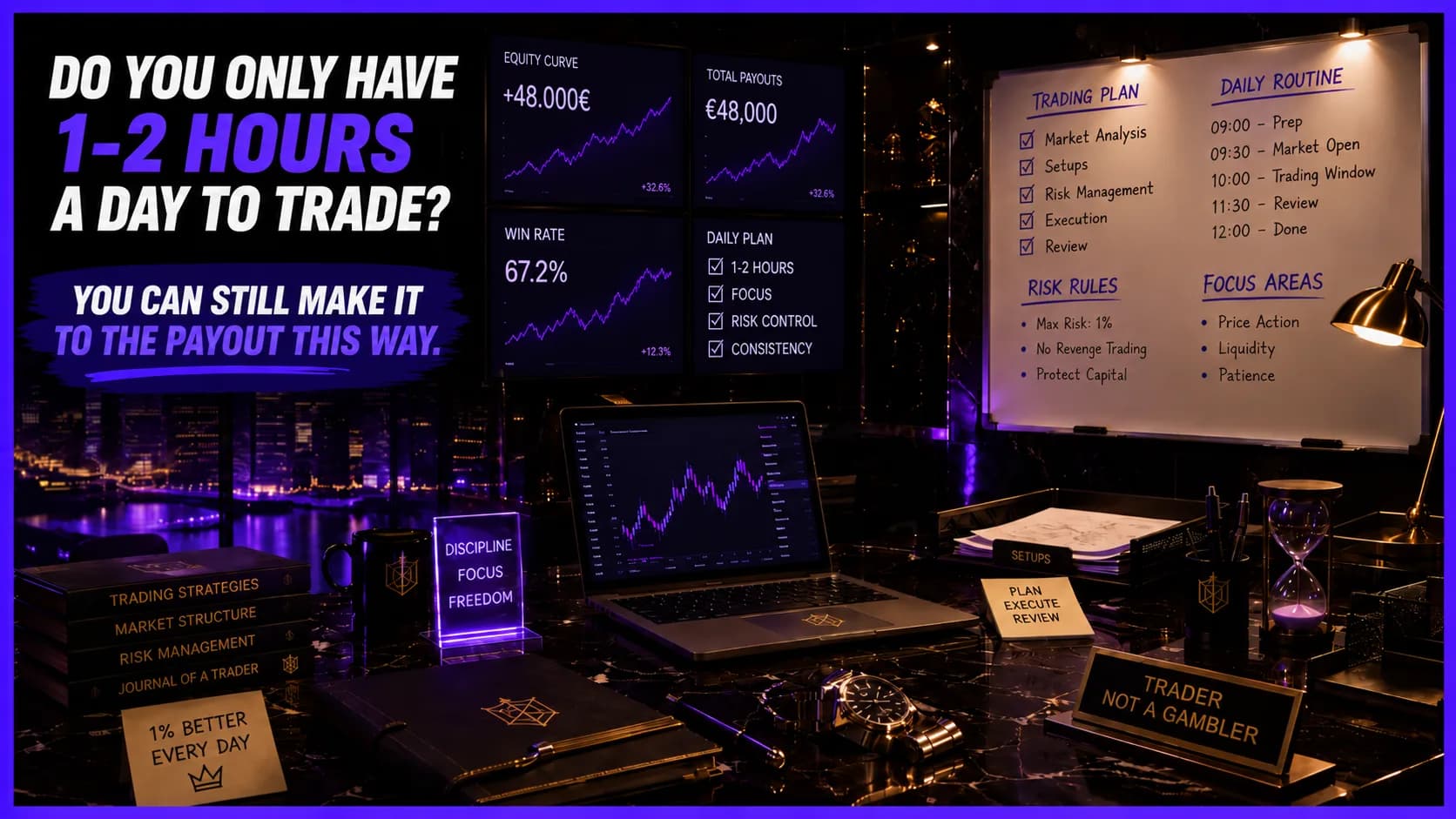
You work all day, run a business, study, or your day is simply full, and only a few hours remain for trading.
When you finally have time, the question may arise: what should you do with it?
Should you watch the market, look for opportunities, analyze previous positions, or prepare for the next day?
Meanwhile, you see that others watch the charts for hours, follow multiple markets, and constantly look for new opportunities.
The lack of time can easily affect your decisions as well, especially when you feel that you absolutely must utilize the few hours at your disposal.
But what happens when you try to fit trading into an already crowded day?
Short summary
How can trading fit into a day that is already filled with work, business, studies, or other tasks?
How can it change your trading if you know in advance when and how long you will deal with it?
What mistakes can you easily slip into when you have little time for trading?
What can we learn from Keith's story, who built his own trading routine alongside running a business?
Keith didn't have empty days either
Keith Camilleri is a Maltese trader who has been trading for years.
However, alongside trading, an entire business is also present in his life. He works full-time, runs his own company, and works together with about 50 employees. According to him, because of this, he often has to specifically find the time he can dedicate to trading.
This is what makes his story interesting, because many traders start from exactly a similar situation.
Some work from morning to afternoon. Others build a business. Someone is trying to make time for trading alongside university. Furthermore, there are also those who have to find room for trading alongside family, work, and everyday tasks.
The common point is time.
Or rather, the lack of it.
For Keith, it was also a continuous challenge to find room for trading in his already crowded days. He traded at different times, sometimes he could make time early in the morning or later.
However, this also raises an important problem.
If someone has little time, they can easily start treating that short period as if every minute must be utilized.
This is exactly where decisions can begin to change.
When you finally have time..
Imagine that after a long workday, you finally sit down to trade..
You didn't have the opportunity to follow the market beforehand, so you quickly try to assess what happened. You look at the charts, look to see if there is an opportunity, and meanwhile, a thought might be lingering in you:
If I've already dedicated this much time to it, it would be good if something actually happened.
This feeling can be especially dangerous.
Because trading does not always adjust to your schedule.
It can happen that when you are available, there simply isn't a situation that meets what you are looking for. At other times, an opportunity might appear exactly when you are not trading.
This is hard to accept in the long run.
Especially when you feel that you have few opportunities to sit in front of the market to begin with. In such cases, a mindset can easily develop where you are no longer primarily examining whether the given situation is truly appropriate.
You are increasingly looking to see if you can find something that you can finally trade with.
And this is a completely different starting point.
In Keith's story, a recurring theme was how important patience is for him during trading. Speaking about his strategy, he did not emphasize that one must constantly be in a position either. His own method also requires waiting until the situation he is looking for develops.
This is a particularly interesting question for a trader with little free time. Because it is possible that your available time and the rhythm of the market do not always meet.
The question in such cases is what you do with this situation.
Do you try to find an entry at all costs?
Or do you have a framework that can help you stay on track even when you end up not opening a single position that day?
Based on Keith's experiences, predetermined boundaries became increasingly important to him over time.
However, this realization did not develop overnight.
Did it require years of losses?
Keith himself talked about how the first years of trading did not turn out the way he wanted them to at all.
In the first years, he lost more than he won, and there was a time when he almost gave up. He lost several accounts, suffered losses of about $20,000 from his own money as well, while constantly trying to learn from his mistakes.
This is exactly one of the important parts of his story.
When someone today only sees his results, it is easy to think that he found a ready-made system, and from then on everything went on a straight path.
However, based on Keith's own account, the journey was much more wavy.
There were times when he achieved profit.
There were times when he lost accounts.
Furthermore, there was also a period when he made a mistake even after an already achieved result.
During his experiences, he returned to the same thought more and more often:
boundaries must be predetermined.
Keith set daily goals for himself, and with losses, he also tried to designate the point in advance after which he would finish trading.
This already goes beyond the question of exactly how many hours you have to trade.
Because if you have a single hour, that can also have a beginning and an end.
If you have three hours, you might still need something that helps determine how long you stay active.
For Keith, daily goals and limits became part of this system over time.
However, the interesting question is:
how can you predetermine the framework of a trading day in such a way that meanwhile the market is unpredictable, and you cannot know exactly what the next few hours will bring?
Let the goal be predetermined
One of Keith's most important realizations is that he needed specific daily goals that he could stick to.
There was a specific result he set as a target on a given day, and when he reached it, he didn't try to look for more opportunities at all costs. There was a time, for example, when he set a maximum daily profit of 200 euros for himself, which he tried to consistently keep on consecutive days as well.
The significance of this attitude, as well as the routines and habits developed, is well demonstrated by his results, since Keith achieved a payout of 48,000 euros in a little more than a month.
Naturally, this in itself does not make a trader successful. A daily goal can rather serve to have a predetermined point that you can return to even when the market or your own emotions would begin to override your original idea.
Alongside the daily goal, the daily limit can be at least as important
The profit side is only one part of the framework.
Keith also developed a clear boundary for himself with losses. For his prop firm accounts, he mentioned a daily loss limit of $1,000, after the reaching of which he finishes trading.
The two together can provide a much clearer framework:
you have a predetermined goal;
you have a predetermined loss limit;
and you have a point where you finish the day.
The specific numbers can naturally vary for every trader. The point is rather that these boundaries exist before the decisions.
Not every day has to be the same
A pre-developed framework can easily be misunderstood as if every trading day must look exactly the same.
The market, however, changes.
Regarding his own strategy, Keith said that he watched trendlines and pullbacks from the 21 exponential moving average, and he needed patience for this. He applied his method on both the MNQ and ES markets.
Based on this, the task of the daily plan would not necessarily be to tell in advance for every day how many trades must be executed.
It could rather determine under what conditions you are willing to enter at all.
This can be particularly important when you have few occasions available for trading.
If you know in advance what situation you are looking for, then a day where you stay out can also be a full-fledged trading day.
It might be that on that day the situation you were waiting for simply did not develop.
This is a completely different outcome than when you open a position because "it's time for trading anyway".
Patience is part of the system
One of the biggest practical advantages of a usable framework might exactly be that it designates your boundaries in advance.
You can know during what period you look for opportunities, what situation you wait for, what risk is acceptable, and after what point you have no more business to do.
This way, the time at your disposal does not necessarily become more valuable because something happens in every minute of it. It can happen that it exactly gives greater control if there are periods when you consciously do nothing.
And based on Keith's journey, there is another important lesson: your system should remain workable even when you make a mistake.
The goal is that a single bad decision cannot drag an entire day down with it.
From here it becomes truly important what you take with you from Keith's story, and what is worth tailoring to yourself.
Developing the routine
If trading comes alongside work, business, studies, or private life, then it must adjust to your day.
Many traders choose a specific period for precisely this reason during which they pay attention to the market. Among futures traders, it is a common question who chooses which period, how they balance this with their work, and whether it is worth focusing on a single market period.
Based on Keith's story, there is no single answer valid for everyone to this. He himself traded at different times, and talked about having to find the right occasions for this alongside his busy days.
That is precisely why it might be worth starting from your own schedule.
When can you actually be present in the market? In the morning, before work? In the afternoon? In the evening?
Is there a period when you are regularly available, and meanwhile you do not have to pay attention to other tasks?
Some choose a single period or a band of a few hours, others adjust their trading to a longer-term approach.
However, it is worth for everyone to develop their own.
What is worth arranging in advance?
With little free time, it can matter especially much that when your time meant for trading comes, you do not have to build everything from the basics.
A simple daily routine could include, for example:
reviewing the more important market events;
selecting the markets you would watch that day;
briefly noting down the situations you are looking for;
reviewing previous trades.
This way, a larger part of your available time can indeed be dedicated to observing the market.
If you have little time, organizing information matters too
Information related to trading often appears in multiple places: charts, results, previous trades, analyses, logged data.
Solo Clash HQ is useful precisely for this reason, because it connects the tools and data related to trading in one place.
For a busy trader, the practical value of this can be that they have to spend less time gathering information, and more attention can remain on the trading process itself.
Frequently Asked Questions (FAQ)
Can you trade on the futures market alongside a full-time job?
Yes. Many traders deal with the market in predetermined periods, and adjust their routine to this.
How much time do you have to spend in front of the charts daily?
There is no uniform answer to this. The necessary time depends on the trading method, the timeframe, and also on how much attention the given market requires.
Is it worth watching multiple futures markets at the same time?
It is possible, but if you have little time, a narrower list of markets can make the process more transparent, and it can be easier to get to know the movement of the markets you follow.
Summary
Keith's story shows that trading can have a place even alongside a life full of busy everyday days. Based on his own experiences, consciousness, consistency, and thinking through your trading process in advance can play an important role in getting the most out of the time available to you.
The next step could be developing your own trading plan, in which you can exactly determine what, when, and under what conditions you want to trade.
For this, you can also find an option among the accounts of Solo Clash that can fit your own trading ideas and routine.