Why does your strategy work well in backtest, if not in the live phase?
In this post
September 16, 2026.
For weeks or months you test a strategy. You look through hundreds of past situations, you develop your entry and exit rules, and based on the backtest results you feel you finally have a system you can build on.
Then you start trading live.
A few losses come, you skip a good entry, you close a profitable position sooner than planned, and after a while the question appears:
"Why did it work in backtest, if I get a completely different result in live?"
At such times it is easy to immediately touch the strategy. Yet the discrepancy can come from several different places: from the backtest, from the market environment, from the execution or from how the real stake affects your decisions.
In this article we show how you can find out where the difference originates, before you unnecessarily rewrite your strategy.
Short summary
If you look for the same entries, are you sure you are trading the exact same strategy in live too?
Behind a strong backtest there can also be such an error which only becomes visible on new data.
How many losing positions are needed for you to truly declare: your strategy no longer works?
A properly executed losing trade can teach more than a profit born from a bad decision.
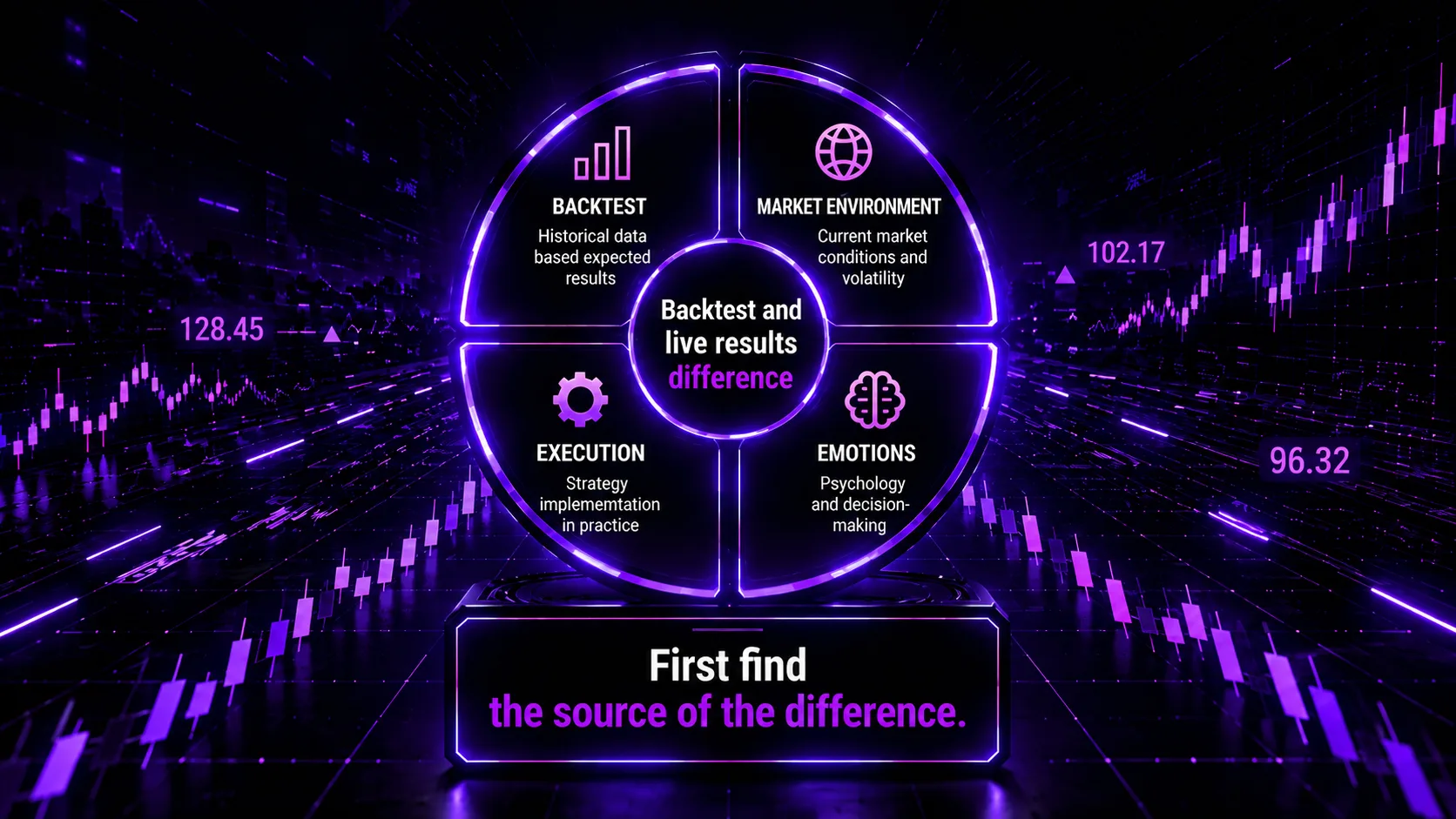
Before you change anything, it is worth examining four separate areas.
1. Why can live trading be different than backtest?
During backtest you examine market situations that have already happened. You look at the entry, the stop, the target price, then you step further to the next situation.
During live trading, however, you have to wait. You see as the position starts against you, gets close to your stop, turns back, then a part of the open profit disappears.
Exactly in these moments the discrepancy can appear between what you previously tested, and what you actually execute.
This, however, is only one possible reason.
2. The 4 areas that you should check before you change
If your live results differ from what you expected based on the backtest, the difference could have originated in multiple places. Therefore before you change your strategy, it is worth separately examining these four areas.
1. The backtest itself
First examine how reliable your testing was. If you continuously added new conditions so that the past result would be more beautiful, it can easily happen that the system fitted too exactly to that data on which you developed it.
This is called overfitting.
The question that is worth asking here:
"Do I get a similar result on such a period too, which I did not use for the development of the strategy?"
With this you check whether the strategy behaves similarly on new data as well, or the previous result was strongly tied to that period on which you developed it.
2. The market environment
The performance of a strategy can differ in different environments. It might be that it is strong in a trend, weaker in ranging. It might be that it works better alongside greater volatility, and less in a calmer period.
Therefore it is worth providing your trades with simple tags, for example: trend, ranging, high volatility, low volatility, morning or afternoon trading.
The goal is that over time you see in what environment your strategy performs well, and when its performance weakens. This way you can also check whether the change in live results coincided with the change in market conditions.
3. Your execution
In backtest it might be that every rule of yours is exact: entry at a given place, stop at a given level, target price.
In live, however, tiny discrepancies easily appear. You close earlier. You enter later. After a loss you skip the next good situation. Seeing a strong movement you enter even outside the plan.
If this happens regularly, after a few dozen trades you can already measure a different result than what you originally tested.
Therefore after every trade it is worth asking this question:
"Did I execute this trade according to my own rules?"
If you deviated, write next to it briefly in what. With this you can separately select those results that were born from following the tested rules from those where your live execution also changed.
4. Your emotions
Emotions become truly important when they change your decisions.
You are afraid of another loss, therefore you skip a suitable entry. You do not want to lose the open profit, therefore you close too soon. You miss out on a large movement, therefore you enter the next weaker situation too.
The useful question here:
"What did I do differently under the influence of the emotion?"
This helps in that instead of the feeling you look for that specific decision which changed because of it. This way you can recognize where your emotional reactions can cause a discrepancy compared to what you previously tested.
If you treat these four areas separately, you already know where it is worth starting to look for the source of the discrepancy. The next step is therefore that you check the exact same thing on your own live trades too.
3. This is how you check your last 20–30 trades
Take out 20–30 live trades. This is not enough yet for you to definitively judge the quality of your strategy, however it can already be suitable for you to find recurring execution errors.
At each one look at:
whether the entry met your rules,
whether you entered where you planned,
whether you used the planned risk,
whether you managed the position according to the plan,
in what market environment it happened,
whether there was such an emotion because of which you deviated from your plan.
After this separately select the regularly executed trades from those where you deviated.
If you find many deviations, you already have a specific area on which you can work. If the regularly executed trades also perform significantly weaker over a longer time, then it is worth further examining the strategy itself and the market environment.
4. Six frequent errors that can distort your results in live
You close the position too soon
If in backtest you regularly wait out the target price, in live however you often close sooner, your average profitable trade can decrease.
You put the stop further away
If a pre-planned loss regularly becomes a larger loss, the risk side of your strategy changes.
After a loss you skip the next good situation
At such times you are no longer trading the exact same opportunities which you previously tested.
You enter outside the plan because of FOMO
Especially dangerous if this trade wins, because it easily reinforces a bad decision pattern.
After a loss you want to get the money back
At such times the position size can increase, you can enter faster, or you can accept a weaker situation too.
After a few bad trades you immediately rewrite the strategy
If you modify the rules too often, you can quickly lose exactly which system's result you are watching.
The common thing in these errors is that each can remove you from that strategy which you originally tested.
An early close or a skipped entry in itself can still seem like a tiny deviation. If, however, these regularly appear, over time your average profit, your average loss, your win rate or even which situations you trade can change.
Let's look on a specific example, how large a difference a few such deviations can cause.
5. A short example: did the strategy really break?
Let's assume that your backtest based on 100 trades showed a 45% win rate, +2R average profit and -1R average loss.
In live after the first 20 trades your win rate is only 35%.
At first it is easy to conclude that the strategy operates weaker. Looking back at your journal, however, it turns out that you skipped five suitable entries, you closed three profitable trades too soon, and you took on two positions outside the plan too.
In this situation the live result is still hard to clearly compare with the backtest, since you do not measure the exact same execution in the two cases.
Therefore from the 35% win rate in itself it does not yet turn out whether the performance of the strategy changed.
First you must separately select those trades where you exactly followed your rules from those where you deviated from them.
Only after this do you get a clearer picture about whether the strategy or your own execution is worth further examining.
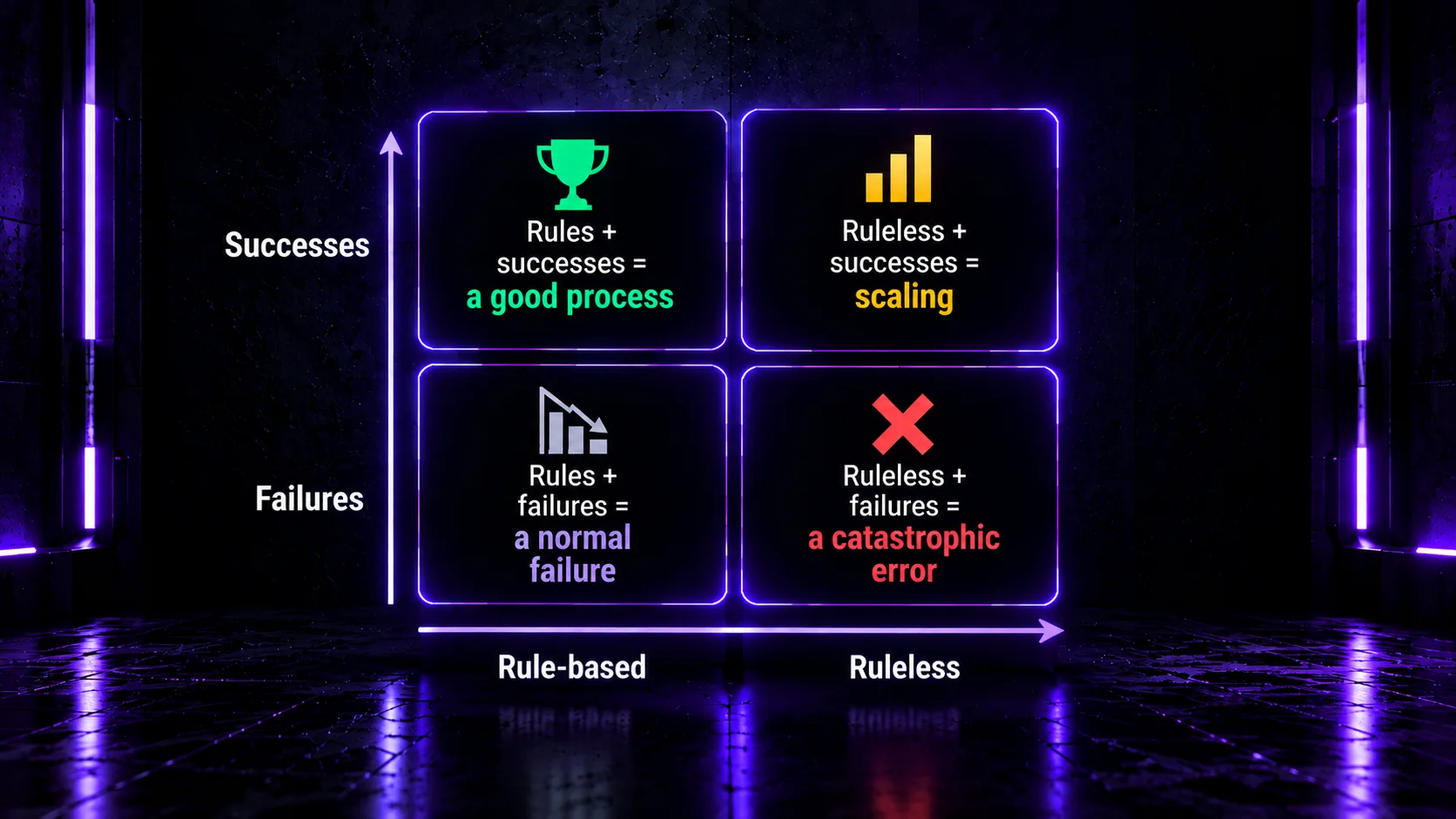
Here comes an important difference: a losing trade can be the result of a good execution, while behind a profitable trade a bad decision can also stand.
A losing trade can also be well executed
Imagine two situations.
The first trade meets every rule of yours, you use appropriate risk, and you manage it according to the plan. The result is -1R.
At the second you miss out on a movement, therefore you enter outside the plan, in addition with a larger position. The result is +2R.
If you only look at the financial result, the second trade can seem better.
From the perspective of your own development, however, it also matters how the result was born.
Therefore at every trade it is worth measuring two separate things:
What was the result?
How exactly did I keep my own rules?
The separation of the two is important because this way over time you can see whether your weaker results stem more often from regularly executed trades or from deviations from your own plan.
6. When is it worth changing your strategy?
There is no exact trade number valid for every strategy, after which you can certainly declare that you must change.
Therefore after a weak period proceed in order.
First check whether you kept your rules. Afterwards look at in what market environment you traded. After this examine how reliable your backtest was.
If based on an appropriate amount of data the regularly executed trades also lastingly differ from what you previously expected, then it is already worth examining the strategy itself in more detail.
This way with a smaller chance do you change a working system only because you are just experiencing a weaker period.
Frequent questions
Why is my win rate worse in live than in backtest?
Your execution can differ, the market environment can be different, the backtest could have been too optimistic, and your emotions can also change your decisions. The win rate in itself does not show the cause.
After how many trades do I know whether my strategy works?
There is no exact number usable for every strategy. The necessary sample size depends on the win rate, on the size of the average profit and loss, as well as on the market environment.
How should I measure my execution?
After every trade note down whether it met your rules, whether you used appropriate risk, and whether you managed the position according to the plan.
What should I do if I am afraid of the next trade?
Observe what specific decision the fear changes in you. If you find this behavior, you already have something that you can follow and improve.
Summary
If your strategy performed well in backtest, and in live you see weaker results, from that it is not yet worth immediately concluding that the system itself is faulty.
First look at the four areas separately:
How reliable was your backtest?
Did the market environment change?
Do you execute your own rules the exact same way?
Do your emotions change your decisions?
If you examine these separately, you can more easily find where the discrepancy comes from, and you can work more targetedly on that area which truly requires attention.
For consistent execution it is also important that you exactly know in advance those frameworks between which you trade.
The rules and structure of the different account types can differ, therefore before choosing it is worth comparing them with your own trading style.