What do those traders do differently who get to the first payout? We show it.
In this post

September 9, 2026.
There is a point in trading with a prop firm where it is already hard to say that you simply need more knowledge.
You know your own strategy. You had profitable trades, maybe quite good weeks too. Yet a bad day can be enough for a significant part of the result built up until then to disappear.
At such times it seems logical to look for even more exact entries, to prepare a stricter trading plan, to reduce the risk or to keep a more detailed journal.
Probably you have already tried a few of these too.
These are fundamentally useful tools. The problem often appears there where you must make a real decision out of the general rule.
It is easy to write down that "keep yourself to your plan". It is much harder to decide what you do after two consecutive losses, when you already want to get back the lost amount.
It is easy to say that "manage the risk". It is a different situation when you already feel yourself close to the payout, and an average opportunity suddenly seems much more important.
Between the plan and its consistent execution there are those moments when you must decide under pressure.
Exactly because of this, in the process leading to the first payout it is worth making certain decisions already before this pressure appears.
In the following we look at where this process usually breaks, what limits you can build in in advance, and how you can find that error in your own trading which pulls you back again and again.
Short summary
Why can your trading change when you get closer to the payout?
Which decisions is it worth making already before the trading day?
How can you stop a single loss from becoming a whole series of losses?
What is worth journaling for you to truly find your recurring errors?
How can you build a followable process towards your first payout out of all this?
And the first payout is a truly important milestone. This is when that which existed only as a goal until then becomes tangible.
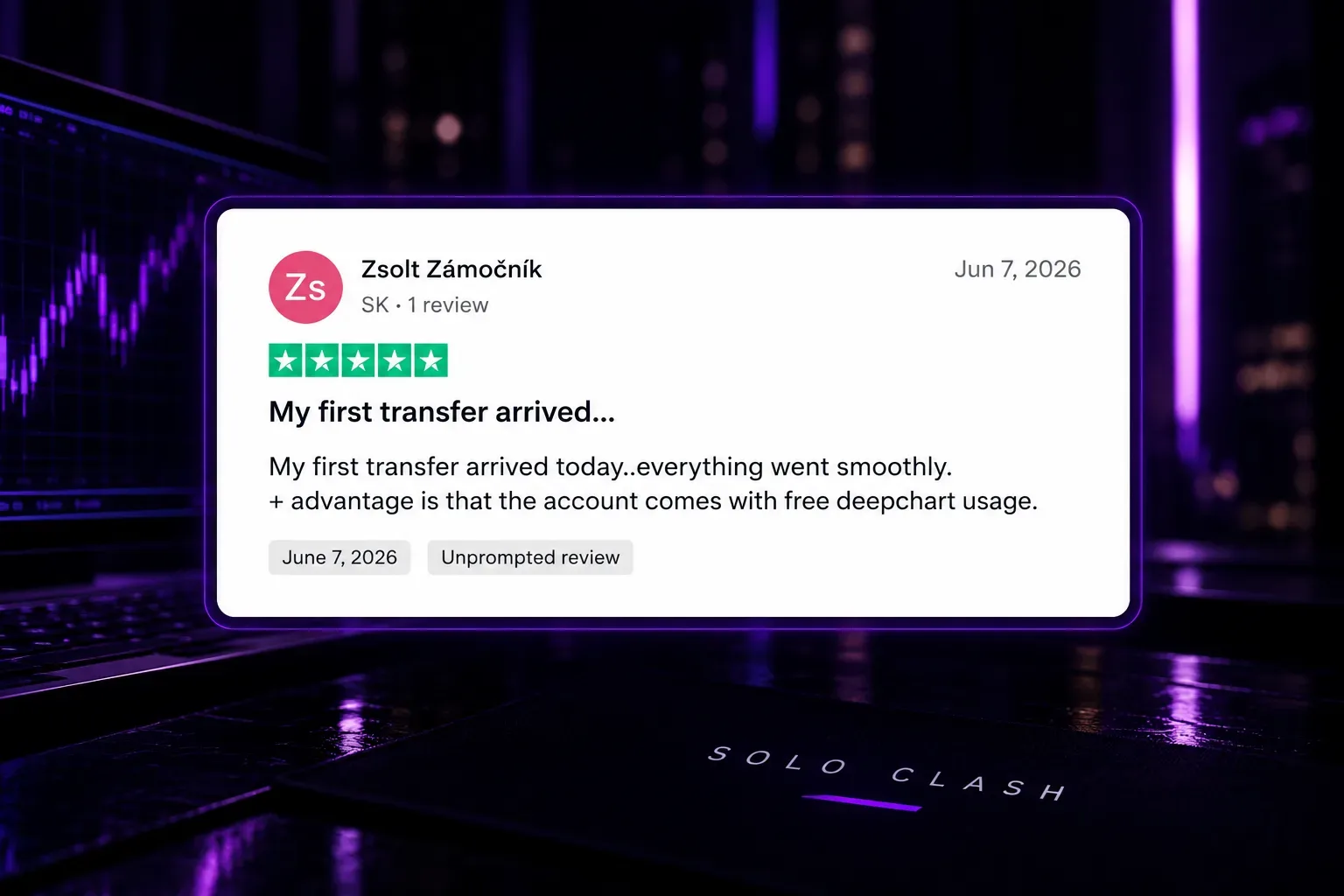
One of our traders reported on Trustpilot that his first payout arrived.
This, however, immediately raises a more important question:
What happens between acquiring the account and the first payout?
1. What changes when only the payout floats before your eyes?
Has it ever happened that the closer you got to a goal, the harder it became to trade the same way as before?
Let's assume that there are several good days behind you.
You look at your result, you calculate how much separates you from your next goal, and a thought appears:
"Only this much is missing."
From then on, an average trading opportunity can easily receive greater significance.
And this can also have an effect on what you accept as a suitable opportunity.
A situation which you would skip at other times can suddenly seem good enough. And a loss can feel larger, because in your head you are already comparing it to that goal to which you got close.
This can be a real obstacle during prop trading. It is a recurring theme in the reports of successful traders that in the proximity of the goal they also had to preserve their patience, they had to follow the predetermined risk, and they had to avoid chasing the profit target.
Decide in advance what you consider a tradable situation
"I will be more patient" in itself is a rule hard to execute.
It is much more specific if you determine already before the trading day what conditions must be fulfilled for you to enter.
Before you open a position, ask yourself for example these three questions:
Does this situation meet my predetermined conditions?
Would I open this same trade even if I did not see my current result now?
Do I know already before the entry how much loss I accept?
The advantage of this method is simple: the payout goal does not get a vote on whether a given situation meets your trading plan.
The goal remains. The conditions of the entry also remain.
There is, however, another decision which is equally important to make in advance.
2. Before you start the day, know also when you finish it
What happens after your first loss? After the second?
In a calm state it is probably easy to answer this.
When you have already truly lost, the situation is different.
The "I will be more disciplined" type of solution collides with an important obstacle here: the strongest self-control is exactly important then when you are already emotionally involved.
Therefore it can be useful to predetermine your own stopping conditions.
For example you can decide that you finish the given trading day, when:
you reach your own predetermined daily loss limit;
you had a determined number of consecutive losing trades;
you notice that you are already looking for situations as well which do not meet your plan.
The exact values must be adjusted to your own strategy, your risk management and the rules of the given account.
Therefore always separately check the current rules of your own account.
The essence is the timing.
You determine the condition of stopping when you still calmly weigh the situation. Later you only have to decide whether the predetermined condition was fulfilled.
And this can prevent such a chain which can be familiar for many traders.
3. One loss is manageable. Your next four decisions are already a different question.
How much damage did the first loss itself cause you last time, and how much did what you did after it?
You open a trade according to your plan.
It doesn't work. You accept the loss.
Until here we are talking about a completely normal trading result. No single strategy makes every trade profitable.
The problem can begin a few minutes later. A new opportunity appears. Now however there is already an amount that you would like to get back.
You enter. This loses too.
At the next trade the thought can appear that with somewhat greater risk a single profitable trade could bring the whole thing back.
This is how the chain can build up:
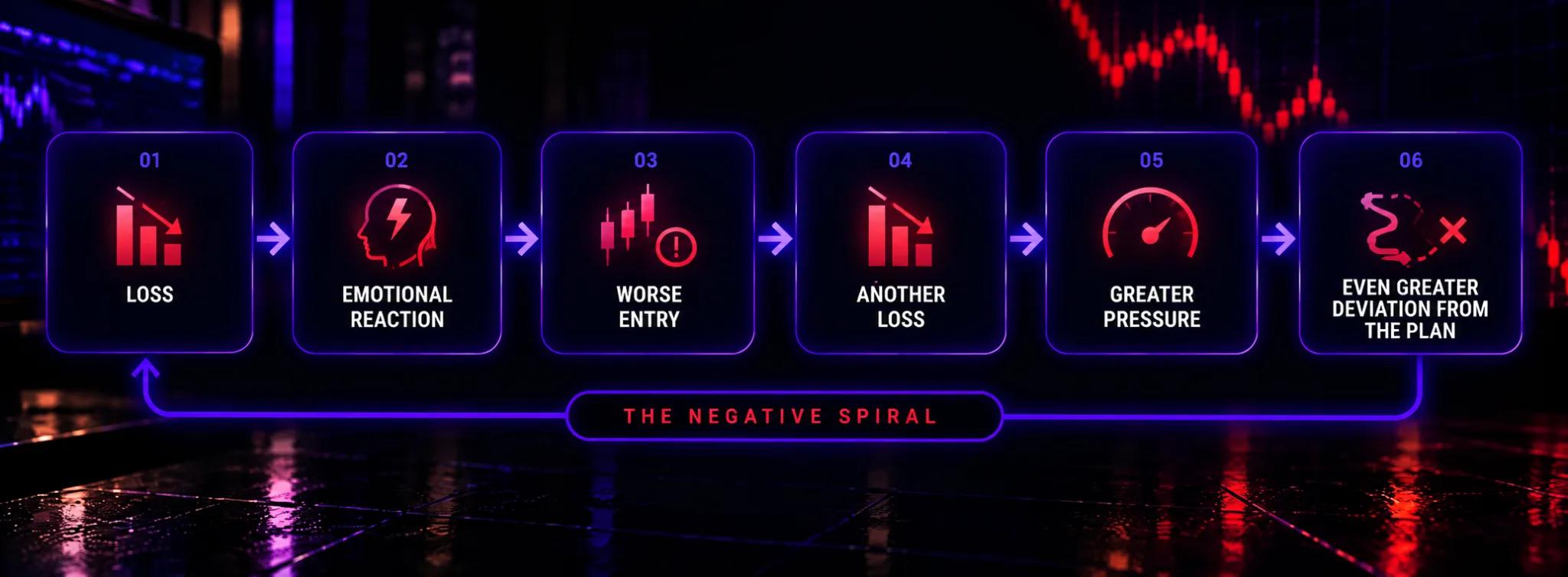
Therefore it is little to know that you would like to avoid emotional trading.
A specific breaking point is needed between the loss and the next decision.
Create an after-loss protocol
A simple version for example:
After a loss you do not immediately open a new position.
You check whether the previous trade met your own plan.
You go through your entry conditions again.
You ask yourself: would I have accepted the next situation even before the first trade?
You only continue if the answer and your predetermined conditions justify this too.
These few steps have a single task: to put time and structure between the emotional reaction and the next financial decision.
This approach also appears in the experiences of successful prop traders. A few traders for example reported that after losses they took a break, they clung to the predetermined risk, and they consciously avoided decisions aimed at the quick recovery of the loss.
The next question, however, is how do you know whether the process truly breaks here for you.
For this you must see your own patterns.
4. Your balance shows the result. Your journal can show how you got there.
If we deleted the profit and the loss from your last twenty trades, could you tell behind which there was a good decision?
Behind a profitable trade can stand a bad decision too.
You break your own rule. You take on too large a risk. The market favors you nonetheless.
The result is positive, while a dangerous behavior received reinforcement.
It can happen the other way around too.
You do everything according to your plan, you take on appropriate risk, the trade still closes with a loss.
If you exclusively record the financial result, these two situations are hard to distinguish.
The trading journal therefore becomes truly usable then when you can look back at your decision too. The regular review makes it possible that instead of memories you can search for patterns from recorded data.
After every trade five questions can be enough:
What justified my entry?
Did the trade meet my plan?
Did I take the planned risk?
Did I deviate anywhere from the plan?
With these exact same informations would I make this decision again?
After one day little turns out from this yet. After several weeks however you can start noticing the patterns.
It might be that after your first loss your entries deteriorate.
It might be that after a profitable morning you start trading too much.
It might be that in a certain market environment you regularly override your own rules.
When you can already exactly name a recurring error, you can finally build a specific rule around it too.
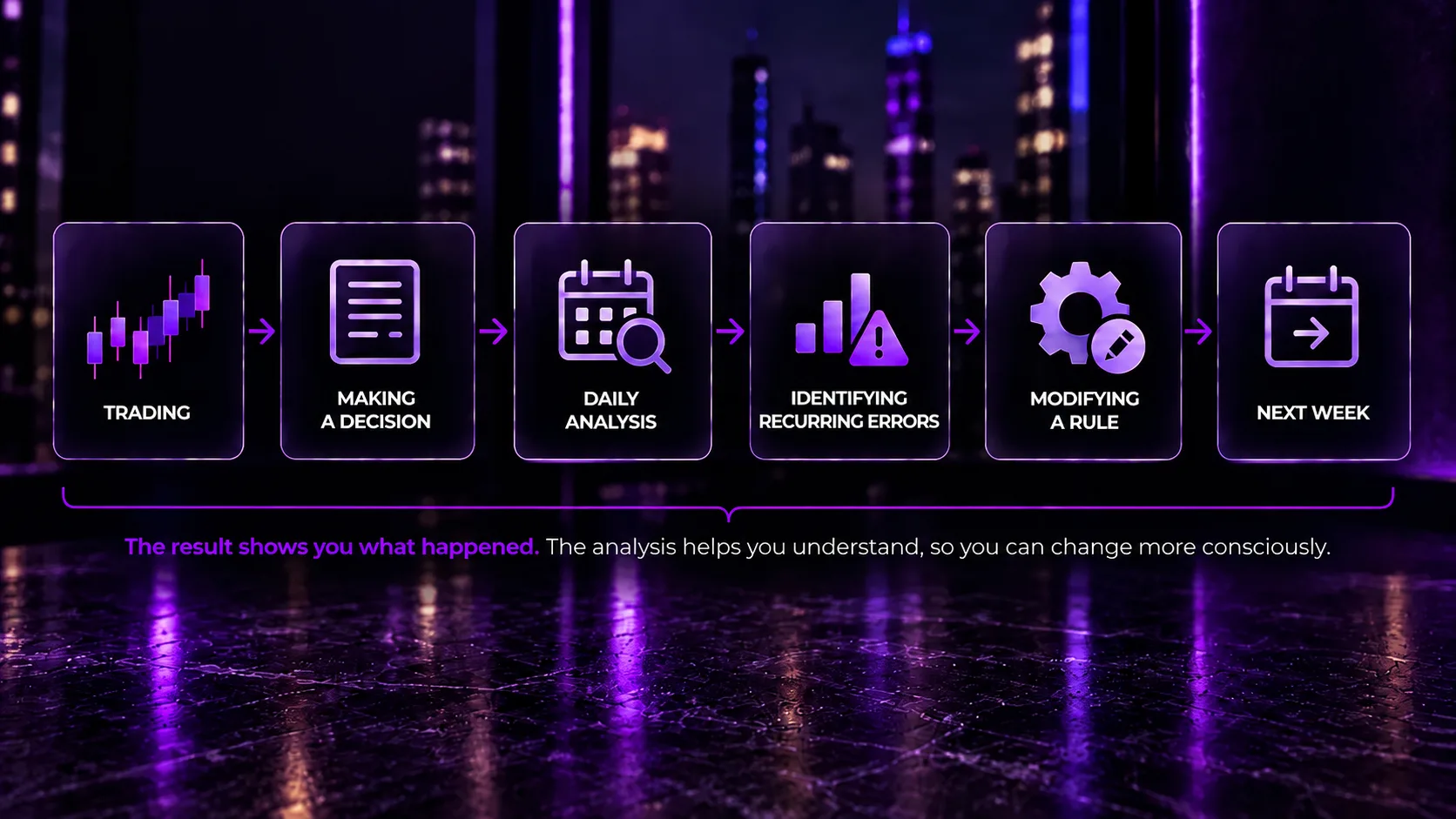
5. Fix one recurring error per week
What do you change first after a bad week?
The strategy?
The entry time?
The position size?
The traded instrument?
If you make five changes at once, next week it will be hard to decide which helped and which worsened the situation.
Therefore it is worth selecting a single recurring, influenceable problem from your journal.
Let's assume that you find this:
Observation: after a loss I look for the next opportunity too quickly.
Out of this you can already prepare a specific change:
New rule: after a losing trade I go through my full entry checklist again, before I open a new position.
And at the end of the next week you have something to check:
Did the number of my trades outside the plan decrease?
This is a significant difference compared to simply saying at the end of the week:
"I must be more disciplined."
"Discipline" is hard to measure. The number of entries outside the plan is already measurable.
Next week you can similarly select another problem.
Over time you increasingly less rely on general trading advices, and you know increasingly more about your own decisions.
6. This is how the process leading to the first payout comes together
What happens if you break down the payout into such steps on which you have an influence on every single trading day?
The process can look like this:
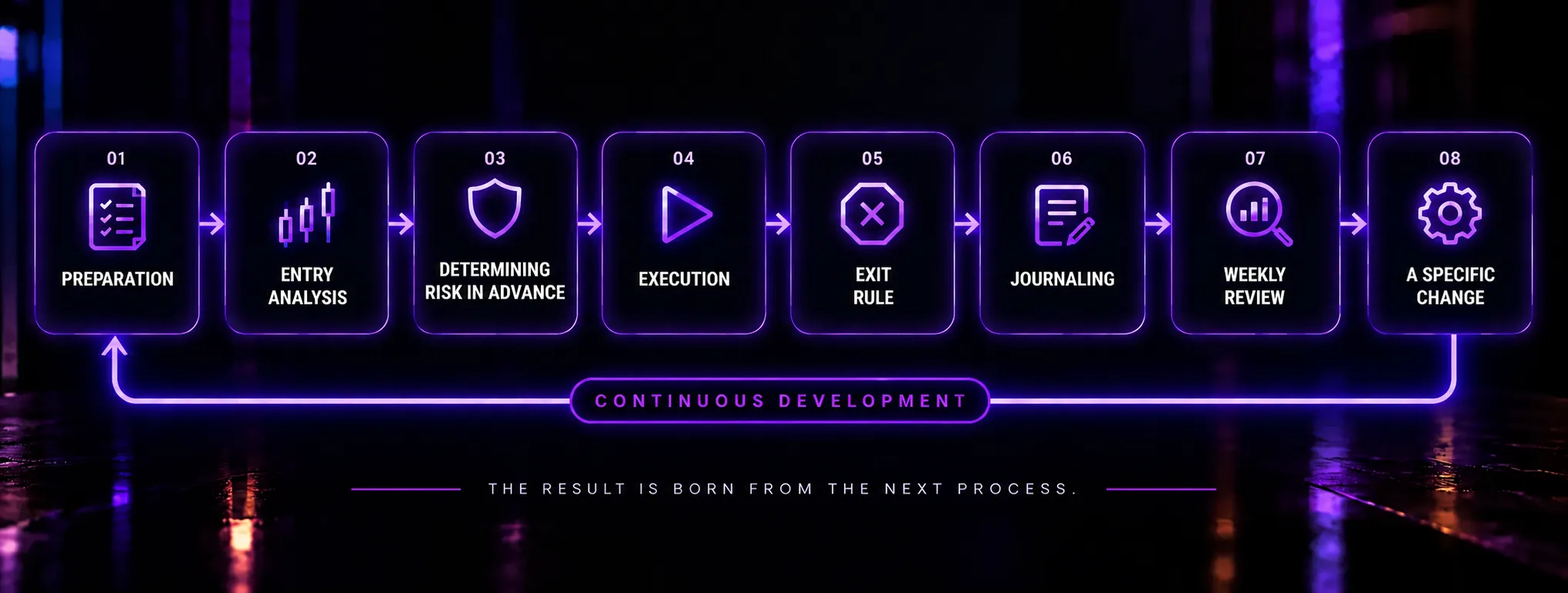
Then it begins anew.
You cannot decide whether your next trade will be profitable.
You can, however, determine in advance in what situation you enter, how much risk you take on, when you stop, what you record after the trade and how you review your own decisions.
This makes the distant goal breakable into smaller, manageable parts. After the first payout this same thinking continues to be important.
Since after a single successful period the next question arises:
Can you repeat it?
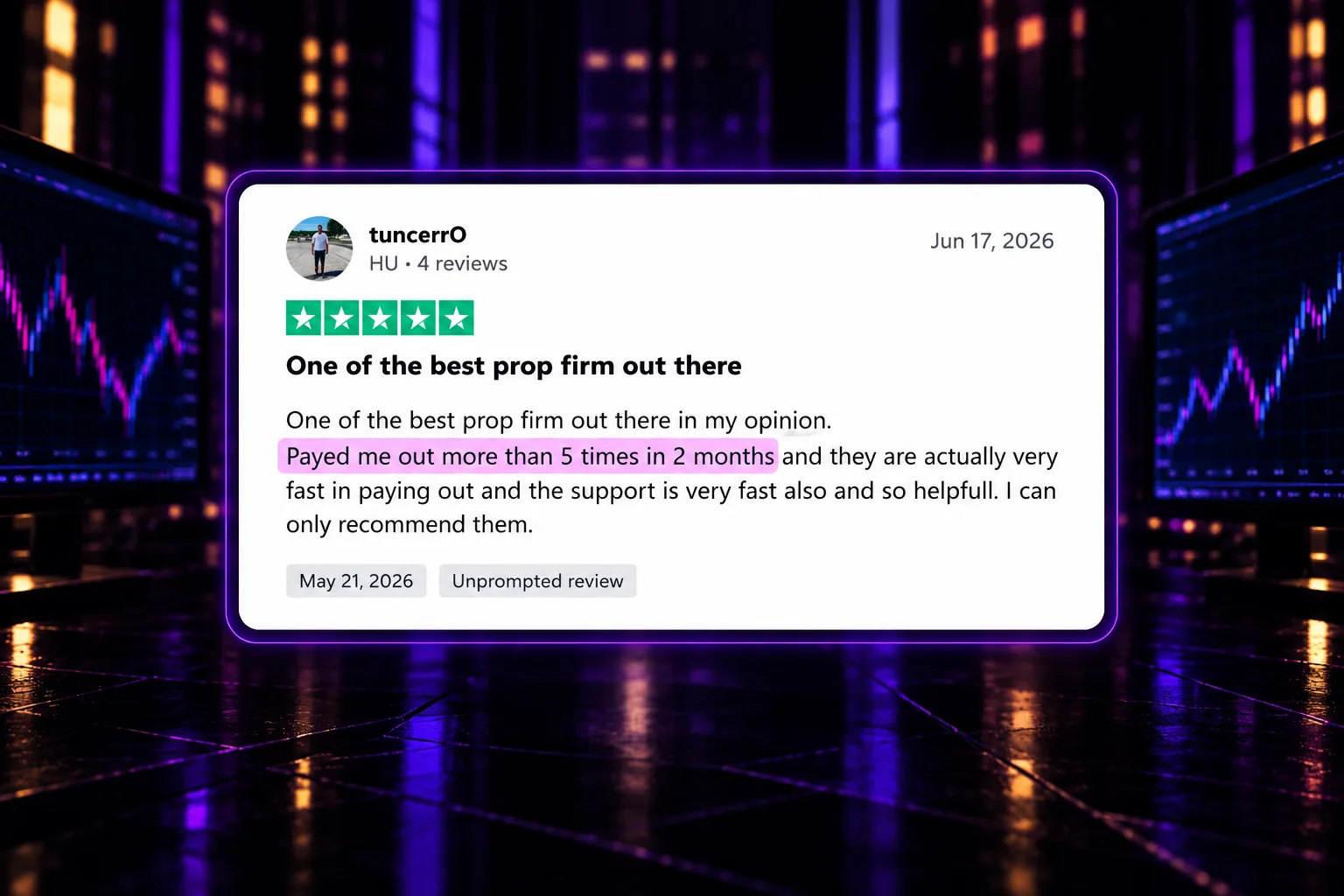
Another trader of ours wrote about having received a payout more than five times within two months.
This shows an important difference between the first payout and the period following it.
The first payout is an important milestone. The next question is whether you are capable of getting there again.
From the review of our trader we do not know with what strategy or routine they achieved these results, therefore it is not worth drawing such a conclusion from this either.
What we do know, however: the payout happened, then repeated multiple times.
And the goal of building your own trading process is exactly that you entrust increasingly fewer decisions to the emotions of the given moment.
Frequent questions (FAQ)
Under how much time can one get to the first payout?
This depends on which Solo Clash account type you choose.
Based on the current rules, if you fulfill every necessary condition as soon as possible, at the LIQUID account 6, at the LIMITLESS account 6, and at the LEGACY account 7 trading days is the earliest possible time until the first payout.
These are theoretical minimums. The actual time depends on how fast you fulfill the evaluation phase and the trading conditions necessary for the payout, therefore it can differ per trader.
What should I do after a losing trade?
Check whether the trade met your plan, then apply your pre-developed after-loss protocol. If you immediately want to get back the lost amount, it is especially important to leave time before the next decision.
What is worth keeping in a trading journal?
Beyond the basic data and the result it is worth recording the reason for entry, the risk taken on, the keeping of the plan and the possible deviations. Out of these it is much easier to search for behavioral and decision patterns later.
How often is it worth looking through my trading journal?
Alongside the daily short check the weekly review can help in the recognition of patterns repeating across multiple trades. The goal is not to change the strategy after every loss, but to identify the truly recurring problems from sufficient data.
Summary
The path leading to the first payout builds up from many smaller, conscious decisions. The predetermined entry conditions, consistent risk management, stopping rules and the regular review of your own errors together can help in that you have to make fewer decisions under pressure.
The goal is that you recognize where your own process usually breaks, then you change at one such point at a time.
If you are ready to apply all this in practice too, the next step is choosing such an account which best fits your strategy.
Choose your Solo Clash account, and set off towards your own payout →
Every trader's path is different. Previous results can be inspiring, but they do not guarantee future performance.