One trader decides everything themselves. The other almost nothing. Which one fares better?
In this post
September 07, 2026.
Two traders watch the same market, use the same strategy, yet they can feel completely differently while trading.
One continuously watches the charts, analyzes the situation, then decides on every single entry and exit themselves.
The other uses pre-laid rules, and when the given conditions are met, a system executes the determined operations.
Both can pursue the same goal. Yet trading can mean a completely different experience for them.
And here comes the interesting question:
Which of them has a greater chance to truly trade in a way that suits their own nature?
The answer is not necessarily that manual or automated trading is "better".
Much rather, which approach fits better with your thinking, your time, your experience, and how you make decisions.
Maybe you too have already thought about spending too much time in front of the market.
Or exactly the opposite: it is hard for you to completely let go of the decisions, because you want to know in every moment what is happening with your positions.
Both feelings are completely understandable.
The question is therefore not simply:
"Which method works better?"
But rather:
"Alongside which method can I operate more consistently?"
Before you choose, it is worth asking a few questions
How much do you get from it if every decision remains in your hands?
When does it mean a real advantage if a system executes the predetermined rules instead of you?
Which method requires more time, and which requires more preliminary preparation?
How do fear, impatience, or precisely excessive confidence change your decisions?
And what is perhaps the most important:
Which suits you better?
To answer this, it is worth first understanding what the two approaches actually mean.
Manual trading: when every decision remains with you
What happens if you are responsible not only for your strategy, but for every single decision as well?
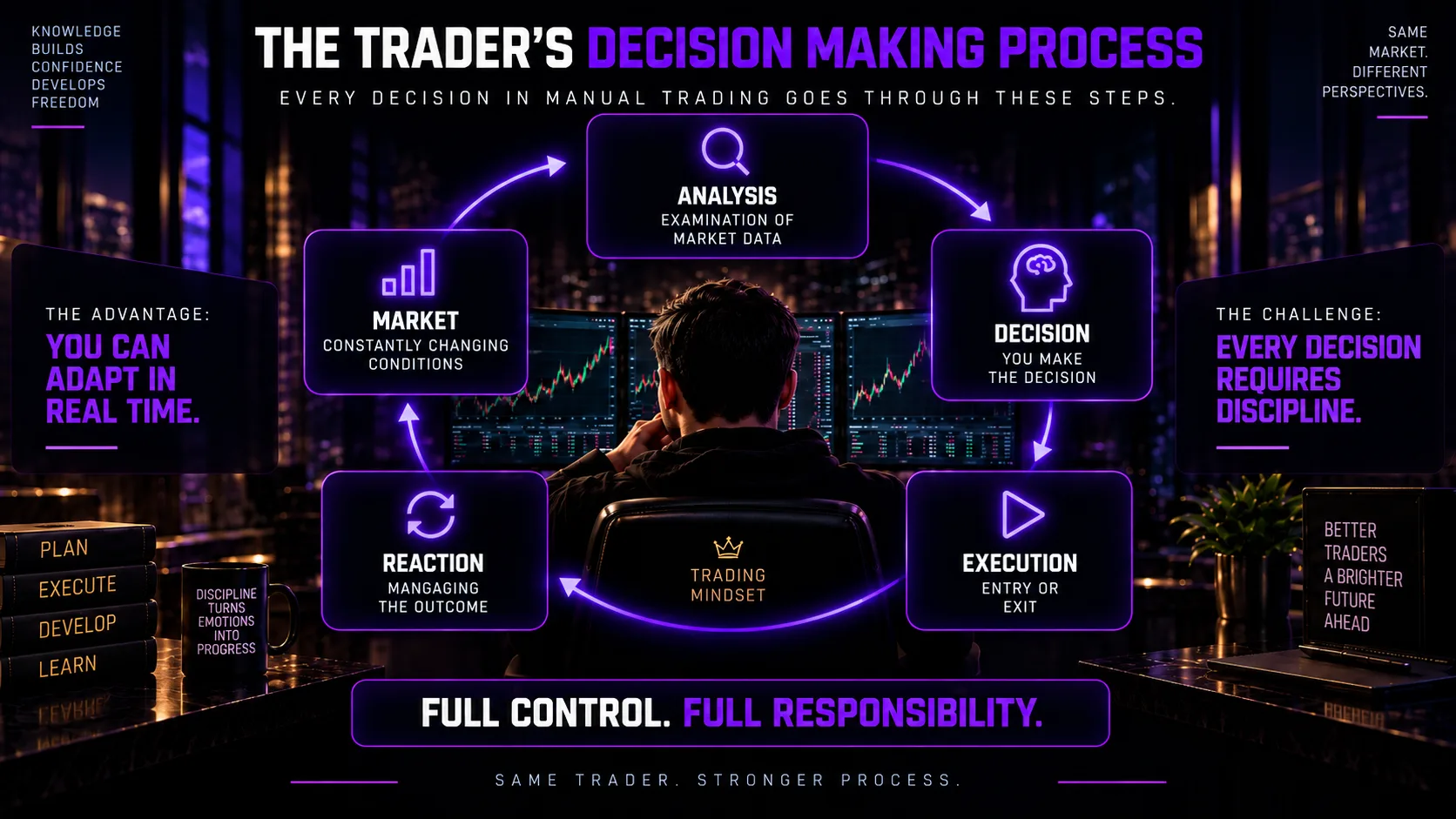
The essence of manual trading is simple: the trader watches the market themselves, evaluates the situations, then decides themselves about when to enter, when to close a position, and how to manage the given situation.
This does not mean that there is no system or strategy behind it.
Exactly the opposite.
A consciously trading person can equally have predetermined rules. The difference is that they make the final decision every time.
This gives significant freedom.
If the market environment changes, you can react to it.
If you see a situation that your previous rules do not cover, you can weigh what you would like to do.
And if you are continuously learning the operation of the market, every decision can mean a new experience.
This can be especially valuable when you are still trying to learn to recognize the different market situations.
You do not only see what a rule resulted in. You yourself live through the decision process.
However, this has a price.
One of the most obvious is time.
If you have to watch the market, then trading can easily require significant attention. It is not necessarily enough to set the strategy once and step further with your day.
With certain approaches, you have to be continuously present, and not only time can be a burden.
Because how you feel right now can also have an effect on your decisions.
What happens after a losing position?
Will it be easier to accept the next loss?
Or do you try to quickly "win back" what you lost?
What happens when after several successful trades you feel that now you almost certainly see the market well?
Maybe you become more cautious.
But it can also be that exactly the opposite: too confident.
Because human decision-making is not always completely rational. Behavioral patterns like clinging to losses or excessive activity can also negatively influence investment decisions.
This does not mean that manual trading is bad.
It means that greater control can also mean greater responsibility.
And control is only an advantage if you are capable of using it appropriately.
From here, the next question becomes truly interesting:
If certain problems are caused precisely by human decision-making, what happens if we entrust certain decisions to pre-laid rules?
Automated trading: when the rules work instead of you
Is it possible to trade in a way that at the moment of decision you no longer have to struggle again and again with your own emotions?
The basic thought of automated trading is built exactly on this.
Instead of you having to make the same decisions every time, you determine the conditions in advance.
If certain conditions are met, the system executes the operation according to the set rules. This can happen in multiple forms, and the extent of automation can also be different.
The common point is that a part of the decision process is taken over by pre-laid rules.
One of the biggest advantages of this is consistency.
A system will not be impatient because three losing trades followed each other.
It will not be overly confident because before it five trades were profitable.
It will not think: "Now it will surely work, because it has worked so far."
It simply executes what you set it to.
This can reduce the role of emotional decisions in certain cases, but here it is important to clear up a misunderstanding.
Automation does not mean that the trader no longer has a job.
Moreover.
Someone has to determine the rules. Someone has to design the system.
Its operation must be checked.
The change in the market environment must be watched.
Furthermore, it must also be recognized if the system tries to execute a rule in a situation that you did not originally expect.
This is important because an automated system can consistently execute a bad rule just the same as a good one.
The consistency of the system in itself does not make the rule correct.
In addition, it does not prove future operation either if a strategy performed well on past data.
The CFTC separately warns that automated and AI-based trading systems are not capable of guaranteeing future results, and past or simulated performance is not identical to future actual results.
Therefore, it is worth treating statements with caution like:
"This bot is guaranteed to make money."
"This system cannot lose."
"Artificial intelligence predicts the market."
These might not simply be exaggerating marketing sentences. Regarding trading systems promising guaranteed or unrealistically high returns, the CFTC explicitly warns to be cautious.
Automation is therefore not a money-making magic button.
A tool.
And its value is determined by what rules you build into it, how you use it, and how you manage the risks that come with it.
The real difference: time, control and discipline
Maybe your problem is not with your trading method, but with the fact that it does not fit how you want to live and decide.
The comparison of manual and automated trading is therefore not worth approaching simply by listing the advantages of one and the disadvantages of the other.
It is much more interesting to look at when the same advantage can become a disadvantage.
Time requirement
Manual trading generally requires more direct attention.
The automated approach can reduce the necessity of real-time decision-making, but designing, testing and supervising the system continues to require time.
That is, automation is not necessarily "less work".
It might be that it rather means a different type of work.
Control
With manual trading, the control is directly with you. This can be a huge advantage if you like to interpret changing situations and react quickly.
But one of the biggest challenges arises from this same thing: you are responsible for every decision of yours.
With automated trading, a part of the decisions gets onto predetermined rules.
This can reduce the necessity of momentary intervention. However, in exchange, you depend more on whether your rules are appropriate for the given situation.
Emotions
With manual trading, emotions can be directly present in the decision process.
Fear.
Impatience.
Excessive confidence.
Reactions triggered by success or loss.
With automation, certain emotional decision points can be eliminated, but this does not mean that emotions completely disappear.
Since someone has to decide about when to start the system, when to modify the rules, and when to stop it.
Flexibility
The manual trader can react more easily to situations for which they did not prepare a rule in advance.
The automated system, however, can only operate between those frameworks that were determined for it.
Therefore, what is flexibility on one side can be predictability on the other.
However, what is predictability on one side can be rigidity on the other.
Discipline
At first, it might seem that automation ceases the necessity of discipline.
In reality, it rather changes its form.
With manual trading, you must disciplinedly keep what you planned.
And with automated trading, you must consistently stick to the rules and the use of the system.
The two approaches therefore do not differ between "discipline is necessary" and "discipline is not necessary".
But in where the discipline is needed.
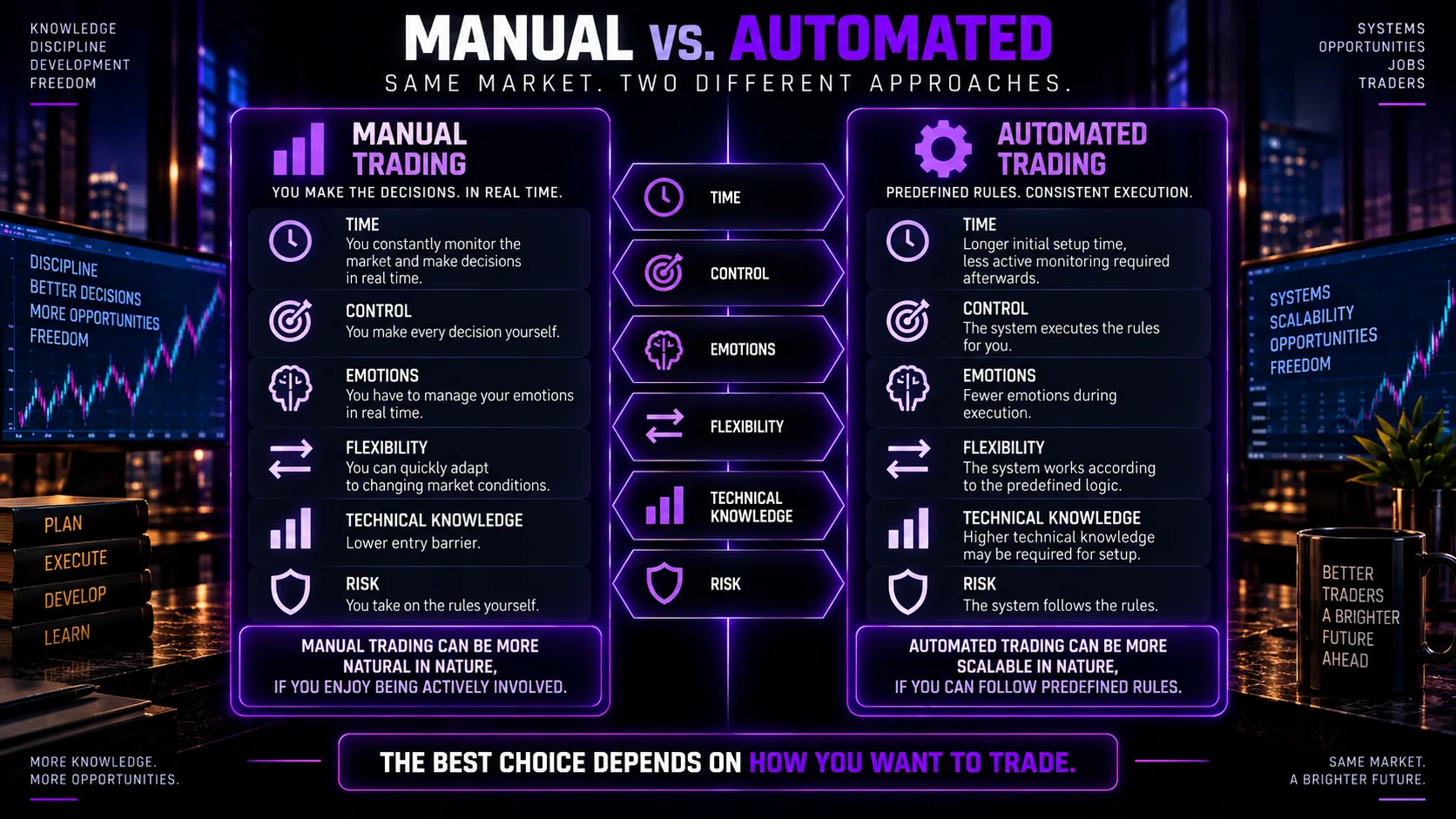
Aspect | Manual trading | Automated trading |
|---|---|---|
Time requirement | Generally higher direct market attention | Less real-time decision may be necessary |
Decision control | Directly at the trader | According to predetermined rules |
Emotional impact | Can be more strongly present | Can be reduced in certain decision situations |
Flexibility | Higher | Bound to the frameworks of the rules |
Learning | Direct market experience | Rule creation and thinking in systems |
Technical risk | Generally smaller technical dependency | Technical dependency can be higher |
Discipline | Necessary at the moment of decision | Consistency to the rules and system is necessary |
Therefore, there is no universal winner.
Greater control is not always better.
Fewer real-time decisions is not always better either.
Flexibility is not always more valuable than consistency.
What matters is which compromise you can manage better.
Which suits you?
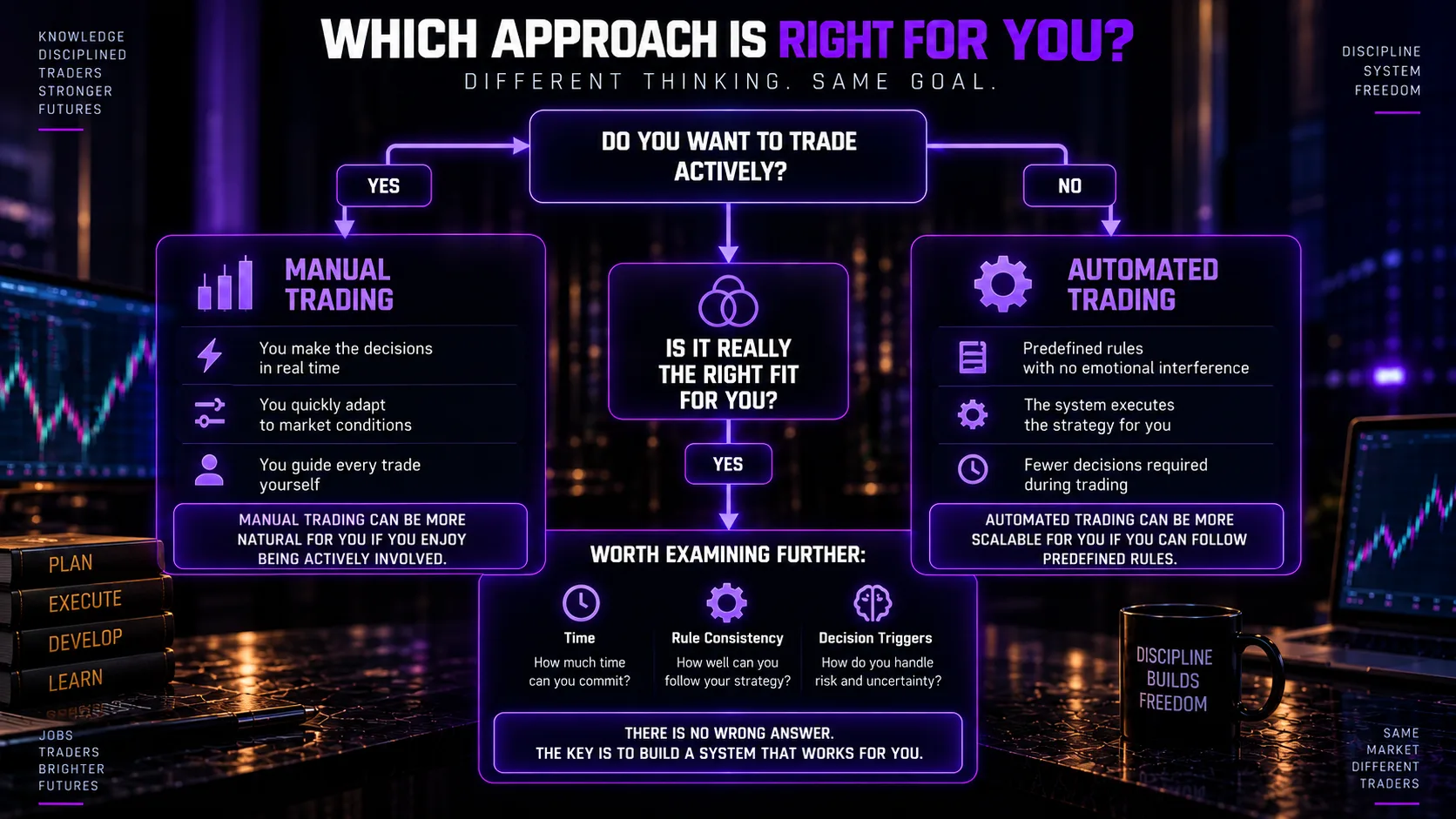
You do not have to figure out which is better. It is enough if you recognize which describes your own operation better.
Think through the following.
You lean rather towards the manual approach if…
You like to interpret the market situations yourself.
It does not bother you that you have to make decisions, and you are specifically interested in what is happening in the market.
You have time to actively watch the market.
The time spent on trading does not mean a problem for you, and it fits into your lifestyle.
It is important for you that you weigh at every decision.
You like it if not a pre-fixed rule determines the next step automatically.
You want to react flexibly to changing situations.
You do not want to fit every market situation into the same template.
You lean rather towards the automated approach if…
Consistent execution is important to you.
You would like a predetermined system to follow the same rules every time.
You would like to reduce the role of emotional decisions.
You know about yourself that in certain situations you easily deviate from your original plan.
You can determine your rules exactly in advance.
Your goal is not to reinterpret your strategy in every moment, but to operate based on a determined logic.
You do not want to make every decision in real time.
Regular manual decision-making does not fit your time schedule or your preferences.
But there is an important third possibility here too.
Maybe your answers do not point clearly in one or the other direction.
This is completely fine.
You do not have to force yourself into a single category.
Frequent questions
Which is better: manual or automated trading?
There is no such general answer that one would be better for everyone. The more suitable approach can depend, among others, on your time, your experience, your decision style, your strategy and on how much you would like to directly control the execution.
As a beginner, is it worth choosing automated trading?
Not necessarily. As a beginner, manual trading can give direct experience in the recognition of market situations and in decision-making. At the same time, the automated approach can also be useful for the one who can already clearly formulate and organize their own strategy into rules.
The point is not which sounds simpler, but whether you understand what you are doing.
Does automated trading really eliminate emotions?
Not completely.
It can remove the immediate human reaction from certain decision situations, but the system itself continues to be built on human rules. Setting up, checking, modifying and using the system continues to require human decisions.
Can you earn more money with automated trading?
There is no general yes or no answer to this.
Automation in itself does not guarantee a better result. The CFTC explicitly warns that neither an automated system, nor an AI-based trading system can guarantee future profit.
How much time does manual trading require?
This completely depends on the strategy and the markets. Certain approaches require much continuous attention, others less. Therefore, it is not worth starting purely from that "manual = all day in front of the chart".
When is it worth switching from manual trading to an automated approach?
It can make sense to think about this when you already understand your own strategy exactly, you can put the decision process into rules, and you have an appropriate basis for checking that the system truly executes what you would like.
Automation does not replace the understanding of the strategy.
First let there be a comprehensible process. After that, it is worth thinking about which parts of it can be automated.
Summary
Between manual and automated trading, there is no clear winner.
The manual approach can give greater control and flexibility, while automated trading can be advantageous in the consistent execution of rules and in the reduction of emotional decisions.
The real question is therefore not which is better, but:
Which suits you better?
Which fits your time, your decision style and how you can follow your own rules?
If it is already outlining what kind of trader you are, the next step is to try yourself out in a real trader environment.
By opening an account, you can not only think further about which approach suits you, but you can also gain your own experience about how you operate in decision situations.