How does your trading change if a competition is involved?
In this post

October 14, 2026.
During a trading competition you can get ahead on the leaderboard, then you can even fall back a few places.
The shaping of your ranking can mean a new circumstance, which can have an effect on your next decisions too.
Do you select your trading opportunities exactly the same way then too, when your ranking achieved in the competition already matters as well?
During a competition you can also examine this based on your own data. You can observe whether your trading frequency, your taken risk or the following of your own conditions changes when you trade in a competitive situation, under pressure.
In this article we show how you can gather usable informations about these, and how you can turn your experiences acquired during the competition to the benefit of your own trading.
Short summary
What changes can a trading competition bring to the surface?
Why can that moment be especially interesting when your ranking changes?
How can you use the leaderboard in such a way that meanwhile you pay attention to your own trading conditions?
With what simple method can you draw usable lessons after the competition?
How can you be informed about the next Solo Clash Tournament?
What can a competitive situation show about your trading?
During your usual trading you can follow your own results and decisions. In a competition the field and the shaping of your ranking also appear to this.
It is worth observing whether this new circumstance changes your trading habits.
Let's assume that in an average, two-hour trading period you usually execute three to four trades.
During a competition under the exact same time however it might be that you execute more trades.
The difference is immediately measurable. But what led to it?
It can occur that more suitable opportunities appeared in the market. It is also possible that under the effect of the competitive situation you accepted such entry situations too which at other times you would have skipped.
To find this out it is worth looking back at the given trades.
You can do the same with the risk taken per trade or the holding time of the positions too.
The competition can this way direct your attention to such deviations which you can later turn to the improvement of your trading.
There is however an especially interesting circumstance, which only becomes examinable if you take the leaderboard into consideration too.
Why can the leaderboard exert pressure on you?
During the Solo Clash Tournament your ranking depends on the performance of the other participants too. You can fall back even if your own trading result remains unchanged meanwhile.
This is important from a psychological perspective. Falling back on the leaderboard can create a feeling of loss even if your own result actually did not deteriorate.
Your ranking can this way easily become a new reference point. The loss of a previously achieved position can create urgency, and catching up can receive increasingly greater attention.
This pressure can spread to your trading decisions too. Your patience to wait out the suitable entry situation can decrease, or you can take on greater risk in the interest of improving your ranking faster.
One of the most important psychological challenges of a competitive situation is exactly this: the change of the leaderboard can influence how consistently you keep yourself to your own trading conditions.
This naturally does not present itself the exact same way at every trader. It is therefore worth observing whether after checking your ranking your attitude towards your decisions changes.
If following the leaderboard causes urgency, you can also check your ranking at the end of the trading period. This way you can continue to participate in the competition, and later you can analyze your result, while during trading you concentrate on your own predetermined conditions.
Therefore the time of checking the leaderboard helps to more accurately interpret your observations.
How often is it worth watching the leaderboard?
Continuous checking is not necessary.
You can even predetermine when you would like to look at your ranking. For example after the closing of the trading period.
This way you can continue to follow the shaping of the competition, while during trading you can concentrate on your own entry conditions.
In our earlier article we already dealt in detail with how following the performance of other traders can influence the judgment of your own results.
During a competition too it is worth consciously choosing when you would like to see external results.
If you check the leaderboard while trading, you can observe its possible effect too. If you rather look at it at the end of the day, you can still prepare a valuable comparison from your trading data gathered during the competition.
This is how you can learn from the competition in four steps
You can organize your experiences acquired during the competition with a simple four-step method.
1. Prepare with your own basis of comparison
Before the competition select a few earlier trading periods of similar length.
If possible use results born in the exact same market, in a similar time of day and alongside an identical trading method.
Note down how many trades you executed, how much risk you took on per trade, and how often it occurred that you deviated from any of your own entry conditions.
Based on these later you can search for specific differences.
2. Observe your trading during the competition
During the competition record the exact same data.
If you look at the leaderboard, write down the time of the check and your ranking seen then too.
With this later you can examine whether a change happened in your decisions after viewing the leaderboard.
You can continue to adjust the frequency of checking the leaderboard to your own trading process.
3. Look for the most important deviations
After the competition put your earlier data and your data gathered during the competition next to each other.
For this you can use this simple table:
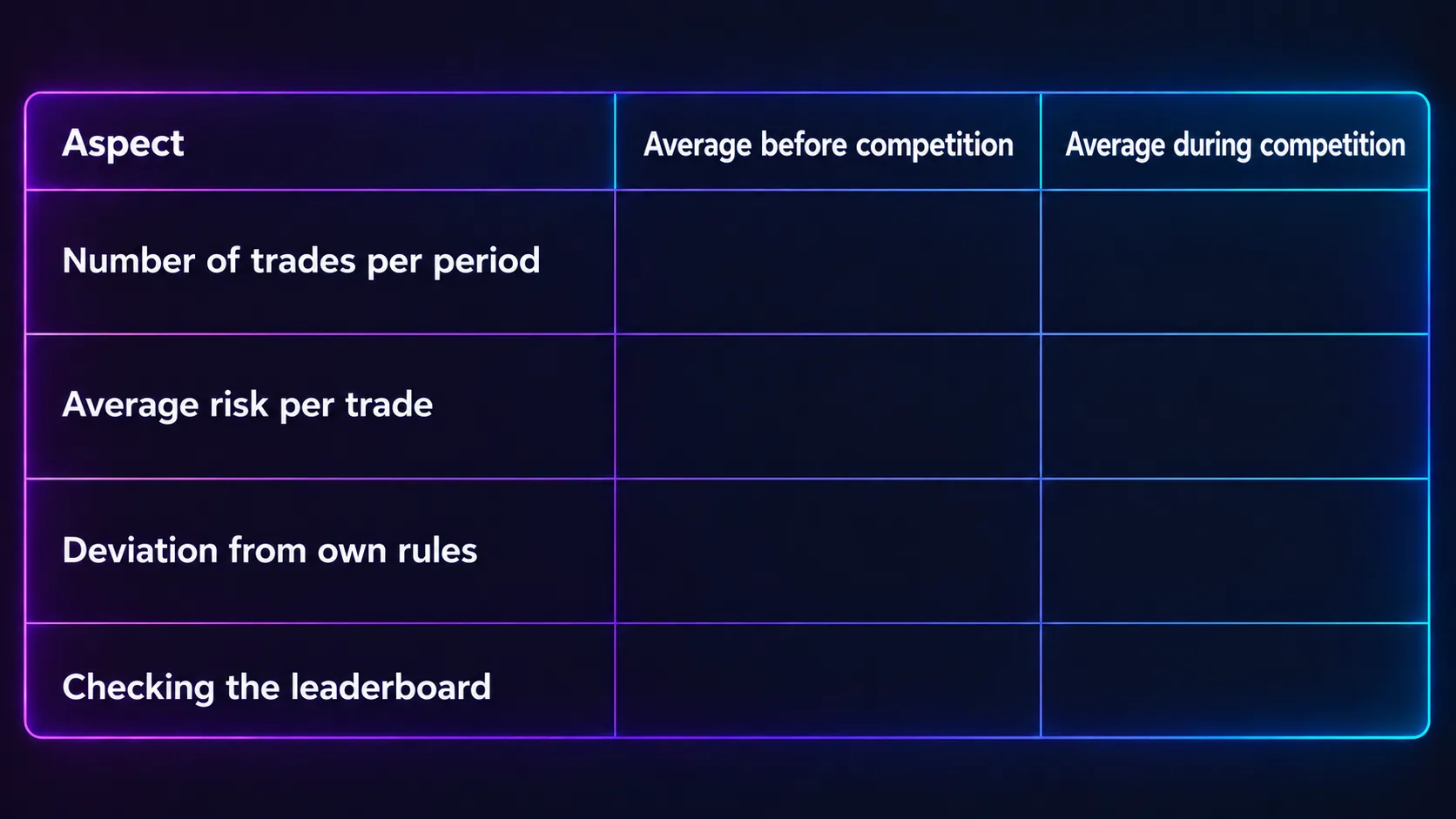
Record the times of viewing the leaderboard separately, because you can connect your specific decisions under the competition to those.
During the comparison take the market circumstances into consideration too.
In a fast-moving market more suitable trading opportunities can develop than in a calmer period. The competition's own rules can also differ from your accustomed trading environment.
Therefore from a single deviation it cannot yet be securely established what caused the change.
If however you see a similar pattern in multiple situations, you already have a specific area which it is worth examining further.
4. Choose a lesson for the next trading period
At the end of the comparison select one such change which proved to be especially interesting.
If your trading method remained consistent during the competition too, it is worth recording that as well. This shows that in the examined period alongside the competitive situation too you managed to keep your own frameworks.
This way after the competition you can continue your trading with a specific, verifiable experience.
What does the Solo Clash Tournament add to this?
We organize the Solo Clash Tournament merely a few times a year, thus it offers a special opportunity for traders to compare their performance with other participants.
At our competitions we usually also distribute cash prizes among the traders achieving the best ranking, up to the ranking determined in the given competition announcement. The prized rankings and the amount of the prizes can differ per competition.
In what does this differ from the leaderboard of the HQ?
Solo Clash HQ offers daily, weekly, monthly and overall leaderboards. On these you can follow the results of traders based on different periods.
The Tournament in contrast is a separately announced competition, with its own period and conditions referring to the given competition.
About the competitions of Solo Clash we give information in our newsletter too, thus you can be informed about the next opportunities there.
Frequent questions (FAQ)
What happens if my trading did not change significantly during the competition?
This is a useful observation too. If your trading frequency, your taken risk and the following of your own rules remained similar, in the examined period alongside the competitive situation too you consistently applied your method.
Who can participate in the Solo Clash Tournament?
About the exact entry conditions and the mode of participation we give information at the announcement of the current Tournament.
Where can I be informed about the next Solo Clash Tournament?
In the newsletter of Solo Clash alongside contents connected to trading we also give news about the competitions and product updates.
Summary
A trading competition can create such an environment in which you can observe your own trading based on new aspects.
The change of your ranking, the presence of the other participants and the shaping of the competition can all be such a circumstance alongside which it is worth examining the consistency of your decisions.
For this a simple method is enough: prepare your own basis of comparison, gather comparable data during the competition, look for the deviations, then choose a lesson which you can observe in the next trading period too.
If you would like to be informed about the next Solo Clash Tournament, subscribe to our newsletter. Alongside the competitions about trading contents and the novelties of Solo Clash we inform first there.
I would like to be informed about the novelties and the competitions ->
The article serves an educational purpose, and does not qualify as financial or investment advice.