The connection of AI, chips and NQ: what is worth understanding as a trader
In this post
October 9, 2026.
In recent years AI came up increasingly frequently when explaining the movements of the NQ. NVIDIA earnings report, data center investments, new chips, growing AI spending — after such news even significant movements can appear in technology stocks.
But what truly connects the demand for AI with the movement of the NQ?
The connection consists of multiple steps, and as a trader it can be especially important to understand where it is worth looking for those changes which can already influence the market's expectations too.
Short summary
Why can the result of a chip manufacturer be important even if you exclusively trade with NQ?
Could the demand for AI chips truly have reached its peak already?
Why can a technology stock move downward even after strong growth data?
From what signs is it worth starting when you try to interpret the reaction of the NQ after an AI-related news?
What does AI have to do with the movement of the NQ?
To understand this, first we must see what the Nasdaq-100 serving as the basis of the NQ tracks.
The Nasdaq-100 tracks the performance of the 100 largest non-financial companies listed on the Nasdaq stock exchange. The index uses a modified market capitalization-based weighting, therefore the price change of the larger companies can more strongly affect the movement of the index.
This becomes interesting from the perspective of AI because according to the Nasdaq's own 2026 analysis the AI exposure of the Nasdaq-100 is significantly larger than that of the broader US stock market.
According to a September Nasdaq analysis at least 70% of the weight of the index was connected to such companies on June 30, 2026, which showed an overlap with two Nasdaq AI-thematic indexes.
It is important that this 70% shows the weight of the affected companies within the index, and in itself it does not indicate what part of their revenue originates from AI.
Among the affected companies can be found among others companies manufacturing semiconductors, providing cloud services, building network infrastructure and developing AI solutions.
This creates the first important connection:
If expectations related to the growth of AI change, that can also change the expectation formed about the future growth of multiple large technology companies. And the price movement of these companies can also appear in the NQ.
But from here an important link is still missing.
Why do chips come up so frequently?
For the operation of AI systems significant computational capacity is needed. As companies build increasingly more AI data centers and operate increasingly larger models, for this they also need processors, memory, network devices and other infrastructure.
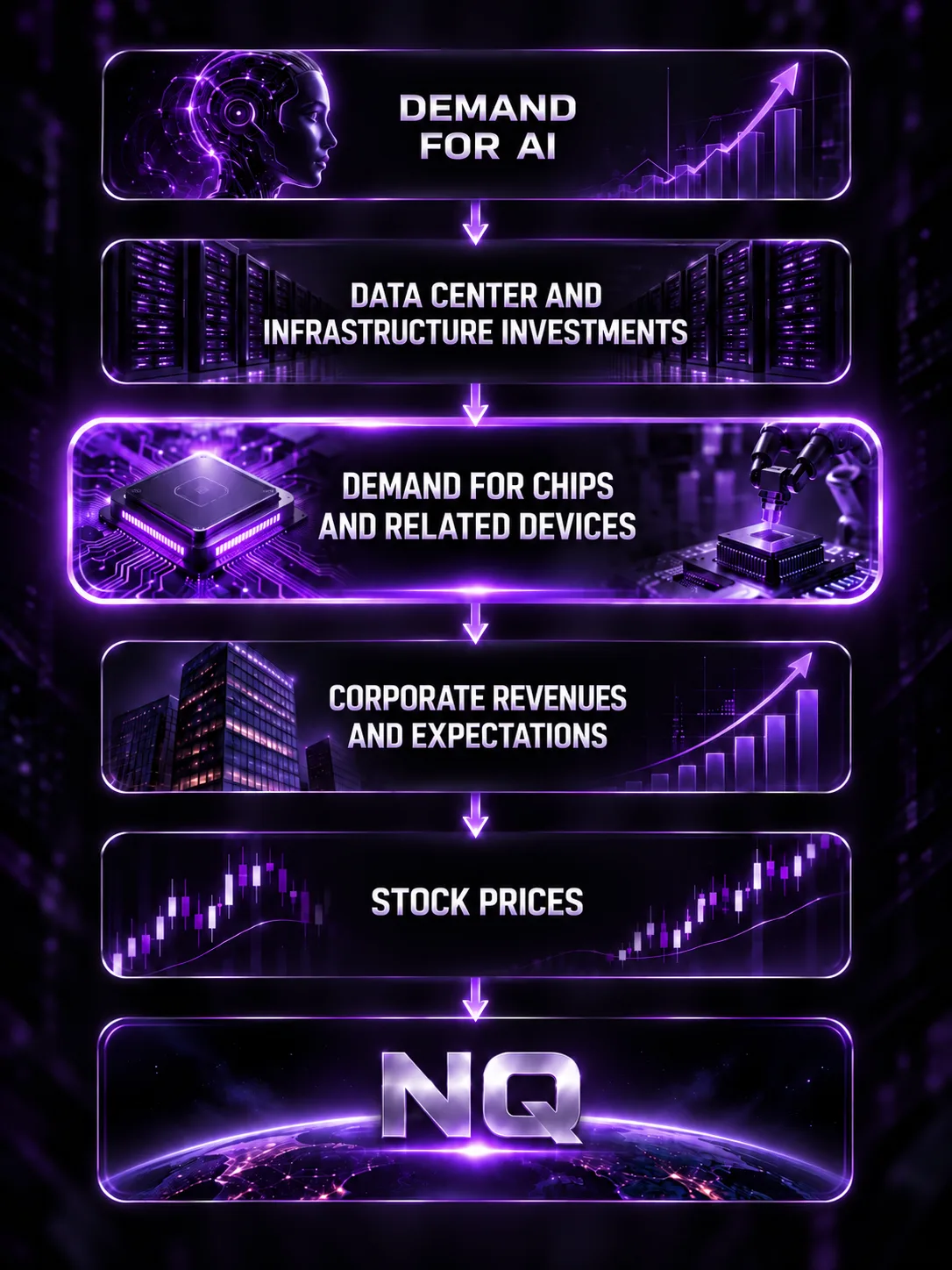
Therefore it is worth imagining AI as a longer economic chain:
A good example of this is given by NVIDIA.
In its quarterly results published on August 26, 2026 the company reported 89 billion dollars of data center revenue. This was 117% higher than a year earlier. The total quarterly revenue of the company meanwhile grew by 106% in annual comparison.
This however raises a much more interesting question.
Can the peak of demand for AI chips already be close?
Currently little evidence supports the simple conclusion that the demand for AI chips would already be generally decreasing.
NVIDIA's freshest numbers continue to show strong data center growth. And Gartner's September 2026 forecast calculates with 2.7 trillion dollars of global AI spending for 2026, which would mean a 49.5% annual growth.
According to Gartner the demand for AI infrastructure continues to be strong, and the spendings of the large cloud service providers devoted to AI servers give one of the largest areas of growth.
The growth of the entire AI market at the same time does not in itself show whether the demand changes at the same pace for every chip type.
From strong industry growth the direction of the next movement of the NQ cannot be determined either.
To understand this we must separate growth and expectations.
Why can a stock fall even if AI demand continues to grow?
Let's assume that the revenue of a company grows by 30% in one year.
At first this can seem like a strong result.
If however the market previously counted on a 40% growth, the actual result fell short of the expectation. The same can happen the other way around too: a slowing growth pace can also trigger a favorable reaction, if the market prepared for an even worse result.
Therefore at an important AI news it is little to examine whether the published data became good or bad.
The next question gives more information in connection with what changed compared to what the market counted on?
For previous expectations the forecasts published in the previous earnings reports of the company and the publicly accessible analyst estimates can give a starting point. You can also find these in the investor briefings of the company, respectively on financial data pages.
Compared with the freshly published results you can already see where the actual performance deviated from previous expectations.
This is also the reason why the slowing of AI demand in itself does not automatically mean a downward pointing NQ movement yet.
The market continuously builds expectations into the prices. Because of this it also has significance whether the slowing causes a surprise, and how it changes the picture formed about the future growth of the large technology companies.
From what can it be recognized if the momentum of AI begins to change?
Here the whole thing becomes usable for an NQ trader.
It is not necessary to follow every data of every AI company. It is much more transparent if you watch a few such areas which together can give a picture about whether previous expectations are changing.
1. Watch the results and forecasts of the large AI-connected companies
The past revenue featuring in the earnings report is only one part of the story.
It can also be especially important what the company expects from the next quarters. If the current results are strong, but the management counts on slower growth, the attention of the market can quickly shift to the future.
Therefore alongside the current results it is also worth watching the corporate forecasts referring to the next period.
2. Look at the investments devoted to AI infrastructure
According to the May 2026 analysis of the Nasdaq the AI-connected investments of the leading large technology companies can reach approximately 700 billion dollars in 2026.
These investments affect multiple areas from semiconductors through cloud services to network infrastructure.
If the growth pace of the planned investments significantly changes, that can influence the expectations referring to the future demand of chips and other AI infrastructures too.
The effect of the growing investments however can differ per company.
For the company selling chips they can bring more orders, while at the company financing the investment it also matters when and how much revenue the new infrastructure generates.
Therefore at an AI investment news it is also worth examining whether the affected company serves the demand originating from the investments, or finances the developments itself.
3. Watch the market reaction itself
This is especially important.
After a strong NVIDIA result for example look at how NVIDIA itself, other large technology companies and finally the NQ react.
If to a seemingly strong news a weak reaction arrives, it is worth examining whether some part of the result fell short of expectations, whether the company's forecast changed, or whether the market already priced in the strong result earlier.
The reaction of the individual companies and the NQ however can differ from each other.
If for example NVIDIA rises after an earnings report, while the NQ weakens, that shows that the favorable reaction of the company in itself was not enough for the rise of the entire market.
At such times it is worth looking at how the rest of the large-weight companies of the Nasdaq-100 reacted.
This way you can interpret the effect of the AI news together with the actual market movements.
A simple three-question system for AI news
At the next larger NVIDIA earnings report, chip industry data or AI investment news open a note, and answer three questions.
1. What changed?
Write it down in one sentence. For example revenue growth accelerated, forecast decreased, or spendings planned for AI infrastructure rose.
2. How does this compare to what they expected earlier?
Compare the new data with the earlier forecasts and analyst expectations. This way you can establish to what extent the new information changes the earlier picture.
3. How does the market react to it?
Observe how the affected stock and the NQ moved after the appearance of the news. Record whether they reacted in the same or different direction, and what further corporate data can help understand the difference.
Repeating this at multiple important events you can build your own observation journal.
Over time you can already connect the new information, the earlier expectation and the actual market reaction. This can help to more accurately interpret what happens after each significant AI news.
Frequent questions (FAQ)
If the demand for AI chips decreases, will the NQ also fall?
From this in itself the next direction of the NQ cannot be determined. It is important how large the change is, whether the market counted on it, which companies it affects, how future earnings expectations change, and finally how the defining technology stocks react.
Is the demand for AI chips currently decreasing?
Based on currently accessible data a general decrease in demand is not visible. NVIDIA's freshest data center results continue to show significant growth, and Gartner's September forecast counts on further strong AI spendings.
These data at the same time do not cover every product of every chip manufacturer, therefore it is worth examining the shaping of demand per company and product category too.
Is it enough to watch NVIDIA if I trade with NQ?
No. NVIDIA is an important part of the AI-connected story, but the Nasdaq-100 standing behind the NQ consists of numerous companies, and the economic impact of AI extends beyond semiconductors to cloud services, network infrastructure, data centers and other technological areas as well.
Summary
To understand the connection between AI and the NQ it is worth watching an entire economic process.
The demand for AI can launch investments. These can increase the demand for chips, data centers and connected infrastructures. This can have an effect on the revenue of large technology companies and the expectations connected to them, whose change can finally appear in the movement of the NQ too.
As a trader therefore it is worth examining three things after an important AI news: what changed, how does the new information compare to earlier expectations, and how did the market actually react to it.
The movement of the NQ is naturally influenced by other factors too. Interest rate expectations, economic data and other corporate results can likewise cause significant movements. Therefore the AI-connected informations are also worth interpreting together with the broader market environment.
And if you would trade NQ with a Solo Clash prop firm account, the next step is looking through which account type's rules best fit to how you trade.
Compare the Solo Clash account types →
The article serves an educational purpose, and does not qualify as financial or investment advice.